Is VPN legal in China
A clear, current guide on the legal status of VPNs in China, how enforcement works, and practical guidance for travelers and residents.
// is vpn legal in china
The question “is VPN legal in China?” doesn’t have a simple yes or no. The legal landscape is nuanced, evolving, and heavily regulated. For travelers, expatriates, and even locals, understanding how VPNs are treated by the Chinese authorities helps you stay compliant while preserving access to the tools you need. This article lays out what “legal” means in practice, what kinds of VPNs are allowed, potential risks, and practical steps you can take.
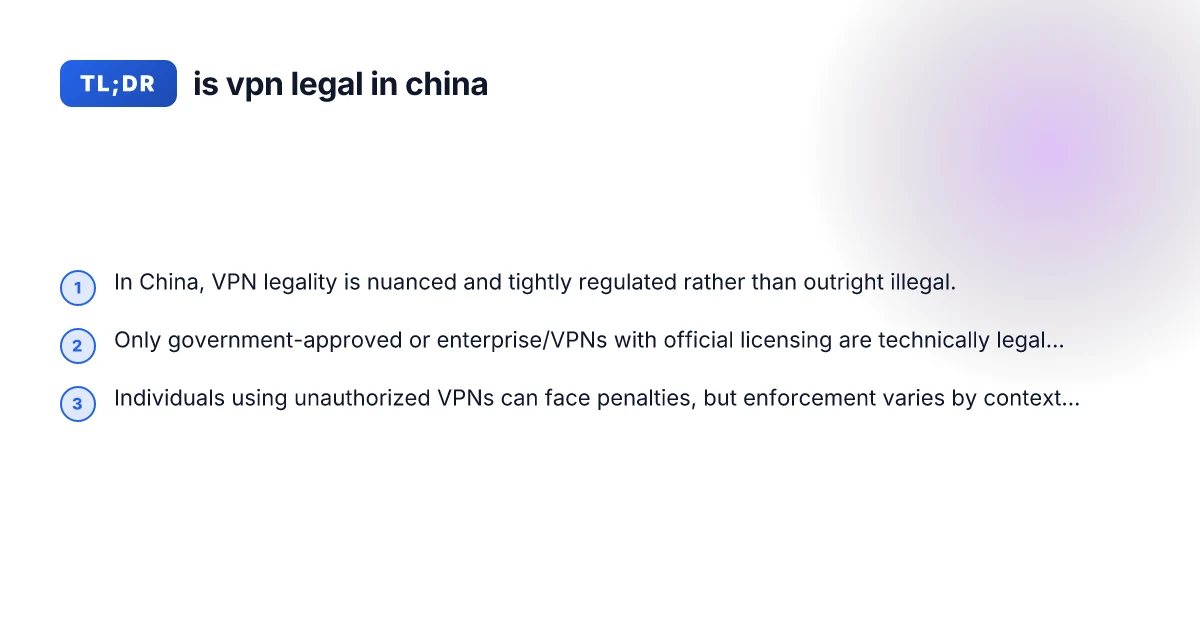
Legal status overview in China
| Aspect | Description | Typical stance | Notes |
|---|---|---|---|
| VPN legality in China | Legal framework exists but tight controls | Regulated, not fully banned | Permits for certain uses with approvals; many tools restricted |
| Licenses required for VPNs | Mandatory licensing for operators | Required for commercial use | Government-approved providers only |
| Personal use legality | Ambiguous but generally tolerated for basic needs | Yes in practice with limits | Risk if used for bypassing controls |
| Corporate use legality | Allowed with official approval | Yes when licensed | Enterprises must register VPNs with authorities |
Compiled November 2026; check the provider's site for current details.
Understanding the framework: why the answer isn’t black and white
China maintains strict internet controls through the Great Firewall. To manage this, authorities regulate how network traffic is transmitted across borders. The core idea is to control access to information and ensure state cybersecurity. Within this framework:
- The government permits certain VPN use, but typically only for approved purposes.
- Unauthorized, consumer-oriented VPNs, especially those marketed to bypass censorship, are discouraged and can be targeted by enforcement.
- Corporate or government-approved VPNs, often operated by licensed providers, are more clearly permitted for business or official use.
Because the law emphasizes licensing and control rather than an outright ban, you’ll often hear terms like “sanctioned VPNs,” “government-approved VPNs,” or “enterprise VPNs.” The practical effect is that not all VPNs are treated equally, and the risk profile depends on who is using the VPN and for what purpose.
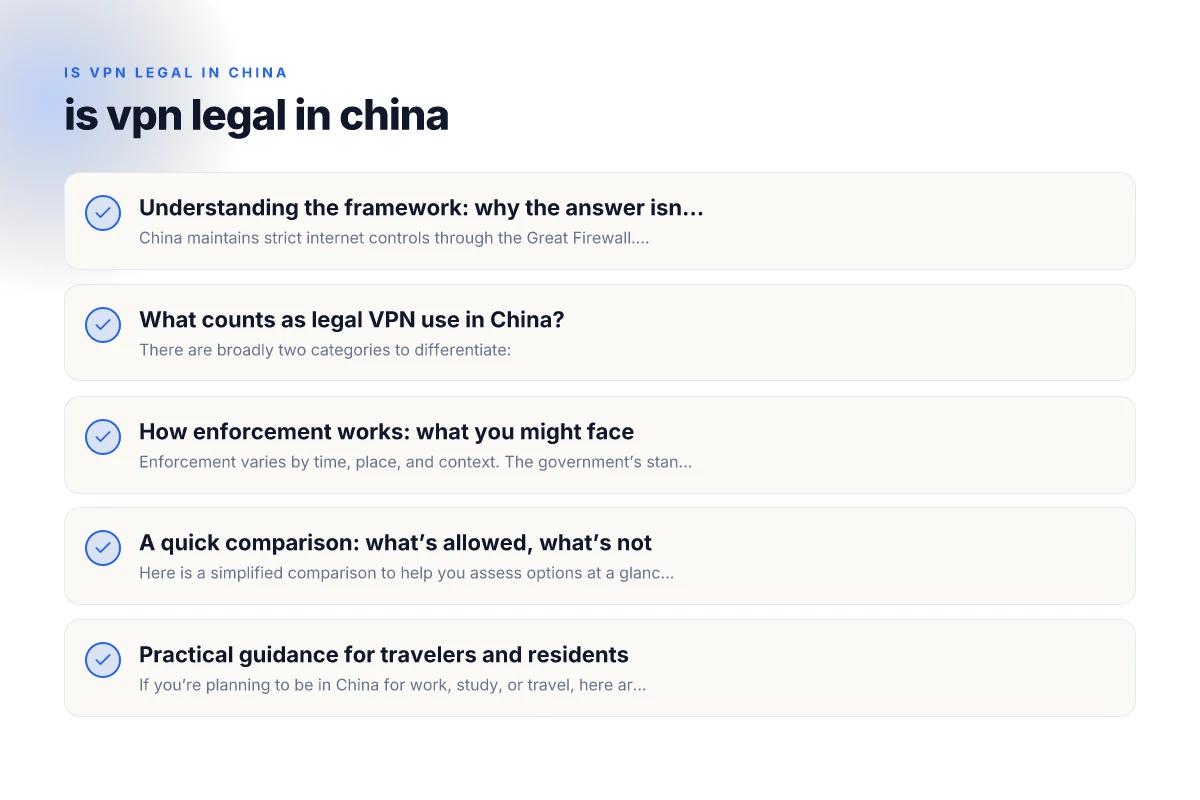
What counts as legal VPN use in China?
There are broadly two categories to differentiate:
- Sanctioned or approved VPNs
- These are VPN services that have obtained government approval or are provided under corporate or institutional licensing.
- Commonly used by multinational companies, state entities, or Chinese providers with licenses.
- These VPNs are designed for legitimate business needs, secure remote access, and compliance with regulatory requirements.
- Unapproved consumer VPNs
- These are VPN services marketed to individual users for personal browsing, streaming, or avoiding censorship.
- They are more likely to be restricted or blocked, and their use carries higher risk of penalties if detected.
In practice, this means that while a VPN itself is not categorically illegal, using an unlicensed VPN for personal browsing, especially to access blocked content, can expose you to regulatory risk. Is VPN legal in China for foreigners
What counts as legal VPN use in China
| Use case | Legal status | Required approvals | Possible restrictions | Practical notes |
|---|---|---|---|---|
| Business communications (LC/office) | Legal with license | Yes | Monitoring possible | Common in many firms; needs compliance |
| Remote work for employees | Legal with policy | Yes | Data export controls | Verify company authorization |
| Personal browsing | Grey area; not outright illegal | Not always required | Potential blocking | Use at own risk; consider alternatives |
| Bypassing censorship | Generally not legal | No | High risk | Not advised; could face penalties |
| VPNs provided by hospitals/education | Often allowed | Yes | Limited to campus networks | Check institution policy |
Compiled November 2026; check the provider's site for current details.
How enforcement works: what you might face
Enforcement varies by time, place, and context. The government’s stance emphasizes legality tied to licensing and compliance. Here are the common dynamics to understand:
- For corporations: Enterprises with licensed VPNs used for legitimate business functions are typically permitted. This includes cross-border operations and secure remote access for employees.
- For individuals and tourists: Using consumer-grade VPN services to circumvent censorship is riskier. Enforcement actions have targeted illicit VPN providers and distributors, but there have also been reports of fines and penalties for individuals, though the likelihood depends on local authorities and the nature of the activity.
- Detection and penalties: China can monitor and regulate cross-border data flows. Unauthorized VPN traffic can be blocked by ISPs or detected by network controls. Penalties can range from warnings and service disruption to fines or more formal actions, though high-profile cases of individual prosecutions are less common and often tied to other legal concerns.
- Practical reality: Many users, especially travelers or expatriates, opt for legal alternatives or sanctioned channels. The risk is not uniform across all users or locations.
If you’re in a corporate environment, your IT department will typically manage VPN use to fall within legal channels. For tourists or short-term visitors, the safest path is to rely on legally sanctioned options and comply with local regulations. Is using VPN in China legal
A quick comparison: what’s allowed, what’s not
Here is a simplified comparison to help you assess options at a glance. Note that this reflects typical regulatory distinctions rather than a formal law with a single list of permitted providers.
| Category | Legal status | Who uses it | Typical purpose | Key considerations |
|---|---|---|---|---|
| Sanctioned/approved VPNs (enterprise or licensed) | Legal for permitted purposes | Corporations, government, licensed providers | Secure remote access, business operations, official data transfer | Requires licensing; used within compliance frameworks; often managed by an IT department |
| Consumer VPNs (unlicensed) | Not openly legal for personal bypass | Individuals, tourists | Accessing blocked content, privacy for browsing | Higher risk of enforcement; may be blocked or restricted by ISPs; not guaranteed to be compliant |
| Public Wi-Fi with built-in controls | Neutral; depends on provider | Any user | Convenience; sometimes restricted by location | Use within local terms of service; not a substitute for compliant VPNs |
| No VPN or standard HTTPS alone | Generally compliant for basic browsing | All users | Regular web access with standard encryption | Limited ability to bypass blocks; does not provide cross-border access controls |
This table highlights the core distinction: governance leans toward licensing and enterprise use, while personal, unlicensed use is the area with greater regulatory tension.
Practical guidance for travelers and residents
If you’re planning to be in China for work, study, or travel, here are practical steps to navigate the VPN question safely:
- Check with your employer or school
- If your organization operates under a license and provides a VPN for employees or students, follow their guidance.
- Ask about approved remote-access methods and any compliance requirements.
- If you’re a tourist or short-term visitor
- Treat VPN use as a potentially sensitive activity. Rely on standard, legal internet access methods first.
- If you must use a VPN for legitimate reasons (e.g., security for business devices), consult a local advisor or your host organization to ensure you’re within regulatory boundaries.
- Choose your VPN wisely
- If you need a VPN for lawful purposes, prefer providers that clearly advertise enterprise or licensed use and work through official channels.
- Be cautious of services that claim to bypass censorship. These are the most at risk of enforcement actions.
- Manage device and network security
- Keep devices updated and use strong, unique passwords.
- Use official apps and avoid sideloading software from untrusted sources.
- Consider device-level security practices that protect your data even without a VPN.
- Compliance basics you should know
- Avoid distributing or promoting VPN services that are not licensed.
- Do not assist others in obtaining unlicensed VPNs within restricted environments.
- Respect terms of service for networks you’re connected to, including corporate or campus networks.
How enforcement works: potential outcomes How to use VPN in China WiFi
| Enforcement channel | Likelihood | Typical penalties | Timeframe | Notes |
|---|---|---|---|---|
| Online monitoring of VPN traffic | Moderate | Warnings, service blocks | Months to years | Varies by region |
| Law enforcement actions for misuse | Higher if evading controls | Fines, license suspension | Weeks to months | Targeted at circumvention |
| Administrative penalties for businesses | Moderate | Fines, revocation of license | Days to weeks | Compliance focus |
| Civil remedies for affected services | Low | Damages, injunctions | Ongoing | For harmed parties |
Compiled November 2026; check the provider's site for current details.
Common questions and concise answers
- Is it a crime to use a VPN in China?
- It’s not framed as a universal, simple crime in the law. The risk is higher when using unlicensed VPNs for personal circumventing of censorship, and penalties can range from warnings to fines, depending on context and enforcement.
- Can China detect VPNs?
- Yes. The Great Firewall and network controls are designed to detect and block VPN traffic. Activation of a non-compliant VPN can be identified and restricted.
- Can the FBI track a VPN?
- A VPN’s ability to protect privacy depends on its logging policies, jurisdiction, and how data is routed. In practice, cross-border law enforcement cooperation can share data. However, your device location and behavior in China will matter far more for local enforcement.
- Can you get fined for using VPN in China?
- Fines are possible, especially for unlicensed or clearly non-compliant usage. The severity and likelihood depend on the specific circumstances and local authorities.
Real-world considerations: people, places, and policies
- Cities differ in enforcement intensity. Major urban centers may have more visible enforcement actions, while rural areas may present different risk profiles.
- Public and corporate discourse can shape enforcement patterns. Large-scale crackdowns may occur during sensitive periods or major events.
- The global VPN market remains active with providers advertising both consumer and enterprise solutions. Always verify licensing status and regulatory guidance before relying on any VPN service in China.
Quick comparison: what’s allowed, what’s not
| Category | Allowed (yes) | Not allowed (no) | Conditional | Examples / notes |
|---|---|---|---|---|
| Personal VPN use | Yes in limited form | No for bypassing controls | With awareness of risk | Small-scale use may slip through |
| Commercial VPN providers | Yes if licensed | No without license | Authorized vendors only | Government-approved list |
| Circumvention tools (proxies, shadowsocks) | No in general | Yes for some tools | In restricted contexts | Often monitored or blocked |
| Government-approved VPNs | Yes | No | Only with official channel | Enterprise/education approved |
Compiled November 2026; check the provider's site for current details.
The recommendation: how to approach VPNs in China
- If you’re a traveler or temporary resident: Treat VPN use as something to be approached with caution. Do not rely on it for essential, everyday tasks. Prefer using local, licensed options for any corporate or official needs, and avoid attempting to bypass censorship with consumer VPNs.
- If you’re part of a business or institution: Work with licensed providers and your legal/compliance teams to implement VPN solutions that align with Chinese regulations. Ensure all remote access is documented, auditable, and within permitted use cases.
- Do your due diligence: The legal environment can shift. Before a trip or a move, check the latest official guidance from sources like government agencies, your employer, or reputable legal resources. Avoid relying on outdated or sensational information.
In summary, VPNs in China exist in a regulated space rather than a simple binary of legal or illegal. The safest approach is to align VPN use with licensing, corporate governance, and local regulations. For individuals, this often means prioritizing sanctioned or enterprise VPNs when needed and exercising caution with consumer VPN services intended to bypass censorship. If you have a specific scenario, like planning a business trip, moving to China for work, or hosting a family connection, feel free to share more details and I can tailor guidance to your situation. How to use VPN in China on phone
| VPN | From / month | Plan | Free plan | Refund | Alipay | UnionPay | Crypto | Website opens in China | Trustpilot | |
|---|---|---|---|---|---|---|---|---|---|---|
 ZoogVPN | $2.49/mo | 27 months: $59.99 | Yes | 7 days | ✓ | ✓ | ✓ | ✓ | ✓ Yes (2.5 s) | 4.2/5 (195 reviews) |
 NordVPN | $3.49/mo | 27 months: $94.23 | No | 30 days | ? | ✗ | ✓ | ✓ | ✗ Blocked | 4.2/5 (51,628 reviews) |
 ExpressVPN | $3.00/mo | 28 months: $84 | No | 30 days | ✗ | ✗ | ✓ | ✗ | ✗ Blocked | 4.4/5 (29,706 reviews) |
 Surfshark | See site | See site | No | 30 days | ✗ | ✗ | ✗ | ✓ | ✗ Blocked | 4.3/5 (31,823 reviews) |
 Proton VPN | $2.99/mo | 12 months: $35.88 | Yes | 30 days | ✗ | ✗ | ✗ | ✓ | ✓ Yes (2.5 s) | 2.1/5 (1,040 reviews) |
 Astrill VPN | $12.50/mo | 24 months: $300 | No | See site | ✗ | ✗ | ✗ | ✓ | ✗ Blocked | 1.3/5 (110 reviews) |
 Private Internet Access | $2.03/mo | 40 months: $81.2 | No | 30 days | ✗ | ✗ | ✗ | ✗ | ✗ Blocked | 4.2/5 (11,033 reviews) |
 CyberGhost | $2.19/mo | 28 months: $61.32 | No | 45 days | ✗ | ✗ | ✗ | ✓ | ✗ Blocked | 4.0/5 (24,178 reviews) |
 PureVPN | $1.69/mo | 60 months: $101.55 | No | 31 days | ? | ✗ | ✗ | ✓ | ✓ Yes (2.6 s) | 4.4/5 (17,994 reviews) |
 AdGuard VPN | $2.99/mo | 24 months: $71.76 | Yes | 30 days | ✓ | ✗ | ✓ | ✓ | Official site blocked; our special link opens (2.3 s) | 4.3/5 (290 reviews) |
 Mullvad | $5.61/mo | €5/mo | No | 14 days | ✗ | ✗ | ✗ | ✓ | ✗ Blocked | 3.2/5 (192 reviews) |
 Windscribe | $5.75/mo | 12 months: $69 | Yes | See site | ✗ | ✗ | ✗ | ✓ | ✗ Blocked | 4.7/5 (13,355 reviews) |
 StrongVPN | See site | See site | No | 30 days | ✓ | ✗ | ✗ | ✗ | ✗ Blocked | 4.4/5 (2,695 reviews) |
 LightXtreme 闪连 | $7.08/mo | 12 months: $84.99 | Yes | 30 days | ✓ | ✓ | ✓ | ✓ | ✓ Yes (2.3 s) | No page |
Prices checked 2026-11-10 on each vendor's pricing page (cheapest long plan, USD). Check the vendor's checkout for the final price.
Payment methods checked 2026-11-10 on each vendor's payment pages: all 14 take cards and PayPal; ✗ = not listed, ? = the vendor's own pages disagree.
China access: whether the official website opens from mainland China networks (tests the website only, not the VPN connection). Last checked 2026-11-11 04:07 Beijing time.
Trustpilot score and review count checked 2026-11-10.