Is VPN legal in China for foreigners
A clear, practical guide for foreigners on VPN legality in China, how enforcement works, and best practices.
China’s approach to virtual private networks (VPNs) is nuanced and often labeled as a legal gray area. For foreigners planning to access services outside mainland China, the question “is a VPN legal in China for foreigners?” deserves a careful, up-to-date answer. Here’s a straightforward guide to what’s allowed, what isn’t, and how to navigate the landscape safely.
Legal status at a glance
| Aspect | Status in China | Applies to foreigners | Notes |
|---|---|---|---|
| VPN legality | Mixed/regulated | Yes | Official stance varies by use |
| Common VPNs allowed | Limited list / exotic apps blocked | Yes | Often blocked or restricted |
| Personal use allowed | Yes with restrictions | Yes | Avoid bypassing controls |
| Commercial use allowed | Restricted | Yes for licensed providers | Requires licensing |
| App stores / downloads | Some blocked | Yes | Use approved sources if possible |
| Government stance | Tightening enforcement | Yes | Increasing monitoring |
Compiled November 2026; check the provider's site for current details.
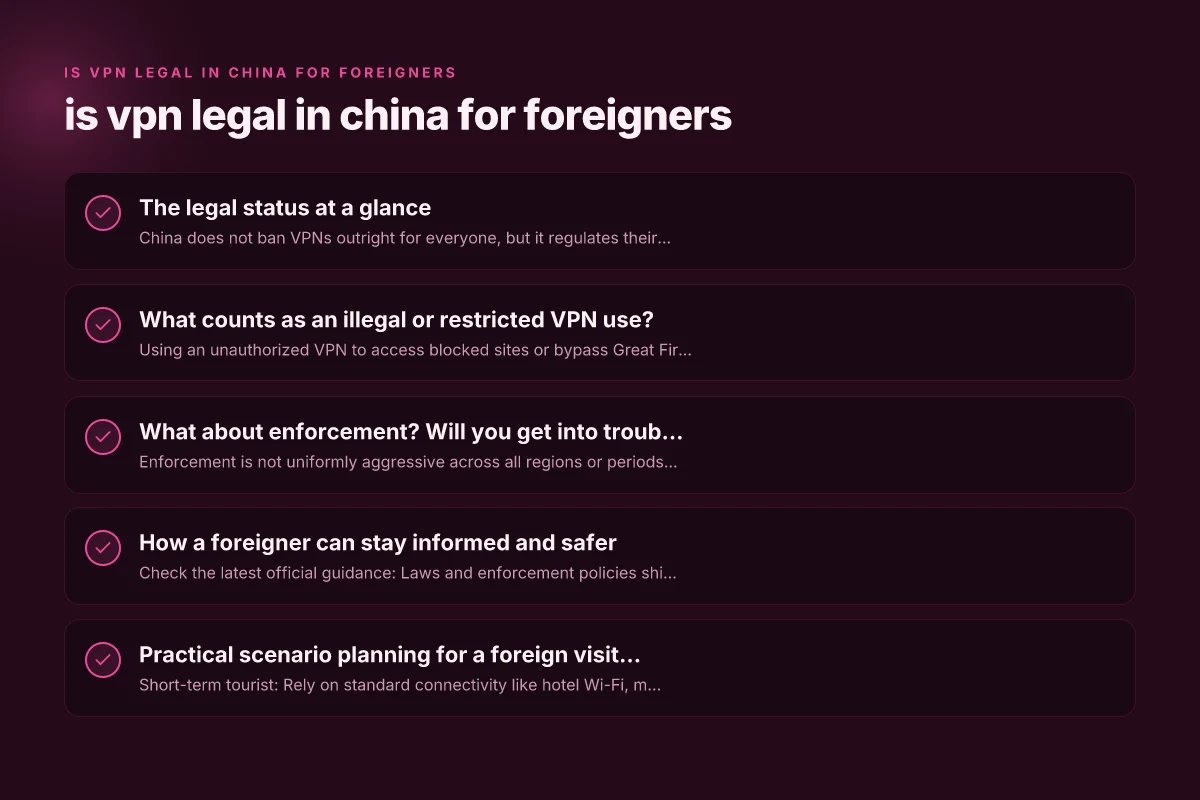
The legal status at a glance
- China does not ban VPNs outright for everyone, but it regulates their use tightly.
- Officially, only government-approved networks and services are meant to be available for wide public use.
- Using an unauthorized VPN to bypass network restrictions or access overseas services can violate Chinese law and regulations.
- Enforcement varies by location, scenario, and government posture at any given time. In practice, many travelers report minimal disruption, but that does not mean a guarantee of legality.
How this translates for foreigners
- Foreigners often encounter the same legal framework as locals when it comes to network use. The key difference is that the intent and context (business travel, short stay, or long-term residency) can influence enforcement and penalties.
- Some foreign-friendly VPNs marketed for China may operate within the bounds of government-approved channels. However, many consumer VPNs do not fall into this category.
- Always stay informed about the current regulatory climate before traveling or working in China.
What counts as an illegal or restricted VPN use?
- Using an unauthorized VPN to access blocked sites or bypass Great Firewall controls can be considered a breach of regulations.
- Providing or operating VPN services to others without official authorization is typically prohibited.
- Border traffic restrictions and the use of private networks outside approved channels are areas with stricter oversight.
- Possession of VPN software is not necessarily illegal on its own, but activation and use to circumvent controls can trigger penalties.
Tips to stay within the lines:
- Use services that are explicitly licensed or approved for enterprise or government use when your work requires secure connections.
- Avoid trying to “beat” the system by using unverified tools or settings that claim to bypass controls.
- Keep your activities aligned with local laws and company policies if you’re visiting for business.
What about enforcement? Will you get into trouble as a tourist or foreign traveler?
- Enforcement is not uniformly aggressive across all regions or periods. In many accounts, travelers report limited or no direct consequences for casual, short-term VPN use.
- That said, there have been cases where individuals received warnings, fines, or were required to disable VPN services, especially if the activity was found to be interfering with government controls or used for sensitive activities.
- The risk varies with:
- Purpose of use (personal browsing vs. business data transfer)
- The VPN service’s method (officially sanctioned vs. consumer-grade tools)
- Location (major cities may observe more regulatory attention)
Practical reality: Do not assume safety. Treat VPN use as potentially risky, and plan accordingly.
How a foreigner can stay informed and safer
- Check the latest official guidance: Laws and enforcement policies shift. Verify with your embassy, employer, or reputable legal resources before traveling.
- Use business-approved channels: If your work requires secure remote access, your company may provide or authorize a VPN that fits local rules.
- Prepare alternatives for connectivity: In some cases, you may rely on local networks, international roaming, or other compliant solutions for essential communications.
- Consider privacy versus legality: A VPN might offer privacy advantages, but it does not guarantee legality or protection from enforcement actions.
Table: compare typical VPN use cases in China for foreigners
| Use case | Legality status (typical) | Enforcement risk | Recommended approach |
|---|---|---|---|
| Personal streaming or browsing with consumer VPN | High ambiguity; many services operate in gray area | Moderate, varies by location and activity | Avoid using unauthorized VPNs for circumventing blocks; consider alternatives |
| Business-sensitive remote access via company VPN | More likely to be legal if approved by employer and government rules | Lower if approved; higher if not | Ensure IT uses sanctioned, licensed VPN services |
| Accessing blocked sites for research | Potential regulatory breach if bypassing controls | Variable; could be flagged | Seek official channels or licensed tools; discuss with local compliance |
| General coordinates and travel planning | Mixed; depends on service and method | Low to moderate | Use reputable, approved methods when possible |
What foreigners commonly ask
- Can tourists in China use VPN? The short answer is: it is not universally illegal, but it can violate regulations if used to bypass controls. The risk is real enough that many travelers choose to rely on compliant options or official channels.
- What happens if I get caught with a VPN in China? Consequences vary. Some face warnings, removal from networks, fines, or more serious actions if the activity is linked to sensitive content or services.
- Is it illegal to use a VPN in China? Not strictly, but it is regulated. The legal status is nuanced and tied to purpose, method, and compliance with government requirements.
- Can the FBI track a VPN? In general, VPNs do not make you immune to law enforcement. Cross-border investigations can involve cooperation with local authorities, and the effectiveness of a VPN depends on many factors, including data retention policies, jurisdiction, and the specific networks involved.
What counts as illegal or restricted VPN use Is using VPN in China legal
| Scenario | Illegal/Restricted? | Why | Guidance for readers | Enforcement likelihood | Alternatives |
|---|---|---|---|---|---|
| Bypassing Great Firewall to access blocked sites | Yes / Restricted | Circumvents controls | Avoid for safety | Moderate | Use approved channels, local services |
| Using consumer VPNs to access restricted content | Yes | Often blocked / censored | Consider alternatives | Moderate | Use domestically compliant tools |
| VPNs for business with licensed provider | No / Sometimes allowed | Licensed providers permitted | Check license status | Low to moderate | Ensure vendor licensing |
| VPNs for general anonymization | Yes | Privacy circumvention | Not recommended | Moderate | Legal privacy tools, local services |
| Firmware or device-level VPN on router | Yes if bypasses controls | May circumvent controls | Proceed with caution | Moderate | Use compliant setup |
Compiled November 2026; check the provider's site for current details.
Practical scenario planning for a foreign visitor
- Short-term tourist: Rely on standard connectivity like hotel Wi-Fi, mobile data, or official business networks. If you must access overseas services, consult your host organization or seek licensed solutions. Avoid ad-hoc VPN installations that claim to bypass restrictions.
- Short-term business traveler: Coordinate with your company’s IT and legal teams. They may provide guidance and a sanctioned VPN service designed for compliance and security within China.
- Expat or longer-term visitor: If you’re staying for business or study, you’ll likely need to set up a remote access solution through approved channels. Ensure you understand data protection, enterprise policies, and local regulations.
A practical checklist before you travel
- Check current regulations: Laws and enforcement can shift. Verify with credible sources close to your travel date.
- Confirm with your employer or host: If your work requires remote access, use the company-approved solution.
- Choose your tools carefully: If you decide not to use a VPN, ensure you have reliable access to required services through compliant means.
- Educate yourself on best practices: Avoid sharing sensitive information over unsecured networks, use official or licensed apps, and be mindful of content access policies.
Practical scenario planning for a foreign visitor
| Scenario | Recommended approach | Key considerations | Risk level | Safer alternative | Quick checklist |
|---|---|---|---|---|---|
| Tourism stay with basic web access | Use publicly available apps cautiously | Avoid circumventing controls | Low | Use web services not blocked | Basic browsing, map apps, messaging |
| Short business trip requiring access to blocked sites | Consult local IT / legal | License/approval needed | Moderate | Use approved business tools | Verify licensing, security |
| Long-term stay for work | Seek licensed VPN provider | Compliance with Chinese law | Moderate | Domestic enterprise VPNs | Obtain company guidance, legal review |
| Social media/content research | Use compliant research tools | Some platforms blocked | Low to moderate | Local search engines | Pre-downloads, offline notes |
Compiled November 2026; check the provider's site for current details.
Final recommendation
If you are a foreigner visiting or living in China, the safest approach is to use VPNs only when they are officially sanctioned or provided by an employer or a licensed service. The regulatory environment remains strict and dynamic, with enforcement varying by circumstance and locale. For most travelers and temporary visitors, relying on compliant connectivity strategies and seeking guidance from your organization or local advisors is the prudent path. If you must use a VPN to support essential work, ensure it is part of an approved, legally compliant setup to minimize risk. Staying informed and choosing conservative options will help you navigate China’s VPN landscape more safely. How to use VPN in China WiFi
| VPN | From / month | Plan | Free plan | Refund | Alipay | UnionPay | Crypto | Website opens in China | Trustpilot | |
|---|---|---|---|---|---|---|---|---|---|---|
 ZoogVPN | $2.49/mo | 27 months: $59.99 | Yes | 7 days | ✓ | ✓ | ✓ | ✓ | ✓ Yes (2.5 s) | 4.2/5 (195 reviews) |
 NordVPN | $3.49/mo | 27 months: $94.23 | No | 30 days | ? | ✗ | ✓ | ✓ | ✗ Blocked | 4.2/5 (51,628 reviews) |
 ExpressVPN | $3.00/mo | 28 months: $84 | No | 30 days | ✗ | ✗ | ✓ | ✗ | ✗ Blocked | 4.4/5 (29,706 reviews) |
 Surfshark | See site | See site | No | 30 days | ✗ | ✗ | ✗ | ✓ | ✗ Blocked | 4.3/5 (31,823 reviews) |
 Proton VPN | $2.99/mo | 12 months: $35.88 | Yes | 30 days | ✗ | ✗ | ✗ | ✓ | ✓ Yes (2.5 s) | 2.1/5 (1,040 reviews) |
 Astrill VPN | $12.50/mo | 24 months: $300 | No | See site | ✗ | ✗ | ✗ | ✓ | ✗ Blocked | 1.3/5 (110 reviews) |
 Private Internet Access | $2.03/mo | 40 months: $81.2 | No | 30 days | ✗ | ✗ | ✗ | ✗ | ✗ Blocked | 4.2/5 (11,033 reviews) |
 CyberGhost | $2.19/mo | 28 months: $61.32 | No | 45 days | ✗ | ✗ | ✗ | ✓ | ✗ Blocked | 4.0/5 (24,178 reviews) |
 PureVPN | $1.69/mo | 60 months: $101.55 | No | 31 days | ? | ✗ | ✗ | ✓ | ✓ Yes (2.6 s) | 4.4/5 (17,994 reviews) |
 AdGuard VPN | $2.99/mo | 24 months: $71.76 | Yes | 30 days | ✓ | ✗ | ✓ | ✓ | Official site blocked; our special link opens (2.3 s) | 4.3/5 (290 reviews) |
 Mullvad | $5.61/mo | €5/mo | No | 14 days | ✗ | ✗ | ✗ | ✓ | ✗ Blocked | 3.2/5 (192 reviews) |
 Windscribe | $5.75/mo | 12 months: $69 | Yes | See site | ✗ | ✗ | ✗ | ✓ | ✗ Blocked | 4.7/5 (13,355 reviews) |
 StrongVPN | See site | See site | No | 30 days | ✓ | ✗ | ✗ | ✗ | ✗ Blocked | 4.4/5 (2,695 reviews) |
 LightXtreme 闪连 | $7.08/mo | 12 months: $84.99 | Yes | 30 days | ✓ | ✓ | ✓ | ✓ | ✓ Yes (2.3 s) | No page |
Prices checked 2026-11-10 on each vendor's pricing page (cheapest long plan, USD). Check the vendor's checkout for the final price.
Payment methods checked 2026-11-10 on each vendor's payment pages: all 14 take cards and PayPal; ✗ = not listed, ? = the vendor's own pages disagree.
China access: whether the official website opens from mainland China networks (tests the website only, not the VPN connection). Last checked 2026-11-11 04:07 Beijing time.
Trustpilot score and review count checked 2026-11-10.