FortiClient VPN Setup: A Step-by-Step Guide
Set up FortiClient VPN on Windows, macOS, or mobile, and troubleshoot common connection problems.
FortiClient VPN setup usually involves installing the app, entering connection details supplied by your organization, and signing in to test the connection. The exact steps depend on your device and whether your organization uses SSL-VPN or IPsec. You will generally need the VPN server address, a username and password, and possibly a portal, gateway, or multifactor authentication code.
Choose the right FortiClient VPN setup path
| Setup path | Best for | What you need | Main steps | Verify success |
|---|---|---|---|---|
| Windows installer | Windows users | Admin access; installer | Install, then configure | VPN connects; internal site opens |
| macOS installer | Mac users | Installer; VPN details | Install, then configure | VPN connects; internal site opens |
| Managed deployment | Organization-managed devices | IT-provided package and settings | Follow organization instructions | Connection works with approved settings |
| Existing installation | FortiClient already installed | VPN connection details | Add or review connection | Correct profile appears |
| IT-assisted setup | Users without required details | IT support | Request server and login information | IT confirms access |
| Remote setup | Users away from the office | Internet access; VPN details | Connect over the internet | Internal resources are reachable |
Compiled November 2026; check the provider's site for current details.
| VPN | Obfuscation | From / month | Plan | Free plan | Refund | Alipay | UnionPay | Crypto | Website opens in China | Trustpilot | |
|---|---|---|---|---|---|---|---|---|---|---|---|
 ZoogVPN | Turn on manually Shadow | $2.49/mo | 27 months: $59.99 | Yes | 7 days | ✓ | ✓ | ✓ | ✓ | Official site blocked; our special link opens (4.4 s) | 4.2/5 (195 reviews) |
 NordVPN | Turn on manually Obfuscated Servers / NordWhisper | $3.49/mo | 27 months: $94.23 | No | 30 days | ? | ✗ | ✓ | ✓ | ✗ Blocked | 4.2/5 (51,628 reviews) |
 ExpressVPN | ✓ On by default all servers | $3.00/mo | 28 months: $84 | No | 30 days | ✗ | ✗ | ✓ | ✗ | ✗ Blocked | 4.4/5 (29,706 reviews) |
 Surfshark | ✓ On by default Camouflage, with OpenVPN | See site | See site | No | 30 days | ✗ | ✗ | ✗ | ✓ | ✗ Blocked | 4.3/5 (31,823 reviews) |
 Proton VPN | Turn on manually Stealth, free plan too | $2.99/mo | 12 months: $35.88 | Yes | 30 days | ✗ | ✗ | ✗ | ✓ | ✗ Blocked | 2.1/5 (1,040 reviews) |
 Astrill VPN | Turn on manually StealthVPN / OpenWeb | $12.50/mo | 24 months: $300 | No | See site | ✗ | ✗ | ✗ | ✓ | ✗ Blocked | 1.3/5 (110 reviews) |
 Private Internet Access | Turn on manually Shadowsocks, OpenVPN only | $2.03/mo | 40 months: $81.2 | No | 30 days | ✗ | ✗ | ✗ | ✗ | ✗ Blocked | 4.2/5 (11,033 reviews) |
 CyberGhost | Turn on manually selected servers | $2.19/mo | 28 months: $61.32 | No | 45 days | ✗ | ✗ | ✗ | ✓ | ✗ Blocked | 4.0/5 (24,178 reviews) |
 PureVPN | Turn on manually switch to OpenVPN | $1.69/mo | 60 months: $101.55 | No | 31 days | ? | ? | ✗ | ✓ | ✗ Blocked | 4.4/5 (17,994 reviews) |
 AdGuard VPN | ✓ On by default TrustTunnel | $2.99/mo | 24 months: $71.76 | Yes | 30 days | ✓ | ✗ | ✓ | ✓ | Official site blocked; our special link opens (3.7 s) | 4.3/5 (290 reviews) |
 Mullvad | Turn on manually QUIC / Shadowsocks / LWO | $5.61/mo | €5/mo | No | 14 days | ✗ | ✗ | ✗ | ✓ | ✗ Blocked | 3.2/5 (192 reviews) |
 Windscribe | Turn on manually Stealth / WStunnel | $5.75/mo | 12 months: $69 | Yes | See site | ✗ | ✗ | ✗ | ✓ | ✗ Blocked | 4.7/5 (13,355 reviews) |
 StrongVPN | Turn on manually Scramble, OpenVPN TCP | See site | See site | No | 30 days | ✓ | ✗ | ✗ | ✗ | ✗ Blocked | 4.4/5 (2,695 reviews) |
 LightXtreme 闪连 | Not listed | $7.08/mo | 12 months: $84.99 | Yes | 30 days | ✓ | ✓ | ✓ | ✓ | ✓ Yes (3.5 s) | No page |
Prices checked 2026-11-10 on each vendor's pricing page (cheapest long plan, USD). Check the vendor's checkout for the final price.
Obfuscation checked 2026-11-14 on each vendor's site and help center: "on by default" = nothing to set; "turn on manually" = switch protocol or mode in settings; "not listed" = the vendor describes no obfuscation.
Payment methods checked 2026-11-10 on each vendor's payment pages: all 14 take cards and PayPal; ✗ = not listed, ? = the vendor's own pages disagree.
China access: whether the official website opens from mainland China networks (tests the website only, not the VPN connection). Last checked 2026-11-18 01:02 Beijing time.
Trustpilot score and review count checked 2026-11-10.
Before you begin
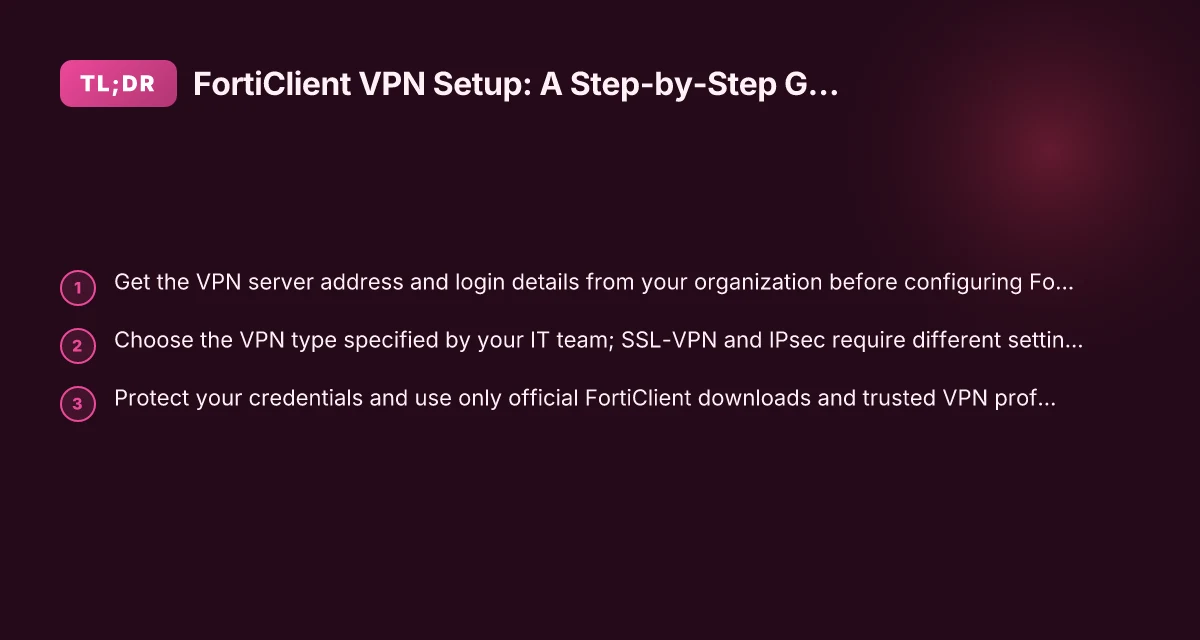
Ask your organization’s IT team for the required settings. A server address alone may not be enough to create a working connection.
Have these details ready:
- Your organization’s VPN server address, such as a hostname or IP address.
- The VPN type: SSL-VPN or IPsec.
- Your username and password, and any multifactor authentication method.
- A port number, VPN portal, or IPsec pre-shared key, if required.
- Any organization-provided configuration file or setup instructions.
Use the FortiClient version and installation method your organization recommends. Some organizations manage VPN settings centrally or provide a customized installer. Avoid downloading installers or configuration files from unfamiliar websites.
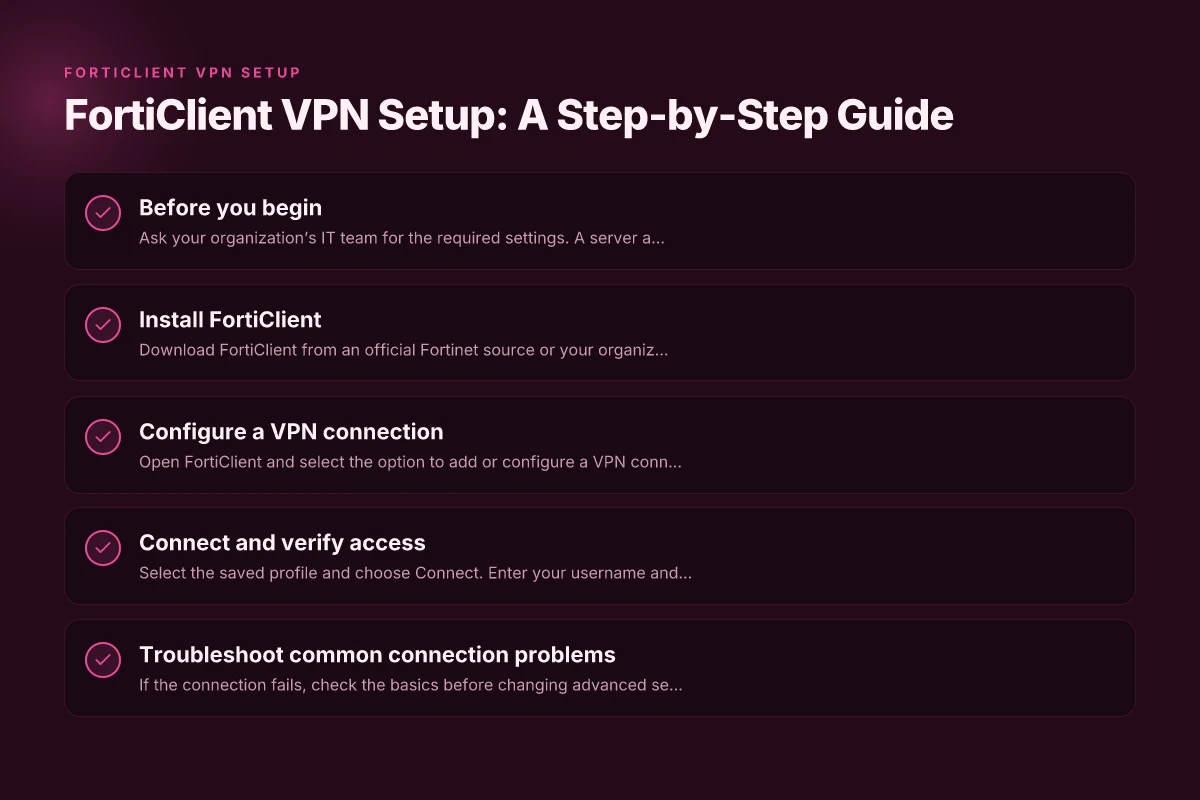
Install FortiClient
Download FortiClient from an official Fortinet source or your organization’s approved software portal. Depending on your device and workplace policies, your IT team may provide a managed version or installation package. Best VPN for Edge Extension: What to Choose and How to Set It Up
Windows and macOS
- Close other applications if your organization’s installer asks you to.
- Open the downloaded installer and follow the on-screen prompts.
- Approve any system permissions required to install network components.
- Launch FortiClient and open its VPN section.
On some computers, you may need administrator permission to install the application or its network extension. If you do not have that access, contact your IT team rather than trying to bypass the restriction.
iPhone, iPad, and Android
Install FortiClient from the Apple App Store or Google Play, or follow your organization’s mobile-device instructions. Your organization may require a managed device, a security profile, or a specific app version before VPN access is allowed.
Compare VPN connection settings before configuring FortiClient
| Setting | What to enter | Source | Common check | If unavailable |
|---|---|---|---|---|
| Connection name | A recognizable label | Choose a name | Check for typos | Ask IT for a naming standard |
| VPN type | Organization-required type | IT instructions | Match the supplied profile | Contact IT |
| Remote gateway | VPN server address | IT instructions | Check spelling and format | Request the address |
| Authentication method | Organization-required method | IT instructions | Match account or certificate setup | Ask IT which method to use |
| Username | Organization account name | Account details or IT | Check spelling and account format | Confirm the correct account |
| Password or sign-in method | Required credentials | Organization instructions | Check for expired credentials | Reset or contact IT |
| Certificate or token | Only if required | IT instructions | Confirm it is installed or available | Request setup help |
Compiled November 2026; check the provider's site for current details. Tuxler VPN Chrome: How It Works, Setup, and Safety Tips
Configure a VPN connection
Open FortiClient and select the option to add or configure a VPN connection. The labels can vary slightly between versions. Choose the VPN type specified by your IT team. Do not guess, as the two common types use different connection settings.
| Setting | SSL-VPN | IPsec VPN |
|---|---|---|
| Common required details | Server address and, if specified, port or portal | Gateway address and authentication details |
| Additional settings | May use a particular VPN portal | May require a pre-shared key or certificate |
| Sign-in | Often uses a username and password, sometimes with MFA | Depends on the organization’s authentication setup |
SSL-VPN setup
- Choose SSL-VPN as the connection type.
- Enter a recognizable connection name, such as “Work VPN.”
- Enter the server address provided by your organization.
- Add a port or VPN portal only if your IT instructions specify one.
- Save the profile.
IPsec setup
- Choose IPsec VPN as the connection type.
- Enter a connection name and the gateway address.
- Select the authentication method your organization requires.
- Enter any provided pre-shared key or select the required certificate, if applicable.
- Save the profile.
Do not share a pre-shared key, certificate, password, or authentication code. If your organization supplies a configuration file, import it only through FortiClient and confirm that it came from a trusted source.
Connect and verify access
Select the saved profile and choose Connect. Enter your username and password when prompted. If multifactor authentication is enabled, approve the sign-in request or enter the code using the method your organization provided.
Wait for FortiClient to show that the connection is established. Then test access to a work resource, such as an internal website or file service. A successful VPN connection does not necessarily mean every resource is available. Access can depend on your account permissions and the network configuration. VPN Change Location Free: How to Switch Your Virtual Location Safely
When finished, disconnect from the VPN using FortiClient. On a shared or public device, sign out of your account and follow your organization’s security rules.
Troubleshoot common connection problems
If the connection fails, check the basics before changing advanced settings:
- Verify the server address and VPN type. A spelling error or choosing IPsec instead of SSL-VPN can prevent connection.
- Check your internet connection. Open a regular website to confirm that your device is online.
- Review sign-in details. Check for typing errors, expired passwords, or an incomplete multifactor authentication prompt.
- Confirm the time and date. Incorrect device settings can interfere with authentication or certificates.
- Update FortiClient if your organization allows it. Use an approved source and follow workplace instructions.
- Restart the app or device. This can clear a temporary issue, but it will not fix incorrect server settings or account restrictions.
- Contact IT if the issue continues. Provide the exact error message, your operating system, the FortiClient version, and the time the problem occurred.
Avoid repeatedly guessing passwords or changing security options. Multiple failed attempts may lock your account, and incorrect changes can make the VPN profile harder to troubleshoot.
Troubleshoot common FortiClient VPN connection problems FortiClient VPN Download Windows 11: Safe Download and Setup Guide
| Problem | First check | Likely next step | Who can help | Access check |
|---|---|---|---|---|
| VPN will not connect | Internet connection | Recheck gateway and profile settings | IT support | Retry the connection |
| Authentication fails | Username and sign-in method | Confirm credentials or reset password | Account support or IT | Sign in again |
| Server cannot be reached | Gateway address and internet access | Check for a typo; ask IT to confirm the server | IT support | Retry after confirmation |
| Connection drops | Internet stability | Reconnect and check network restrictions | IT support | Confirm the tunnel stays connected |
| VPN connects but a site does not open | Correct internal address | Check required access and resource availability | IT or resource owner | Try another approved internal resource |
| Certificate error | Certificate availability and validity | Follow organization certificate instructions | IT support | Reconnect after correction |
Compiled November 2026; check the provider's site for current details.
Recommendation
For a reliable FortiClient VPN setup, use the installer and connection details supplied by your organization, select the VPN type it specifies, and test access to a work resource after connecting. If a setting is missing or the connection fails, ask your IT team to verify the profile rather than guessing.