VPN Change Location Free: How to Switch Your Virtual Location Safely
Learn how a free VPN can change your virtual location, what its limits are, and how to choose a safer option.
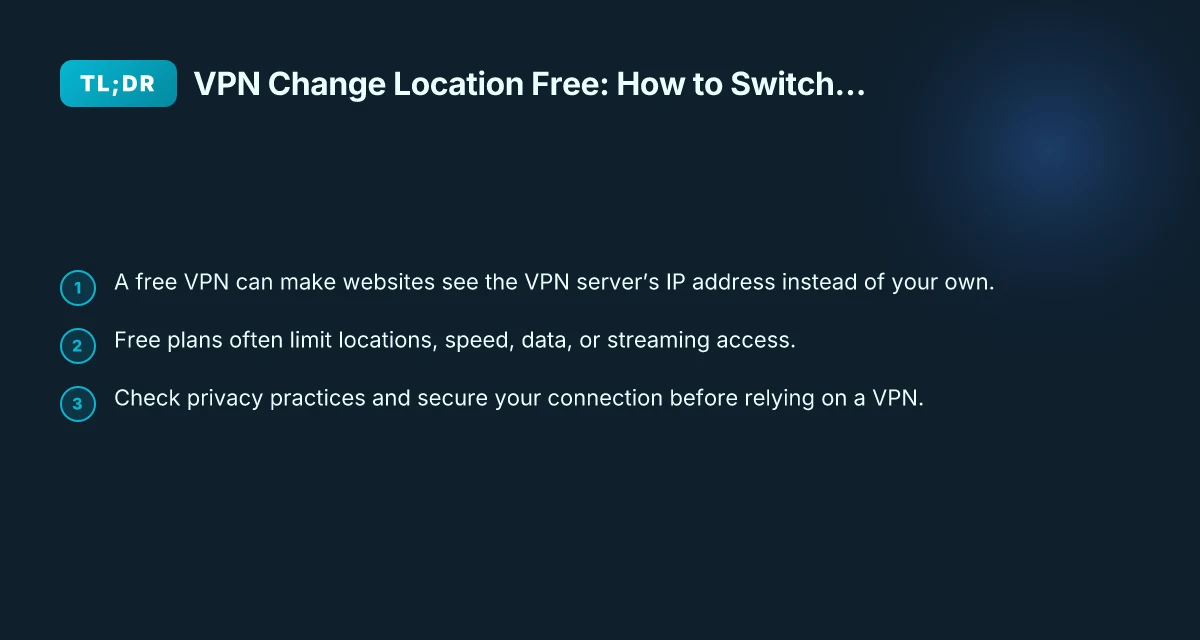
A free VPN can change your apparent online location by routing your internet traffic through a server in another region. Websites then generally see the server’s IP address, not your regular public IP address. To do this, choose a reputable VPN with a free plan, install its app, connect to an available server, and check your IP location. The location change is approximate: a VPN does not alter your device’s GPS position, billing country, or account region, and it does not guarantee access to every location-restricted service.
How free and paid VPNs compare
| Feature | Free VPN | Paid VPN | What to check |
|---|---|---|---|
| Server locations | Often limited | Often broader choice | Locations listed |
| Data allowance | May be capped | Often higher or unlimited | Monthly limit |
| Connection speed | May vary | Often more consistent | Speed limits |
| Device support | May be limited | Often supports more devices | Device policy |
| Privacy practices | Varies by provider | Varies by provider | Privacy policy |
| Ads | May be included | Often absent | Ad policy |
| Streaming access | May be unreliable | May be more reliable | Service compatibility |
| Support | May be limited | Often more support options | Support channels |
Compiled November 2026; check the provider's site for current details.
| VPN | Obfuscation | From / month | Plan | Free plan | Refund | Alipay | UnionPay | Crypto | Website opens in China | Trustpilot | |
|---|---|---|---|---|---|---|---|---|---|---|---|
 ZoogVPN | Turn on manually Shadow | $2.49/mo | 27 months: $59.99 | Yes | 7 days | ✓ | ✓ | ✓ | ✓ | Official site blocked; our special link opens (4.4 s) | 4.2/5 (195 reviews) |
 NordVPN | Turn on manually Obfuscated Servers / NordWhisper | $3.49/mo | 27 months: $94.23 | No | 30 days | ? | ✗ | ✓ | ✓ | ✗ Blocked | 4.2/5 (51,628 reviews) |
 ExpressVPN | ✓ On by default all servers | $3.00/mo | 28 months: $84 | No | 30 days | ✗ | ✗ | ✓ | ✗ | ✗ Blocked | 4.4/5 (29,706 reviews) |
 Surfshark | ✓ On by default Camouflage, with OpenVPN | See site | See site | No | 30 days | ✗ | ✗ | ✗ | ✓ | ✗ Blocked | 4.3/5 (31,823 reviews) |
 Proton VPN | Turn on manually Stealth, free plan too | $2.99/mo | 12 months: $35.88 | Yes | 30 days | ✗ | ✗ | ✗ | ✓ | ✗ Blocked | 2.1/5 (1,040 reviews) |
 Astrill VPN | Turn on manually StealthVPN / OpenWeb | $12.50/mo | 24 months: $300 | No | See site | ✗ | ✗ | ✗ | ✓ | ✗ Blocked | 1.3/5 (110 reviews) |
 Private Internet Access | Turn on manually Shadowsocks, OpenVPN only | $2.03/mo | 40 months: $81.2 | No | 30 days | ✗ | ✗ | ✗ | ✗ | ✗ Blocked | 4.2/5 (11,033 reviews) |
 CyberGhost | Turn on manually selected servers | $2.19/mo | 28 months: $61.32 | No | 45 days | ✗ | ✗ | ✗ | ✓ | ✗ Blocked | 4.0/5 (24,178 reviews) |
 PureVPN | Turn on manually switch to OpenVPN | $1.69/mo | 60 months: $101.55 | No | 31 days | ? | ? | ✗ | ✓ | ✗ Blocked | 4.4/5 (17,994 reviews) |
 AdGuard VPN | ✓ On by default TrustTunnel | $2.99/mo | 24 months: $71.76 | Yes | 30 days | ✓ | ✗ | ✓ | ✓ | Official site blocked; our special link opens (3.7 s) | 4.3/5 (290 reviews) |
 Mullvad | Turn on manually QUIC / Shadowsocks / LWO | $5.61/mo | €5/mo | No | 14 days | ✗ | ✗ | ✗ | ✓ | ✗ Blocked | 3.2/5 (192 reviews) |
 Windscribe | Turn on manually Stealth / WStunnel | $5.75/mo | 12 months: $69 | Yes | See site | ✗ | ✗ | ✗ | ✓ | ✗ Blocked | 4.7/5 (13,355 reviews) |
 StrongVPN | Turn on manually Scramble, OpenVPN TCP | See site | See site | No | 30 days | ✓ | ✗ | ✗ | ✗ | ✗ Blocked | 4.4/5 (2,695 reviews) |
 LightXtreme 闪连 | Not listed | $7.08/mo | 12 months: $84.99 | Yes | 30 days | ✓ | ✓ | ✓ | ✓ | ✓ Yes (3.5 s) | No page |
Prices checked 2026-11-10 on each vendor's pricing page (cheapest long plan, USD). Check the vendor's checkout for the final price.
Obfuscation checked 2026-11-14 on each vendor's site and help center: "on by default" = nothing to set; "turn on manually" = switch protocol or mode in settings; "not listed" = the vendor describes no obfuscation.
Payment methods checked 2026-11-10 on each vendor's payment pages: all 14 take cards and PayPal; ✗ = not listed, ? = the vendor's own pages disagree.
China access: whether the official website opens from mainland China networks (tests the website only, not the VPN connection). Last checked 2026-11-18 01:02 Beijing time.
Trustpilot score and review count checked 2026-11-10.
How a VPN changes your location
Your internet provider normally assigns your connection a public IP address, which can reveal an approximate location, such as a city or region. A VPN creates an encrypted connection to a VPN server. Traffic to the internet then appears to come from that server’s IP address.
For example, if you connect to a VPN server in another country, websites may identify your connection with that country’s IP address. However, IP-based location databases are not exact. A server listed in one city might be registered to an address elsewhere, and websites may use other signals to estimate where you are.
A VPN’s location change usually applies to internet traffic handled by the VPN app. It does not necessarily change:
- GPS location reported by a phone or tablet
- Your account’s country, payment method, or billing address
- Location data saved in cookies or app settings
- The region associated with a mobile network
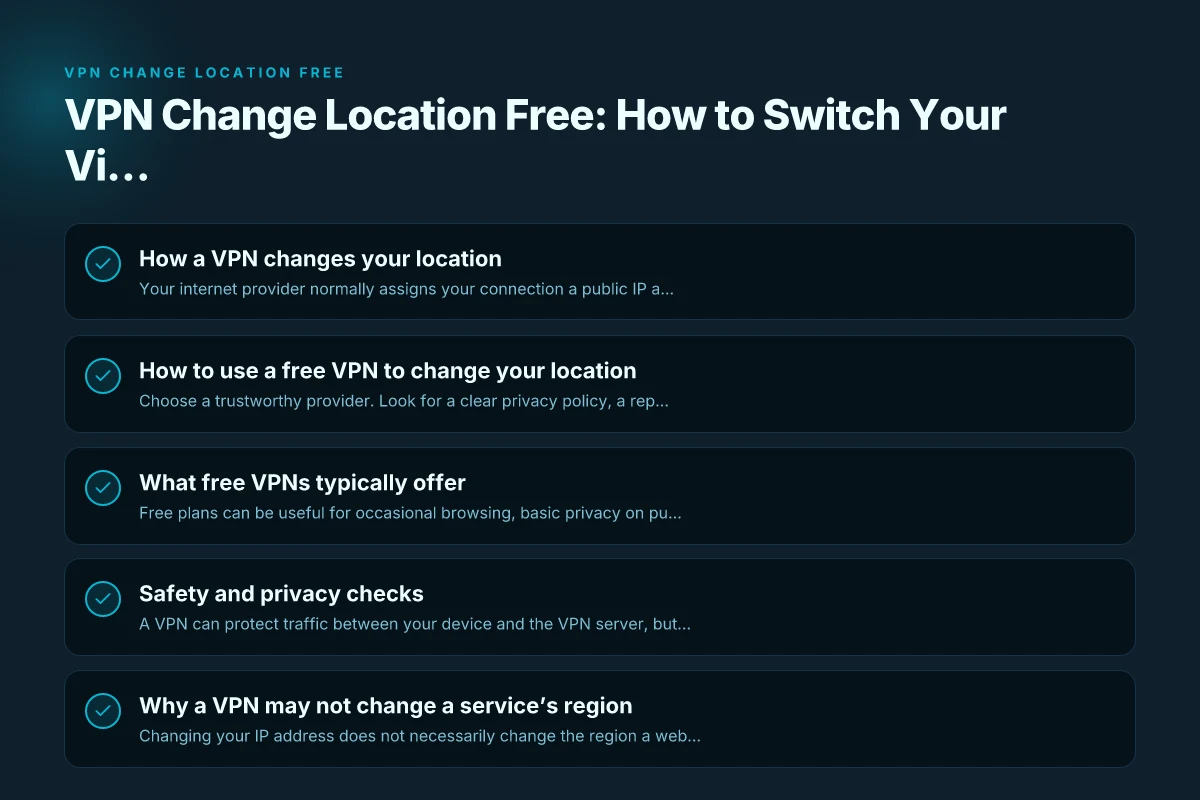
How to use a free VPN to change your location
- Choose a trustworthy provider. Look for a clear privacy policy, a reputable track record, and a free plan with understandable limits. Download the app from the provider’s official website or your device’s official app store.
- Create an account if needed. Review what information the provider asks for and whether the free plan requires a subscription or payment details.
- Install and open the app. Check the requested permissions. A VPN typically needs permission to add a VPN configuration to your device.
- Select an available server location. Free plans may offer only a few countries or automatically select a server.
- Connect and verify. Use an IP-checking service to see whether your public IP address and approximate country have changed. If your device has a VPN indicator, confirm that it shows a connection.
- Disconnect when finished. You can switch back to your normal connection through the VPN app.
If the IP check still shows your usual location, reconnect to another server, close and reopen the browser, and check for app or browser permissions that share location data. A VPN connection may also fail or disconnect, so look for a kill switch or connection-protection feature if the provider offers one. FortiClient VPN Download Windows 11: Safe Download and Setup Guide
Safety and privacy checks before choosing a VPN
| Check | Safer sign | Warning sign | Why it matters |
|---|---|---|---|
| Privacy policy | Clearly explains data handling | Vague or missing policy | Shows what may be collected |
| Logging | States what is and is not logged | Unclear logging claims | Affects privacy |
| Permissions | Requests only needed access | Requests unrelated access | Limits unnecessary data exposure |
| Security features | Explains connection protection | Security claims lack detail | Helps assess protection |
| Ownership | Provider is identifiable | Ownership is unclear | Supports accountability |
| Business model | Explains how service is funded | Funding is unexplained | Helps assess incentives |
| Independent reviews | Findings are available | No verifiable assessments | Adds evidence beyond claims |
| App source | Available from an official source | Download source is unclear | Reduces risk of altered apps |
Compiled November 2026; check the provider's site for current details.
What free VPNs typically offer
Free plans can be useful for occasional browsing, basic privacy on public Wi-Fi, or trying a VPN before paying. They are often limited, though, and their features vary by provider.
| Feature | Common free-plan experience | What to check |
|---|---|---|
| Server locations | A small selection of countries or regions | Whether you can choose a location yourself |
| Data allowance | A monthly or daily cap, or unlimited use with restrictions | How much data your activities need |
| Speed | May vary with server load and plan limits | Performance at the times you usually connect |
| Streaming | Access may be limited or unreliable | Whether the service permits your intended use |
| Privacy features | Basic protection, with some features reserved for paid plans | Logging policy, kill switch, and leak protection |
A free plan may be enough for a short task but not for frequent video streaming, large downloads, or constant use. If a provider advertises unlimited service at no cost, read its privacy and business-model details carefully. “Free” does not automatically mean that a service collects or sells data, but the provider should clearly explain how it operates and what information it retains. Proxy Server: What It Is, How It Works, and When to Use One
Safety and privacy checks
A VPN can protect traffic between your device and the VPN server, but it does not make you anonymous. The VPN provider may be able to observe certain connection details, and websites can still identify you when you sign in, accept tracking cookies, or share personal information.
Before choosing a free VPN, check for:
- A clear privacy policy: Look for what data is collected, how long it is kept, and whether it is shared.
- A credible provider: Prefer established services with transparent ownership and security practices.
- A secure app: Keep it updated and install it only from trusted sources.
- Leak protection: DNS or IP leaks can expose information that a VPN connection is meant to hide.
- A kill switch: This can block internet traffic if the VPN connection drops, though availability varies by plan and device.
- Reasonable permissions: Be cautious if a VPN app asks for access unrelated to its stated function.
Avoid unknown apps that make sweeping promises, such as guaranteeing complete anonymity or access to every website. A VPN is one privacy tool, not a substitute for strong passwords, software updates, and careful sharing of personal information.
Why a VPN may not change a service’s region
Changing your IP address does not necessarily change the region a website or app assigns to your account. A service may use several signals, including GPS, cookies, account history, payment details, and device settings. Streaming platforms and other services may also detect or restrict VPN traffic, so access can vary and may stop working without notice. CJ VPN Login: How to Sign In and Fix Common Problems
Use a VPN in line with the service’s terms and local laws. If your goal is simply to protect your connection, you may not need to change countries at all. Connecting to a nearby server can provide a more stable experience.
Free VPN or paid VPN?
A free VPN is best treated as a limited option for occasional use. A paid plan may offer more locations, higher data allowances, better performance, and additional security features, but payment alone does not guarantee good privacy. Compare providers on the same basics: transparency, security, location choice, and whether the service meets your needs.
If you only need to check how a website appears from another region, a reputable free plan may be enough. If you need reliable access, frequent location changes, or sustained bandwidth, compare paid plans and their cancellation terms before subscribing.
Why a VPN may not change a service’s region Proton VPN Download: How to Get the Official App Safely
| Possible cause | What it means | What to check | Next step |
|---|---|---|---|
| Server location | VPN exit location may differ from the intended region | Connected server | Choose another available server |
| IP address detection | Service may recognize the VPN address | Service error or region notice | Try a different server |
| Account region | Account settings may determine the region | Account country or billing details | Review service settings |
| Device location | GPS or device settings may reveal location | Location permissions | Check app permissions |
| Browser data | Cookies may retain earlier location signals | Site cookies and cache | Clear site data |
| DNS settings | DNS requests may reveal a different region | VPN DNS protection | Check VPN settings |
| Service restrictions | Service may block VPN connections | Service terms or help pages | Follow service rules |
| Free plan limits | Free tier may not offer the needed location | Available server list | Check plan locations |
Compiled November 2026; check the provider's site for current details.
Recommendation
For a free VPN change of location, choose a reputable provider with a transparent privacy policy, connect to one of its available servers, and verify the result with an IP check. Treat the location as an approximate IP-based signal, not a GPS change or a promise of access, and use a paid service only if a free plan’s limits do not meet your needs.