Fast btc to stablecoin conversion
A practical guide to quickly swapping BTC for stablecoins with minimal risk and clear steps.
BTC is widely traded against stablecoins like USDT, USDC, and other dollar-pegged assets. If you need to convert BTC to a stablecoin quickly, you’re usually weighing speed versus cost and risk. This guide lays out practical paths, what to expect on each, and concrete steps to take to speed up the process while keeping your funds secure.
Quick overview: what “fast BTC to stablecoin” really means
“Fast” can mean a few different things depending on your priorities:
- Speed of settlement: how quickly the BTC is exchanged for a stablecoin and credited to your destination.
- On-chain vs. off-chain: on-chain trades settle on the Bitcoin blockchain and then a stablecoin wallet, or you can use cross-chain or custodial services that streamline the flow.
- Fees and liquidity: higher liquidity venues and stable-coin pairs often settle faster with lower slippage, but sometimes at a premium.
- Security and risk: custodial solutions may be faster but introduce trusted counterparty risk. Non-custodial or smart-order routing can be slower if liquidity is fragmented.
In practice, most fast BTC-to-stablecoin moves use one of these routes: a crypto exchange, a cross-chain liquidity protocol, or a crypto payments/swap service that handles the BTC-to-stablecoin conversion and delivers the stablecoin to your wallet.
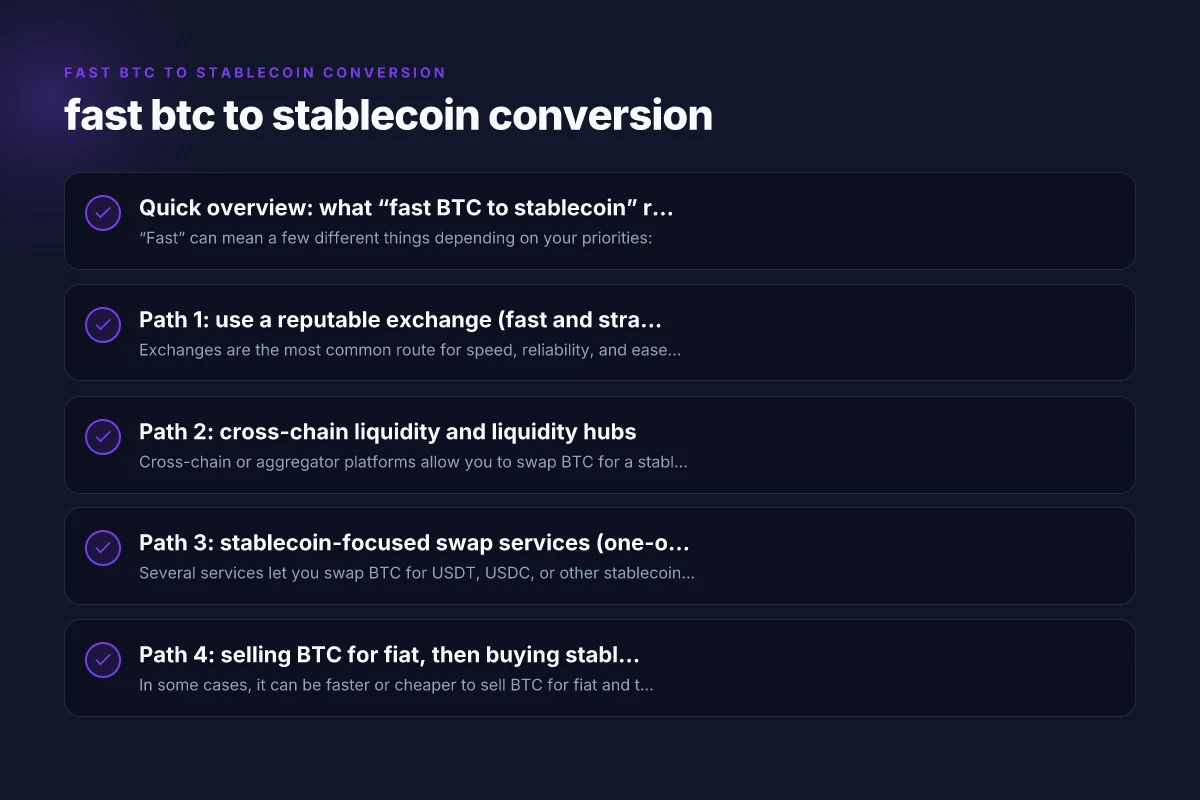
Path 1: use a reputable exchange (fast and straightforward)
Exchanges are the most common route for speed, reliability, and ease of use.
- Steps to follow:
- Open a newly funded or already verified account on a reputable exchange that supports BTC-to-stablecoin pairs (for example BTC/USDT, BTC/USDC, BTC/DAI, etc.).
- Deposit BTC (or use a previously held BTC balance) and wait for the required number of confirmations. Most major exchanges require a few confirmations (typically 3–6) before the deposit is credited.
- Place a market or instant sell order to convert BTC into your chosen stablecoin.
- Withdraw the stablecoin to your own wallet address (or keep it on the exchange if you plan to trade again soon).
- Pros:
- Fast execution when you use market orders.
- Clear fee schedules and reliability.
- Often immediate withdrawal of stablecoins once the trade settles.
- Cons:
- Requires trust in the exchange’s custody and security.
- Fees can add up (trading fee plus withdrawal fee).
- KYC/compliance steps may be required.
Tips to speed it up: Err_http2_protocol_error: what it is, causes, and how to fix it
- Pre-create the stablecoin withdrawal address to avoid entry delays.
- Use a funding method that’s already verified on the exchange to avoid extra verification.
- Consider a “convert-and-withdraw” flow in a single session to minimize hopping between apps.
Path 2: cross-chain liquidity and liquidity hubs
Cross-chain or aggregator platforms allow you to swap BTC for a stablecoin with potentially lower fees and fast settlement, sometimes without leaving your wallet.
- Common approaches:
- Symbiosis and similar cross-chain routers that allow BTC-to-stablecoin swaps via liquidity pools.
- On-platform swap tools that convert BTC to stablecoins directly, using an internal liquidity pool.
- How it works:
- You initiate a BTC-to-stablecoin swap on the platform.
- The system routes your BTC through liquidity pools or bridges and delivers the stablecoin to your specified address.
- You may pay a liquidity or network fee, and price is determined at swap time.
- Pros:
- Potentially lower fees and faster settlement for some routes.
- Can be non-custodial if you maintain control of your BTC and receive stablecoins in your wallet.
- Cons:
- Complexity and potential for price impact/slippage in pools.
- Availability varies by region and platform, and some services may be less beginner-friendly.
- Best practices:
- Check the quoted rate and minimum/maximum trade sizes.
- Ensure you’re interacting with reputable protocols and verify contract addresses.
- Be aware of cross-chain gas fees and bridge risk.
Path 3: stablecoin-focused swap services (one-off swaps)
Several services let you swap BTC for USDT, USDC, or other stablecoins directly, sometimes with fast, built-in settlement.
- How to use:
- Enter the amount of BTC you want to swap.
- Choose the stablecoin you want to receive.
- Provide the destination stablecoin address. The platform handles the swap and funds you the stablecoin.
- Pros:
- Simplicity and speed in a single transaction.
- Often integrated fiat on-ramp/withdrawal options.
- Cons:
- Fees vary by service. Some services are optimized for convenience rather than minimal cost.
- Reputation and trust are important. Confirm if the service is custodial or non-custodial.
- Things to verify:
- Public rate transparency and fee breakdown.
- Whether the service provides trade confirmation, swap routing times, and settlement guarantees.
- Security track record and any insurance coverage.
Path 4: selling BTC for fiat, then buying stablecoin (two-step but sometimes fastest for high liquidity)
In some cases, it can be faster or cheaper to sell BTC for fiat and then buy stablecoins with fiat on a trusted platform, especially if you already have fiat funding lines or debit cards enabled.
- Steps:
- Sell BTC on an exchange for fiat currency (USD, EUR, etc.) using a market order to speed it up.
- Withdraw fiat to your bank or a payment method that supports stablecoins purchase.
- Use the fiat balance to purchase your preferred stablecoin on the same or another platform.
- Pros:
- High liquidity and potentially lower price impact for large trades.
- Familiar flow if you’re used to fiat on-ramps.
- Cons:
- Slower if bank transfers are involved due to processing times.
- Two separate steps mean more friction and more potential points of failure.
- When this makes sense:
- If you need to move funds off-chain quickly and have fiat automation options in your region.
- If you’re consolidating a tax lot and prefer to settle in stablecoins with fiat provenance.
Path 5: trading bots and automation for speed and consistency
If you execute crypto-to-stablecoin conversions regularly, automation can shave seconds off each trade. Jokercard.ca: What You Need to Know About Canada’s Joker Prepaid Card
- How it works:
- A trading bot or API-based setup routes BTC-to-stablecoin trades on supported venues with pre-defined parameters.
- You define thresholds, slippage tolerance, and destination addresses, and the bot handles the rest.
- Pros:
- Consistency, repeatability, and reduced manual steps.
- Potential for better price performance via programmable routing.
- Cons:
- Requires technical setup and ongoing maintenance.
- API keys introduce additional security considerations.
- Security tips:
- Use exchange APIs with restricted permissions (read-only for monitoring, deploy with a dedicated trading key).
- Enable hardware 2FA and withdrawal whitelisting.
- Periodically audit connected services and rotate keys.
Side-by-side comparison: which path is fastest for you?
Here’s a quick comparison to help you decide based on speed, cost, and risk.
| Path | Typical settlement time | Common fees | Custody risk | Best cases |
|---|---|---|---|---|
| Exchange (BTC -> stablecoin) | Minutes to a few hours (depending on confirmations and withdrawal) | Trading fee + withdrawal fee; network fees | Medium (exchange custodial) | High liquidity, straightforward KYC flow |
| Cross-chain liquidity | Minutes (often 0–30 minutes) | Liquidity provider fees; possible bridge fee | Low to medium (non-custodial in some setups) | Fast routing, potential savings on fees |
| Direct swap service | Minutes | Service fee; possible spread | Variable (custodial or non-custodial) | Simple, single-step experience |
| BTC fiat path | Hours (depends on bank processing) | Trading fee + fiat withdrawal fee | Medium (varies by method) | High liquidity for large trades |
| Automation/bots | Minutes to seconds after setup | Varies; trading fees apply | Medium to high (API keys) | Consistent, scalable for frequent swaps |
- Key takeaway: If speed is your top priority, exchanges with market orders plus a fast stablecoin withdrawal are typically your fastest bet, especially when you’ve preconfigured addresses and verification steps.
- If you value lower costs and you’re comfortable with a bit more setup, cross-chain liquidity and direct swap services can offer speed with potential savings.
- For large trades, sometimes a two-step BTC-to-fiat-to-stablecoin route can beat direct crypto-to-stablecoin paths on price, but it introduces more sequencing risk and potential delays.
Security and compliance considerations
- Verify the platform’s reputation and security track record. Look for established exchanges with a long history, transparent security practices, and independent audits if available.
- Enable strong authentication: hardware security keys where possible, or at minimum, authenticator apps, plus SMS as a backup.
- Use withdrawal address whitelists to prevent unauthorized transfers.
- Be mindful of KYC/AML requirements. Some regions require enhanced verification for larger transfers, which can affect speed if you’re in a rush.
- Tax considerations: converting BTC to stablecoins is a taxable event in many jurisdictions. Keep records of trades, timestamps, and cost basis to simplify reporting.
Practical step-by-step checklist to get fast BTC-to-stablecoin conversion today
- Decide on the target stablecoin (e.g., USDT, USDC, or another peg).
- Pick the fastest route aligned with your risk tolerance:
- If you want minimal friction and you’re already on an established exchange, use that exchange’s BTC-to-stablecoin pair and withdraw the stablecoin to your wallet.
- If you want lower fees and more control, explore a reputable cross-chain liquidity route or a direct swap service.
- Prepare your addresses ahead of time:
- Have your stablecoin wallet address ready and verified for withdrawals.
- Confirm your confirmations and fees:
- For BTC deposits, ensure you know how many confirmations your chosen venue requires.
- Review the total cost: trading fee, withdrawal fee, and any bridge/liquidity fees.
- Execute the trade:
- Use a market order for speed, unless slippage is a concern and you’re trading a large amount.
- Complete the receipt of stablecoins:
- Verify the balance in your wallet before ending the session.
- Secure your funds:
- Move stablecoins to a secure wallet if you don’t intend to trade them immediately.
- Review security hygiene: 2FA, withdrawal whitelists, and periodic key rotation for API-based trading.
Recommendation For most users who want the fastest, reliable BTC-to-stablecoin conversion, the recommended path is to use a reputable major exchange with BTC-to-stablecoin trading pairs and a quick withdrawal to your own stablecoin wallet. This path benefits from:
- Clear and predictable settlement times (often within minutes for market executions, longer for withdrawals depending on network conditions and destination).
- Transparent fee structures and a broad selection of stablecoins.
- Strong liquidity and robust customer support.
If you’re comfortable with a bit more complexity and want potentially lower fees, you can experiment with cross-chain liquidity platforms or direct swap services, but do so with caution. Always verify the platform’s reputation, review the exact price quotes, and confirm the destination stablecoin address before confirming any trades.
In sum: choose the fastest route that aligns with your risk tolerance. For most users, a trusted exchange with a market sale into your preferred stablecoin, followed by a swift withdrawal to your wallet, delivers speed with the assurance of established processes and support. Understanding Proxies: What They Are and When to Use Them