Organization structure and the payroll department: shaping efficiency and control
A practical guide to aligning your organization structure with a payroll department for accuracy, compliance, and agility.
The organization structure of a business shapes how work flows, who makes decisions, and how departments interact. When the payroll department is integrated into this structure with clear roles and processes, payroll runs become predictable, compliant, and efficient. This article explores how to design or refine an organization structure that supports a strong payroll function, what roles typically exist, and how to measure success.
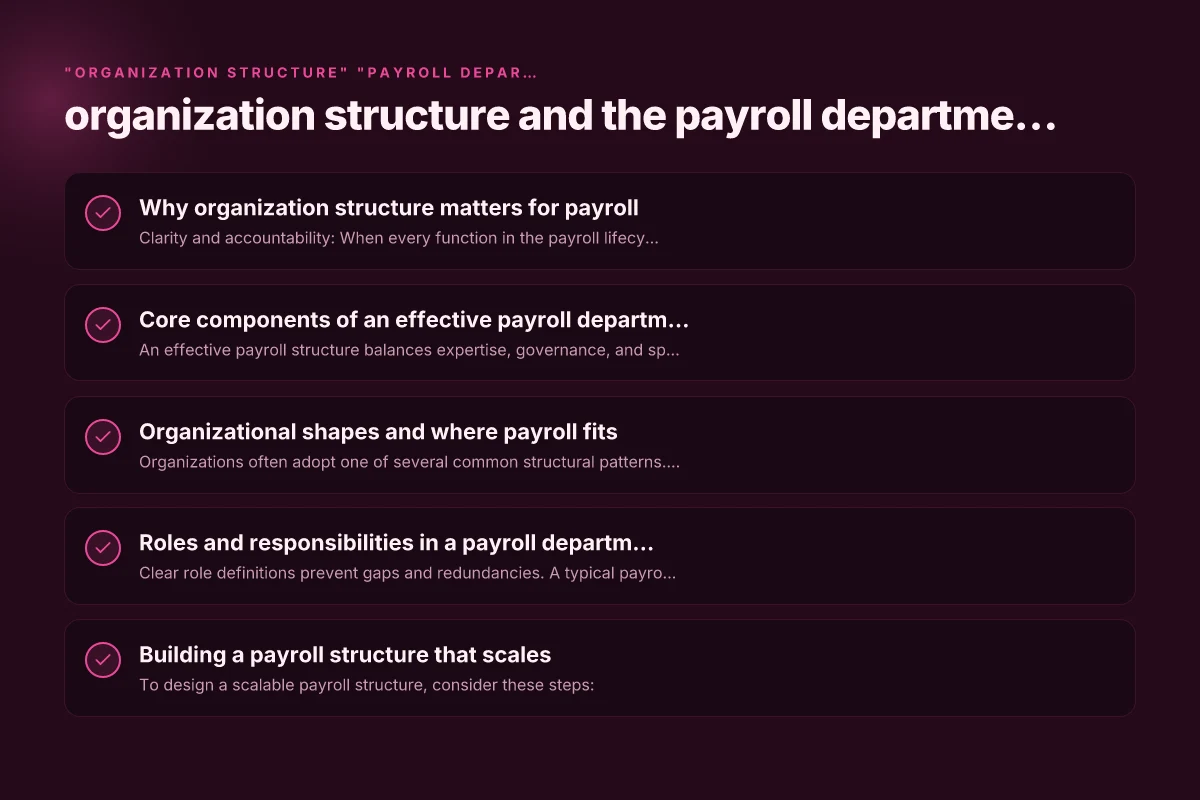
Why organization structure matters for payroll
- Clarity and accountability: When every function in the payroll lifecycle has a defined owner, mistakes are easier to catch and correct.
- Compliance and controls: A well-defined structure creates segregation of duties, reducing the risk of fraud or errors in tax withholding, benefits, and reporting.
- Scalability: A payroll operation that aligns with the broader org chart can adapt to hiring surges, new jurisdictions, and evolving regulations.
- Communication flow: Clear reporting lines ensure payroll policies are understood and consistently applied across departments.
A typical payroll workflow touches HR, finance, IT, and departments that hire or reimburse employees. Without a deliberate structure, cross-functional handoffs can become bottlenecks, causing delays in payroll runs, incorrect tax filings, or misapplied deductions.
Core components of an effective payroll department structure
An effective payroll structure balances expertise, governance, and speed. The following elements are commonly found in well-functioning organizations:
- Payroll leadership: A payroll director or manager who owns strategy, policy, and risk management.
- Payroll operations: Specialists focused on processing, benefits administration, timekeeping, and wage calculations.
- Tax and compliance: Roles responsible for tax filings, statutory reporting, and regulatory updates.
- Benefits and deductions: Team members who manage voluntary benefits, retirement plans, and other withholdings.
- System and data integrity: Analysts or admins who maintain payroll systems, security, and data quality.
- Controls and governance: Compliance officers or internal auditors ensuring proper controls and audits.
- Human resources interface: Liaisons who translate HR policies into payroll practice and resolve discrepancies.
- Finance interface: Individuals who align payroll with budgeting, cash management, and financial reporting.
A simple way to think about it is: the payroll function sits at the intersection of people data, money movement, and regulatory compliance. Structure should reflect this triad.
Organizational shapes and where payroll fits
Organizations often adopt one of several common structural patterns. Each pattern has implications for payroll: Cato VPN: what it is, how it compares
- Functional structure: Payroll operates as a function within HR or Finance. Pros: clarity within specialized teams; Cons: risk of silos between HR admin and payroll operations.
- Matrix structure: Payroll staff report to both HR and Finance managers for some tasks. Pros: better alignment with policies and financial control; Cons: potential reporting complexity.
- Centralized payroll: A single team handles payroll for the entire organization. Pros: consistency, efficiency, easier governance; Cons: potential bottlenecks if growth is rapid.
- Decentralized payroll: Multiple payroll teams by region or business unit. Pros: local compliance and speed; Cons: duplication of effort and higher governance overhead.
- Hybrid model: Core centralized processes with regional or business unit specialists handling niche requirements. Pros: balance of control and agility; Cons: requires robust interfaces and data standards.
When designing or revising structure, map payroll processes to your business model. For example, a multinational company may need separate tax and compliance experts for each jurisdiction, while a smaller firm may rely on shared services with standardized procedures.
Roles and responsibilities in a payroll department
Clear role definitions prevent gaps and redundancies. A typical payroll department might include:
- Payroll Director/Manager: Sets policy, ensures compliance, oversees payroll calendar, audits, and strategic improvements.
- Payroll Processor: Executes payroll runs, ensures accuracy of earnings, deductions, and benefits.
- Time and Attendance Specialist: Validates hours, leave, and overtime. Interfaces with timekeeping systems.
- Tax and Compliance Specialist: Manages tax withholding, filings, year-end reporting, and regulatory updates.
- Benefits Administrator: Handles deductions for health, retirement, and other benefits. Coordinates with HR and payroll.
- Data and System Administrator: Maintains payroll software, security, access controls, and data integrity.
- Audit and Controls Analyst: Monitors controls, performs internal audits, and supports external audits.
- HR Liaison: Partners with HR to translate policies into payroll outcomes, resolve discrepancies.
- Finance Liaison: Ensures payroll aligns with cash flow, budgeting, and financial reporting.
- Customer Support/Employee Experience: Answers employee questions about pay, deductions, and benefits.
In smaller organizations, several of these roles may be combined. For example, a payroll specialist might also handle time and attendance, or a payroll manager may act as both a compliance lead and HR liaison. In larger firms, teams become more specialized.
Building a payroll structure that scales
To design a scalable payroll structure, consider these steps: CSL eslim: what it is, who uses it, and how it fits into CSL Plasma’s offerings
- Define the payroll lifecycle: hiring, data capture, timekeeping, calculation, approvals, payment, reporting, and reconciliation.
- Assign owners for each step: who is responsible for data accuracy, who approves adjustments, who signs off on tax filings.
- Establish governance: policy documents, standard operating procedures, and a payroll calendar with deadlines.
- Create data standards: common data fields, formats, and data quality checks to ensure consistency across systems.
- Invest in interfaces: ensure seamless data flow between HRIS, timekeeping, benefits providers, and the payroll system.
- Implement controls: segregation of duties, access controls, change management, and audit trails.
- Plan for risk: identify single points of failure and create contingency processes for holidays, system outages, and tax changes.
- Build cross-functional collaboration: formalized touchpoints with HR, Finance, IT, and legal/legal compliance.
A practical way to illustrate this is to define a RACI model for payroll activities: who is Responsible, Accountable, Consulted, and Informed for each major task.
How to measure payroll structure effectiveness
Metrics help you gauge whether your organization structure is delivering value. Useful payroll KPIs include:
- Payroll accuracy rate: percentage of payroll runs without errors.
- On-time payroll delivery: percentage of runs completed by the scheduled payday.
- Time-to-close for year-end and tax filings: how quickly you finalize annual reports.
- Tax compliance status: number of filings completed on time and absence of penalties.
- Data quality score: assessments of data accuracy in systems (driven by data audits).
- Employee inquiry volume and resolution time: how efficiently the team handles questions.
- DSO relating to payroll-related expenses: days sales outstanding tied to payroll cash movements.
- Cost per payroll processed: total payroll cost divided by number of employees or payroll runs.
A table can help, for example, to compare structures across scenarios:
| Scenario | Centralized vs Decentralized | Key Benefit | Potential Challenge |
|---|---|---|---|
| Centralized | Centralized | Consistency, control, scale | Possible bottlenecks, slower regional support |
| Decentralized | Regional units | Local compliance, faster responses | Higher admin overhead, duplication |
| Hybrid | Core centralized with regional specialists | Best of both worlds | Requires strong data standards and interfaces |
Regular audits and performance reviews should accompany these metrics. Use dashboards that pull data from HRIS, payroll software, and finance systems so leadership can see trends at a glance. Is coofandy.shop legit
Common pitfalls and how to avoid them
- Overcomplicating the structure: Too many roles create confusion. Start with essential roles and expand as needed.
- Misaligned interfaces: If HR, IT, and Finance teams don’t share data effectively, payroll suffers. Invest in data governance and system integrations.
- Inadequate segregation of duties: Ensure multiple people are involved in critical steps to prevent fraud and errors.
- Inflexible processes: Rigid procedures that don’t adapt to new regulations or business changes slow down payroll. Build adaptable SOPs with regular updates.
- Poor change management: New payroll processes fail without training and clear communication. Include onboarding and ongoing education for staff.
Practical steps to implement changes
- Assess current structure: Map existing roles, responsibilities, and handoffs. Identify gaps or bottlenecks.
- Engage stakeholders: Involve HR leadership, Finance, IT, and executive sponsors early. Gather input on pain points and goals.
- Define a future-state design: Create an organization chart that reflects desired roles, reporting lines, and cross-functional interfaces.
- Develop governance documents: SOPs, policy manuals, data dictionaries, and control matrices.
- Plan for people and technology: Identify required hires or role changes, and evaluate payroll systems for scalability and integration.
- Pilot and iterate: Test changes in a controlled scenario (e.g., one region or a subset of employees) before full rollout.
- Train and communicate: Deliver role-specific training, publish updates, and maintain clear communication channels for questions.
- Monitor and adjust: Use KPIs to assess impact and adjust the structure as the business evolves.
Final recommendations
- Start with purpose: Design the payroll structure to support business strategy, not the other way around. If your company expands internationally, plan for jurisdiction-specific roles early.
- Prioritize governance: Build controls, data integrity, and compliance into the DNA of the payroll function. This reduces risk and preserves trust with employees and regulators.
- Invest in interfaces: A well-integrated tech stack that connects HR, timekeeping, benefits, and payroll reduces manual work and errors. Data quality is the backbone of accurate payroll.
- Build in flexibility: A hybrid or matrix approach often offers the best balance between control and agility as business needs and regulations change.
- Measure and communicate value: Track KPIs that matter to leadership (accuracy, timeliness, compliance, cost efficiency) and share progress openly with stakeholders.
A thoughtfully designed organization structure around the payroll department not only ensures accurate and timely pay but also underpins broader financial discipline and regulatory compliance. When payroll is integrated into the organizational fabric with clear roles, robust processes, and strong data governance, the company gains a reliable engine for people operations and financial health.