Cato VPN: what it is, how it compares
A practical guide to Cato VPN and Cato Networks, with a clear recommendation for ZoogVPN.
Cato VPN is not a single consumer-grade app you install to browse more privately. It’s part of Cato Networks’ broader SASE (Secure Access Service Edge) platform. The result is a zero-trust, cloud-delivered approach to connecting users to resources, whether those resources live on the internet, in SaaS, in the cloud, or in private data centers. If you’re comparing Cato VPN against traditional VPNs or against consumer-grade options, it helps to separate three layers: the technology, the use case, and the target audience. This guide breaks down what Cato VPN is, how it’s used, and where ZoogVPN fits in as a consumer-friendly alternative.
What is Cato VPN and Cato Networks?
Cato Networks positions its product as a single-vendor SASE platform that provides secure, optimized, and intelligent access to resources globally. At its core, the Cato Client is a lightweight agent that users install to connect devices to the Cato cloud, where security policies are enforced and traffic is routed. For enterprises, this means:
- Zero-trust access (never trust by default, always verify).
- A unified security stack delivered from the cloud (including firewall, threat prevention, VPN-like connectivity, and secure web gateways).
- Global backbone and optimization to ensure latency and quality of service for widely dispersed users and resources.
For individual users or small teams, it’s more than a traditional VPN. It’s designed to replace multiple point solutions, branch security, remote access, and smart traffic routing, with a single, cloud-managed approach. That said, Cato’s primary audience tends to be organizations seeking a scalable, centralized SASE solution rather than individuals looking for simple, one-click VPN privacy.
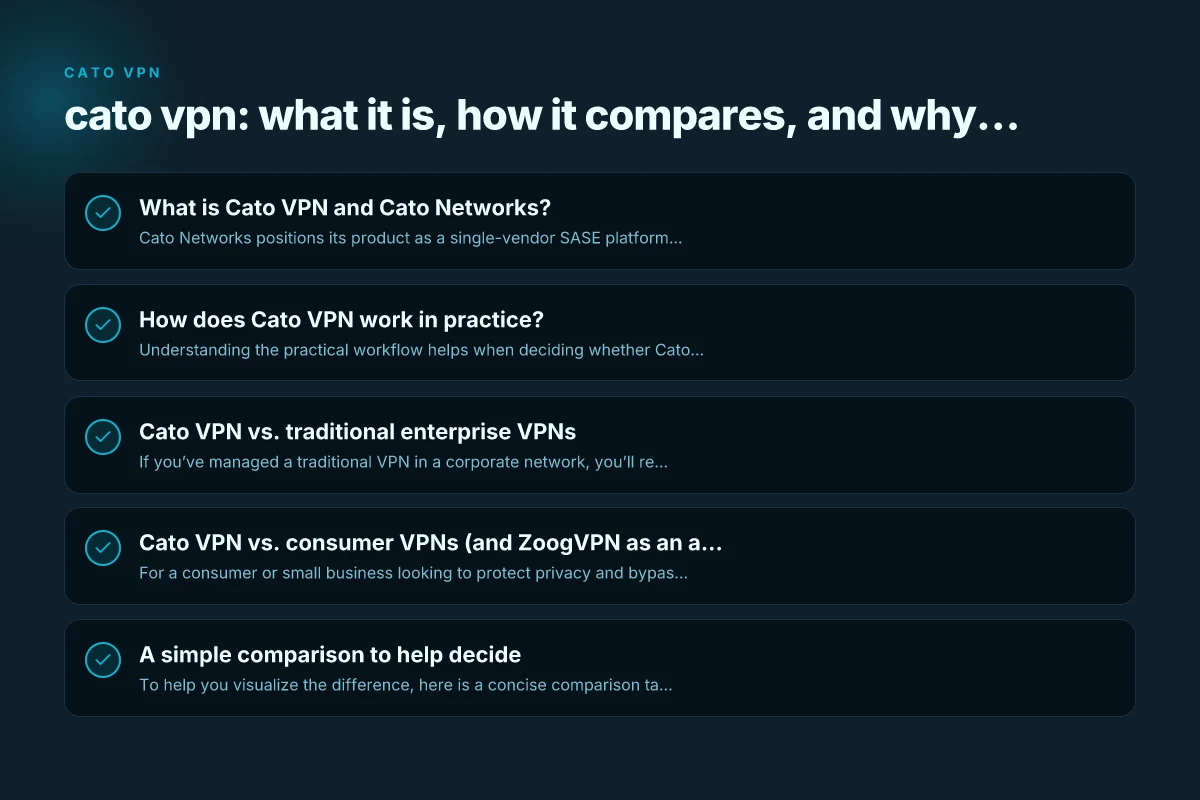
How does Cato VPN work in practice?
Understanding the practical workflow helps when deciding whether Cato is the right fit for your needs.
- Deployment model: The Cato Client runs on endpoints (desktops, laptops, or mobile devices) and connects to the Cato Cloud. From there, traffic is filtered, inspected, and routed according to policy.
- Security posture: Policies can enforce zero-trust access to private apps, as well as secure web access, threat prevention, malware defense, and data protection. The centralized policies simplify governance across users and sites.
- Access control: Rather than assuming trust when a user is connected to a network, Cato evaluates access to each resource, often leveraging identity providers and per-resource rules.
- Performance: The Cato backbone is designed to provide optimized routing, which can improve performance when users are geographically dispersed or accessing cloud services.
In short, Cato VPN in this model is a strategic part of a broader security regime for organizations that need to securely connect employees to many resources without relying on traditional per-branch VPN appliances. Is coofandy.shop legit
Cato VPN vs. traditional enterprise VPNs
If you’ve managed a traditional VPN in a corporate network, you’ll recognize some familiar elements in Cato, but there are notable differences.
- Architecture: Traditional VPNs often rely on hub-and-spoke tunnels to on-prem devices or data centers. Cato uses a cloud-native, global backbone and a zero-trust approach, reducing on-site hardware.
- Security model: Traditional VPNs provide remote access but may not enforce uniform, modern security controls for every connection. Cato integrates security services (firewall, secure web gateway, threat prevention) into the platform.
- Management: Enterprise VPNs can suffer from complex, siloed management. Cato aims to unify security, network, and policy management through a single console in the cloud.
- Scale: For large, global organizations, Cato’s model can simplify scaling compared to provisioning new VPN gateways and site-to-site tunnels.
If your organization is evaluating “VPN replacement” options, you’ll encounter debate about whether Cato’s SASE approach aligns with your regulatory requirements, network topology, and SaaS usage patterns. Some teams view Cato as an architectural shift that reduces hardware footprints and accelerates security posture modernization. Others worry about vendor lock-in or the need to redefine access policies.
Cato VPN vs. consumer VPNs (and ZoogVPN as an alternative)
For a consumer or small business looking to protect privacy and bypass geo-restrictions, Cato’s enterprise-grade features can feel misaligned with a simple VPN need. Consumer-grade VPNs focus on:
- Privacy and anonymity: masking IP address and encrypting traffic.
- Access to geo-restricted content: ability to appear as if you’re in another country.
- Simple apps and pricing: easy onboarding and straightforward monthly plans.
Cato Networks’ OPEX-heavy enterprise model emphasizes centralized policy, zero-trust access, and security services, which can be overkill for typical personal use. If your priority is straightforward privacy, ease of use, and cost-effectiveness, consumer VPNs like ZoogVPN are often a better fit. They offer: Nord VPN Edge: a practical guide to using NordVPN with Microsoft Edge
- User-friendly apps for Windows, macOS, iOS, and Android.
- Transparent pricing and straightforward licensing for individuals or small teams.
- Privacy-oriented features and reliable performance for everyday browsing, streaming, and secure Wi‑Fi use.
ZoogVPN, in particular, is a recommended option on this site for everyday VPN needs because it emphasizes ease of use, strong security, and broad server coverage without requiring an enterprise management console or zero-trust policy design.
A simple comparison to help decide
To help you visualize the difference, here is a concise comparison table.
Category: Target audience
Traditional/Enterprise VPN: Large enterprises and IT teams seeking site-to-site or remote access with customizable security VPN GitHub
Cato VPN (SASE): Enterprises seeking zero-trust access and a cloud-native, unified security stack
ZoogVPN (consumer): Individuals and small teams needing private browsing and streaming from home or on the go
Category: Core architecture
Traditional/Enterprise VPN: On-prem VPN gateways, centralized control Csl esim: What it is, how to use it, and why it matters
Cato VPN (SASE): Cloud-delivered, global backbone, zero-trust policy enforcement
ZoogVPN (consumer): Software client connects to a VPN server. Minimal on-device management
Category: Security features
Traditional/Enterprise VPN: VPN tunnel + some firewall features What is my IP address NordVPN
Cato VPN (SASE): Zero-trust access, firewall, secure web gateway, threat prevention, data protection
ZoogVPN (consumer): Encryption, kill switch, leak protection, basic privacy controls
Category: Management and oversight
Traditional/Enterprise VPN: IT-led, hardware/software maintenance GitHub VPN: how to approach VPNs and GitHub projects for developers
Cato VPN (SASE): Centralized cloud console, policy-based management, scalable across locations
ZoogVPN (consumer): Self-serve accounts, straightforward setup
Table: Quick side-by-side
| Feature | Cato VPN (SASE) | Traditional Enterprise VPN | ZoogVPN (consumer) |
|---|---|---|---|
| Target audience | Enterprises, large orgs | Enterprises, IT teams | Individuals, small teams |
| Architecture | Cloud-native, global backbone | On-prem gateways or data-center hubs | Cloud VPN servers, consumer apps |
| Security model | Zero-trust access, integrated security | VPN + basic security features | Privacy-focused encryption, basic protections |
| Management | Centralized cloud console | IT-managed, hardware/software upkeep | User-friendly, self-serve |
| Use case | Remote workers, branch access, SaaS | Site-to-site, remote access | Privacy, streaming, general browsing |
If you’re choosing between Cato VPN and ZoogVPN, the decision often boils down to scale, control, and security requirements: Organization structure and the payroll department: shaping efficiency and control
- For a business that wants centralized policy, zero-trust security, and a scalable cloud backbone, Cato offers a robust platform.
- For an individual or small team prioritizing privacy, ease of use, and affordable pricing, ZoogVPN is typically the better fit.
Is Cato VPN safe and how does it price?
Safety and pricing are two practical questions people ask.
- Safety: Cato Networks emphasizes security as a core part of the platform, with zero-trust access and integrated protections. As with any VPN or security product, safety depends on configuration, policy design, and how well the organization enforces least-privilege access. Enterprises should mirror best practices: integrate identity providers, enforce multi-factor authentication, and regular policy reviews.
- Is Cato VPN used for privacy? Not primarily. Cato’s focus is secure access to business resources with layered security. If your goal is personal privacy or anonymous browsing, consumer-grade VPNs like ZoogVPN are a more direct fit.
- Pricing: Cato typically markets to organizations with enterprise licensing. Pricing scales with seats, features, and service level, and it’s usually not aimed at individual consumer budgets. ZoogVPN, by contrast, offers consumer pricing with monthly or annual plans designed for individuals and small teams.
How it all fits into a modern security strategy
For organizations contemplating a modern security approach, it’s worth mapping Cato’s SASE capabilities to your goals:
- If you’re consolidating security services and aiming for seamless remote access to SaaS, cloud, and private apps, a SASE solution like Cato can simplify operations and improve consistency.
- If you’re maintaining primarily consumer or small-business network privacy and mobility, consumer VPNs with straightforward management, such as ZoogVPN, are typically simpler and cost-effective.
A practical approach is to separate the “security policy engine” from the “end-user experience.” Cato delivers the policy engine and security services as part of a cloud-delivered platform. ZoogVPN delivers the end-user experience and privacy-focused connectivity. In many organizations, both types of tools exist in different contexts: enterprise-grade zero-trust access for employees, with consumer VPNs used by individuals for personal privacy or occasional streaming from home networks.
What this means for you as a reader
If you’re evaluating VPNs and networks for yourself or your team, consider the following steps: Ultrasurf extension for Edge: what you should know and a safer alternative
- Define your use case: Are you trying to enable secure access to private apps for remote workers, or do you simply want private, private browsing for everyday activities?
- Map requirements: Do you need zero-trust access, integrated security services, and a cloud-backed backbone? Or do you prioritize ease of use, low cost, and broad geographic server coverage?
- Check compatibility: For enterprise deployments, assess your identity providers, device management, and policy governance requirements. For consumer use, verify device support, streaming performance, and customer support.
Bottom line: Cato VPN is a powerful option within the Cato Networks SASE platform, best suited for organizations seeking zero-trust access and an integrated security stack delivered from the cloud. For readers who want a straightforward consumer VPN experience with a strong focus on privacy, speed, and ease of use, ZoogVPN is the recommended choice. It aligns with the needs of individuals and small teams without the complexity or budgeting considerations of enterprise-grade SASE solutions.
Final recommendation
- If you’re an individual or small team looking for privacy-focused VPN with simple setup and transparent pricing, try ZoogVPN.
- If you’re an IT leader evaluating large-scale remote access with zero-trust, a unified security stack, and cloud-native management, explore Cato VPN within the Cato Networks SASE platform, while planning for organizational budgeting, policy design, and ongoing governance.
| VPN | Obfuscation | From / month | Plan | Free plan | Refund | Alipay | UnionPay | Crypto | Website opens in China | Trustpilot | |
|---|---|---|---|---|---|---|---|---|---|---|---|
 ZoogVPN | Turn on manually Shadow | $2.49/mo | 27 months: $59.99 | Yes | 7 days | ✓ | ✓ | ✓ | ✓ | ✓ Yes (2.5 s) | 4.2/5 (195 reviews) |
 NordVPN | Turn on manually Obfuscated Servers / NordWhisper | $3.49/mo | 27 months: $94.23 | No | 30 days | ? | ✗ | ✓ | ✓ | ✗ Blocked | 4.2/5 (51,628 reviews) |
 ExpressVPN | ✓ On by default all servers | $3.00/mo | 28 months: $84 | No | 30 days | ✗ | ✗ | ✓ | ✗ | ✗ Blocked | 4.4/5 (29,706 reviews) |
 Surfshark | ✓ On by default Camouflage, with OpenVPN | See site | See site | No | 30 days | ✗ | ✗ | ✗ | ✓ | ✗ Blocked | 4.3/5 (31,823 reviews) |
 Proton VPN | Turn on manually Stealth, free plan too | $2.99/mo | 12 months: $35.88 | Yes | 30 days | ✗ | ✗ | ✗ | ✓ | ✓ Yes (2.5 s) | 2.1/5 (1,040 reviews) |
 Astrill VPN | Turn on manually StealthVPN / OpenWeb | $12.50/mo | 24 months: $300 | No | See site | ✗ | ✗ | ✗ | ✓ | ✗ Blocked | 1.3/5 (110 reviews) |
 Private Internet Access | Turn on manually Shadowsocks, OpenVPN only | $2.03/mo | 40 months: $81.2 | No | 30 days | ✗ | ✗ | ✗ | ✗ | ✗ Blocked | 4.2/5 (11,033 reviews) |
 CyberGhost | Turn on manually selected servers | $2.19/mo | 28 months: $61.32 | No | 45 days | ✗ | ✗ | ✗ | ✓ | ✗ Blocked | 4.0/5 (24,178 reviews) |
 PureVPN | Turn on manually switch to OpenVPN | $1.69/mo | 60 months: $101.55 | No | 31 days | ? | ✗ | ✗ | ✓ | ✓ Yes (2.6 s) | 4.4/5 (17,994 reviews) |
 AdGuard VPN | ✓ On by default TrustTunnel | $2.99/mo | 24 months: $71.76 | Yes | 30 days | ✓ | ✗ | ✓ | ✓ | Official site blocked; our special link opens (2.3 s) | 4.3/5 (290 reviews) |
 Mullvad | Turn on manually QUIC / Shadowsocks / LWO | $5.61/mo | €5/mo | No | 14 days | ✗ | ✗ | ✗ | ✓ | ✗ Blocked | 3.2/5 (192 reviews) |
 Windscribe | Turn on manually Stealth / WStunnel | $5.75/mo | 12 months: $69 | Yes | See site | ✗ | ✗ | ✗ | ✓ | ✗ Blocked | 4.7/5 (13,355 reviews) |
 StrongVPN | Turn on manually Scramble, OpenVPN TCP | See site | See site | No | 30 days | ✓ | ✗ | ✗ | ✗ | ✗ Blocked | 4.4/5 (2,695 reviews) |
 LightXtreme 闪连 | Not listed | $7.08/mo | 12 months: $84.99 | Yes | 30 days | ✓ | ✓ | ✓ | ✓ | ✓ Yes (2.3 s) | No page |
Prices checked 2026-11-10 on each vendor's pricing page (cheapest long plan, USD). Check the vendor's checkout for the final price.
Obfuscation checked 2026-11-14 on each vendor's site and help center: "on by default" = nothing to set; "turn on manually" = switch protocol or mode in settings; "not listed" = the vendor describes no obfuscation.
Payment methods checked 2026-11-10 on each vendor's payment pages: all 14 take cards and PayPal; ✗ = not listed, ? = the vendor's own pages disagree.
China access: whether the official website opens from mainland China networks (tests the website only, not the VPN connection). Last checked 2026-11-11 04:07 Beijing time.
Trustpilot score and review count checked 2026-11-10.