FortiGate IPsec VPN: Setup, Configuration, and Troubleshooting
Learn how FortiGate IPsec VPN works, how to configure a site-to-site tunnel, and how to troubleshoot common connection issues.
FortiGate IPsec VPN creates an encrypted connection between networks, such as two offices, or between a remote user and a company network. To set up a site-to-site tunnel, configure matching Phase 1 and Phase 2 parameters on both FortiGate devices, add routes to the remote network, and create firewall policies that allow the intended traffic. The tunnel can be established while traffic still fails, so routing and policy configuration matter as much as encryption settings.
Compare common FortiGate IPsec VPN deployment options
| Option | Connects | Typical use | Main setup inputs | Best fit |
|---|---|---|---|---|
| Site-to-site | Two networks | Branch connectivity | Peer address, subnets, keys | Fixed locations |
| Remote access | Individual users to a network | Workforce access | User identity, client, gateway | Traveling users |
| Route-based tunnel | Networks through an interface | Flexible routing | Tunnel interface, routes, policies | Dynamic routing |
| Policy-based tunnel | Networks through matching policies | Specific traffic flows | Selectors, policies, peer settings | Narrow traffic scope |
| Static peer | Known public endpoint | Stable internet links | Peer IP, authentication settings | Fixed-address sites |
| Dynamic peer | Endpoint with changing address | Remote or variable links | Peer identity, authentication settings | Changing-address peers |
Compiled November 2026; check the provider's site for current details.
| VPN | Obfuscation | From / month | Plan | Free plan | Refund | Alipay | UnionPay | Crypto | Website opens in China | Trustpilot | |
|---|---|---|---|---|---|---|---|---|---|---|---|
 ZoogVPN | Turn on manually Shadow | $2.49/mo | 27 months: $59.99 | Yes | 7 days | ✓ | ✓ | ✓ | ✓ | Official site blocked; our special link opens (4.4 s) | 4.2/5 (195 reviews) |
 NordVPN | Turn on manually Obfuscated Servers / NordWhisper | $3.49/mo | 27 months: $94.23 | No | 30 days | ? | ✗ | ✓ | ✓ | ✗ Blocked | 4.2/5 (51,628 reviews) |
 ExpressVPN | ✓ On by default all servers | $3.00/mo | 28 months: $84 | No | 30 days | ✗ | ✗ | ✓ | ✗ | ✗ Blocked | 4.4/5 (29,706 reviews) |
 Surfshark | ✓ On by default Camouflage, with OpenVPN | See site | See site | No | 30 days | ✗ | ✗ | ✗ | ✓ | ✗ Blocked | 4.3/5 (31,823 reviews) |
 Proton VPN | Turn on manually Stealth, free plan too | $2.99/mo | 12 months: $35.88 | Yes | 30 days | ✗ | ✗ | ✗ | ✓ | ✗ Blocked | 2.1/5 (1,040 reviews) |
 Astrill VPN | Turn on manually StealthVPN / OpenWeb | $12.50/mo | 24 months: $300 | No | See site | ✗ | ✗ | ✗ | ✓ | ✗ Blocked | 1.3/5 (110 reviews) |
 Private Internet Access | Turn on manually Shadowsocks, OpenVPN only | $2.03/mo | 40 months: $81.2 | No | 30 days | ✗ | ✗ | ✗ | ✗ | ✗ Blocked | 4.2/5 (11,033 reviews) |
 CyberGhost | Turn on manually selected servers | $2.19/mo | 28 months: $61.32 | No | 45 days | ✗ | ✗ | ✗ | ✓ | ✗ Blocked | 4.0/5 (24,178 reviews) |
 PureVPN | Turn on manually switch to OpenVPN | $1.69/mo | 60 months: $101.55 | No | 31 days | ? | ? | ✗ | ✓ | ✗ Blocked | 4.4/5 (17,994 reviews) |
 AdGuard VPN | ✓ On by default TrustTunnel | $2.99/mo | 24 months: $71.76 | Yes | 30 days | ✓ | ✗ | ✓ | ✓ | Official site blocked; our special link opens (3.7 s) | 4.3/5 (290 reviews) |
 Mullvad | Turn on manually QUIC / Shadowsocks / LWO | $5.61/mo | €5/mo | No | 14 days | ✗ | ✗ | ✗ | ✓ | ✗ Blocked | 3.2/5 (192 reviews) |
 Windscribe | Turn on manually Stealth / WStunnel | $5.75/mo | 12 months: $69 | Yes | See site | ✗ | ✗ | ✗ | ✓ | ✗ Blocked | 4.7/5 (13,355 reviews) |
 StrongVPN | Turn on manually Scramble, OpenVPN TCP | See site | See site | No | 30 days | ✓ | ✗ | ✗ | ✗ | ✗ Blocked | 4.4/5 (2,695 reviews) |
 LightXtreme 闪连 | Not listed | $7.08/mo | 12 months: $84.99 | Yes | 30 days | ✓ | ✓ | ✓ | ✓ | ✓ Yes (3.5 s) | No page |
Prices checked 2026-11-10 on each vendor's pricing page (cheapest long plan, USD). Check the vendor's checkout for the final price.
Obfuscation checked 2026-11-14 on each vendor's site and help center: "on by default" = nothing to set; "turn on manually" = switch protocol or mode in settings; "not listed" = the vendor describes no obfuscation.
Payment methods checked 2026-11-10 on each vendor's payment pages: all 14 take cards and PayPal; ✗ = not listed, ? = the vendor's own pages disagree.
China access: whether the official website opens from mainland China networks (tests the website only, not the VPN connection). Last checked 2026-11-18 01:02 Beijing time.
Trustpilot score and review count checked 2026-11-10.
What FortiGate IPsec VPN does
IPsec protects IP traffic by authenticating the participating gateways and encrypting data between them. A common FortiGate deployment is a site-to-site VPN: one FortiGate at each location establishes a tunnel across the internet or another shared network.
FortiGate can also provide remote-access IPsec VPNs for individual devices. Their setup differs from site-to-site VPNs because it involves user authentication, client configuration, and address assignment. This guide focuses on the site-to-site configuration, which is the usual interpretation of FortiGate IPsec VPN.
The two main negotiation stages are:
- Phase 1 (IKE): The FortiGates identify and authenticate each other, then establish a secure management channel.
- Phase 2 (IPsec): The devices agree on the traffic to protect and establish the keys used to encrypt it.
Both peers need compatible settings. The devices do not always need identical firmware or interface names, but their VPN proposals, authentication details, and traffic selectors must agree. VPN FortiGate: How It Works, Setup Options, and Best Practices
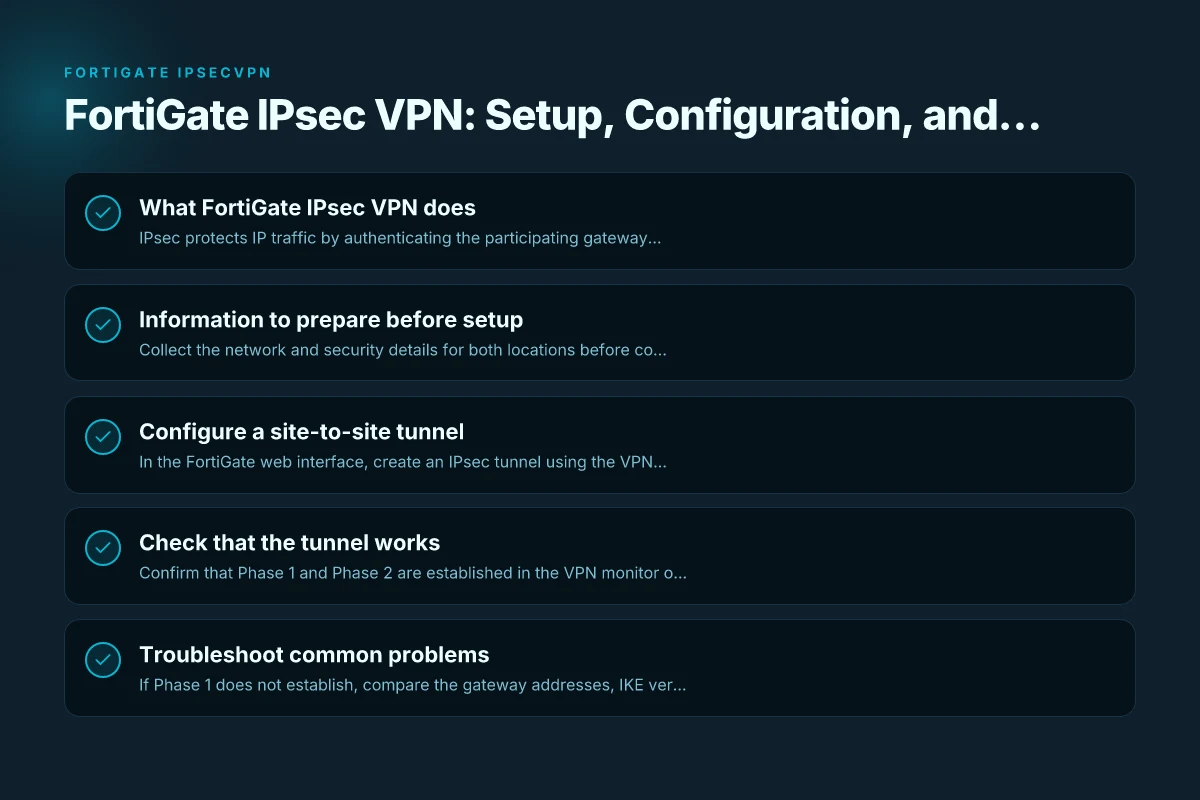
Information to prepare before setup
Collect the network and security details for both locations before configuring the tunnel. For example, Site A might use 192.168.10.0/24 and Site B 192.168.20.0/24. These ranges must not overlap.
You will typically need:
- Each FortiGate’s public IP address or reachable hostname.
- The local and remote protected subnets.
- An agreed authentication method, such as a pre-shared key or certificates.
- Compatible IKE version, encryption, authentication, and Diffie-Hellman settings.
- Phase 2 encryption, authentication, and lifetime settings.
- The intended interface, routing approach, and permitted services.
Use strong cryptographic proposals supported by both devices and follow your organization’s security standards. Avoid reusing a pre-shared key across unrelated tunnels. Where practical, certificates can provide more manageable identity-based authentication.
Configure a site-to-site tunnel
In the FortiGate web interface, create an IPsec tunnel using the VPN wizard or manual settings. Menu labels and available options can vary by FortiOS version, so check the documentation for the version installed on each device. What Is com.NordVPN.Android? A Guide to the NordVPN Android App
Phase 1 settings
On the first FortiGate, specify the remote gateway’s public address and the local outgoing interface. Choose an IKE version and authentication method, then configure the agreed proposals and key lifetime. Enter the pre-shared key if that method is used.
Configure the second FortiGate with the first device’s public address and the corresponding settings. Ensure that each peer identifies the correct remote gateway. If a device is behind NAT, configure NAT traversal as needed and confirm that upstream routers allow the required traffic.
Phase 2 settings
Define the local and remote subnets for the traffic selector. The networks must be reversed on the other peer:
| Setting | Site A FortiGate | Site B FortiGate |
|---|---|---|
| Local subnet | 192.168.10.0/24 |
192.168.20.0/24 |
| Remote subnet | 192.168.20.0/24 |
192.168.10.0/24 |
| Remote gateway | Site B public IP | Site A public IP |
Select compatible Phase 2 proposals and lifetimes. If the protected networks are larger or more complex than a single subnet, create selectors that accurately represent the traffic both sides should encrypt. Certificate Validation Failure Cisco VPN: Causes and Fixes
Routes and firewall policies
A tunnel interface does not automatically make every network reachable. Add a route for the remote subnet through the IPsec interface, or configure dynamic routing if that is part of the design.
Create firewall policies in the required directions. A typical policy allows traffic from the local LAN to the remote subnet through the VPN interface, with a corresponding policy for return traffic where required by the configuration. Restrict services and source or destination addresses to what users actually need. For a standard routed IPsec tunnel, source NAT is generally not used between the protected subnets unless the design specifically requires it.
Compare information to prepare before configuring a tunnel
| Item | Needed for | Example or format | Check before setup |
|---|---|---|---|
| Local network | Local traffic selector | Subnet or address range | Confirm reachable networks |
| Remote network | Remote traffic selector | Subnet or address range | Confirm non-overlapping ranges |
| Peer address | Identify remote gateway | Public IP or hostname | Verify reachability |
| Authentication | Establish trusted peer | Pre-shared key or certificates | Match settings at both ends |
| IKE version | Negotiate the connection | IKEv1 or IKEv2 | Ensure peer compatibility |
| Encryption settings | Protect tunnel traffic | Matching algorithms and proposals | Align both endpoints |
| Routing plan | Direct traffic into tunnel | Static route or routing protocol | Avoid conflicting routes |
| Firewall policies | Permit intended traffic | Source, destination, services | Allow traffic in both directions |
Compiled November 2026; check the provider's site for current details. FortiClientVPNOnlineInstaller: How to Download and Install FortiClient VPN
Check that the tunnel works
Confirm that Phase 1 and Phase 2 are established in the VPN monitor or IPsec status page. A tunnel may show as down simply because no matching traffic has attempted to use it. In some configurations, it comes up on demand. Generate traffic from a host in one protected subnet to a permitted host in the other.
Then verify the complete path:
- The sending host has the correct default gateway.
- The FortiGate has a route to the destination subnet through the tunnel.
- Firewall policies permit the traffic in the relevant direction.
- The remote network has a return route to the source subnet.
- Endpoint firewalls allow the test service, such as ICMP or an application port.
Test with a service that policy and endpoint settings explicitly allow. A failed ping alone does not prove the VPN is broken, since ICMP may be blocked even when other applications work.
Troubleshoot common problems
If Phase 1 does not establish, compare the gateway addresses, IKE version, authentication method, pre-shared key, proposals, and peer identity. Also check internet reachability and whether intervening equipment is blocking IKE or NAT-T traffic. Best Free VPN Extension for Microsoft Edge: What to Know
If Phase 1 is up but Phase 2 is down, inspect the Phase 2 proposals, lifetimes, and local and remote traffic selectors. A common mistake is entering the same local and remote subnets on both devices instead of reversing them.
If the tunnel is up but traffic fails, focus on routing and policy rather than changing encryption settings. Confirm that both FortiGates know how to reach the opposite subnet and that no overlapping route, policy, or address translation is diverting the traffic.
FortiGate’s VPN status views and event logs can help identify negotiation failures. For deeper diagnosis, administrators can use CLI commands such as get vpn ipsec tunnel summary and, when appropriate, IKE debug commands. Debug output can contain sensitive operational details. Enable it only during investigation and disable it afterward.
Compare troubleshooting checks for common IPsec VPN symptoms NordVPN in China: Does It Work and What Should You Know?
| Symptom | First check | Likely area | Useful evidence | Next step |
|---|---|---|---|---|
| Tunnel will not establish | Peer reachability | Network or peer address | IKE logs | Verify endpoint and connectivity |
| Authentication fails | Credentials and identity | Pre-shared key or certificates | IKE negotiation logs | Match authentication settings |
| Phase 1 fails | IKE proposals | Version or crypto mismatch | Phase 1 status and logs | Align IKE settings |
| Phase 2 fails | Traffic selectors | Subnets or proposals | Phase 2 status and logs | Match selectors and algorithms |
| Tunnel is up, traffic fails | Routes and policies | Routing or firewall rules | Route table and policy hits | Confirm permitted paths |
| One-way traffic | Return route | Asymmetric routing | Packet captures | Check both directions |
| Intermittent tunnel | Link stability and timers | WAN or negotiation settings | Event logs | Review connectivity and rekey settings |
Compiled November 2026; check the provider's site for current details.
Recommendation
Use a documented configuration with matching Phase 1 and Phase 2 settings, non-overlapping subnets, explicit routes, and least-privilege firewall policies. After testing traffic in both directions, save the configuration details securely and monitor logs and tunnel status so changes or outages can be identified quickly.