Entry level pay scale philippines

A practical guide to starting salaries in the Philippines for fresh graduates, with typical ranges by industry and tips to negotiate.
Starting out after college or vocational training, many fresh graduates in the Philippines wonder: what can I realistically expect to earn at entry level? The short answer is: it varies widely. Across industries, job functions, and locations, you’ll see a broad spectrum from modest starting pay to higher early-career offers, often accompanied by non-monetary benefits and clear paths for advancement. This guide pulls together the typical ranges people report for entry-level roles in the Philippines and highlights what can push those numbers up or down.
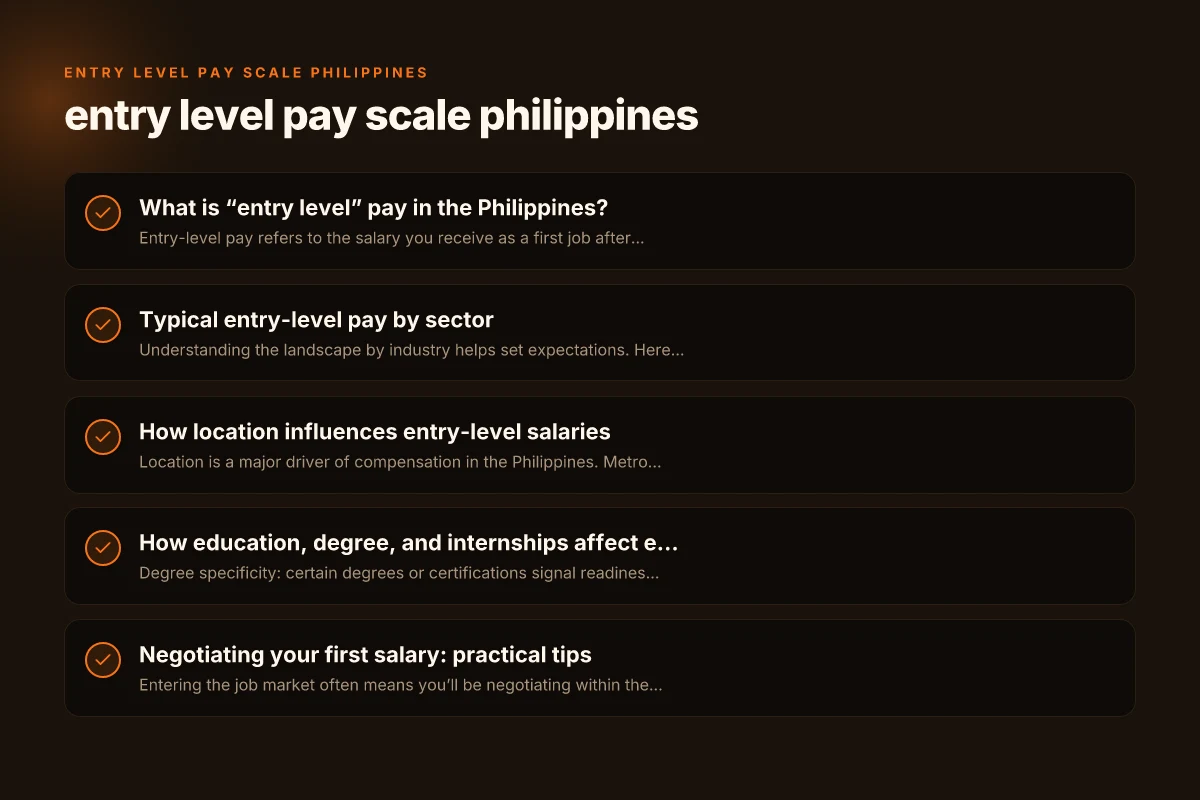
What is “entry level” pay in the Philippines?
Entry-level pay refers to the salary you receive as a first job after completing your studies, with little to no professional experience in the field. In the Philippine market, fresh graduates commonly see monthly salaries that fall within a general band, but with notable nuances:
- Common starting range: roughly ₱15,000 to ₱25,000 per month.
- Variability: some roles offer as low as ₱12,000–₱14,000, while others, especially in high-demand fields or certain BPO/tech-adjacent roles, can start higher, around ₱25,000–₱30,000 or more.
- The role and sector matter: data shows wide gaps between fields like customer service, administrative support, IT, engineering, marketing, and finance.
- Location matters: salaries in Metro Manila and other major cities tend to be higher than in rural areas, but the cost of living is also higher in those areas.
These ranges come from various sources people share online and aggregated job sites, and they can shift with macroeconomic factors, inflation, and demand for skills.
Typical entry-level pay by sector
Understanding the landscape by industry helps set expectations. Here are common patterns you’ll see when you search job boards, company postings, or salary reports:
- Customer service / BPO (inbound calls, chat, support): often ₱15,000–₱22,000 to start, with some larger centers offering ₱23,000–₱28,000 for specialized or night-shift roles.
- Administrative / clerical / data entry: typically ₱15,000–₱20,000. More technical admin roles reach ₱20,000–₱25,000.
- Finance and accounting (entry-level associates, bookkeeping): commonly ₱18,000–₱25,000. Top-entry roles can go higher if audit or finance technician skills are present.
- Marketing / digital marketing (entry-level): usually ₱15,000–₱22,000. Specialized roles or agencies in Metro Manila may push toward ₱25,000.
- IT / software support (help desk, entry IT): ₱20,000–₱30,000 is common, with growth potential as you gain real-world skills.
- Engineering (fresh graduates in certain disciplines): ₱18,000–₱25,000 in many fields. Some engineering streams may offer more with high demand or internship credentials.
- Healthcare support (non-clinical roles like medical transcription, admin): ₱15,000–₱22,000 for many roles.
Note: These ranges are approximate and reflect a mix of job postings, salary surveys, and discussions in online communities. Individual offers may differ based on the employer’s budget, the candidate’s credentials, and market conditions. Free VPN for Edge
How location influences entry-level salaries
Location is a major driver of compensation in the Philippines. Metro Manila and other major urban centers (Cebu City, Davao, etc.) tend to offer higher starting pay, reflecting higher living costs and concentration of employers. In contrast, provincial towns and smaller cities may present lower starting salaries, often supplemented by growing economies and lower expenses.
- Metro Manila: higher base ranges, especially in BPO, IT, and multinational firms.
- Other big cities: rising opportunities and competitive starting salaries, particularly in tech-adjacent roles.
- Rural provinces: more limited salary bands but sometimes enhanced by local incentives, government programs, or industry clusters.
If you’re considering relocating for a role, balance the starting pay with cost of living, commute, and career development prospects. A ₱3,000 to ₱7,000 difference in salary can be offset by lower living costs or better training opportunities elsewhere.
How education, degree, and internships affect entry pay
- Degree specificity: certain degrees or certifications signal readiness for higher-responsibility roles and can push entry pay up. For example, IT-related degrees or certifications (like CompTIA, Microsoft, or coding bootcamps) tend to correlate with higher starting offers in tech-adjacent roles.
- Internships and practical experience: internships, co-ops, or relevant part-time work during college can raise your starting offer, particularly if the employer values hands-on experience.
- Certifications: in finance, IT, or data roles, entry certifications or proficiency in in-demand tools can differentiate you and lead to better starting salaries.
If you’re a fresh graduate with strong internships or a standout project portfolio, highlight these in your resume and during interviews, they can nudge you toward the higher end of the entry-level range.
Negotiating your first salary: practical tips
Entering the job market often means you’ll be negotiating within the typical entry-level band. Here are practical steps to maximize your starting offer without overstepping: Nord VPN: A Reader’s Guide
- Do your homework: review multiple job postings for similar roles in your location to establish a realistic range. Use reputable salary resources and talk to mentors or career services if possible.
- Quantify your value: if you have internships, awards, college projects, or certifications, quantify them (e.g., “led a team of 4 on a project that reduced process time by 20%”).
- Consider total compensation: base salary is important, but also look at benefits (health insurance, leave, allowances), training budgets, performance bonuses, signing bonuses, and potential for rapid promotion.
- Be flexible with the offer: if the base is slightly below your target, negotiate for a slightly higher base, or ask for guaranteed training or a performance review after 6 months with a salary recheck.
- Demonstrate commitment: emphasize your willingness to learn, contribute to the team, and stay for at least a year. Employers value retention, especially for entry-level hires.
When to push back: if the offer is clearly below market benchmarks for your role and location, and you have solid justification (certifications, a competitive internship record, etc.), it’s reasonable to ask for a review or clarifications on growth paths.

A simple comparison table: example starting salaries by sector (illustrative ranges)
| Sector / Role | Typical starting monthly pay (PHP) | Notes |
|---|---|---|
| BPO / Customer Service | 15,000 – 22,000 | Night shifts can offer higher pay in some centers |
| Administrative / Data Entry | 15,000 – 20,000 | Higher when paired with specialized admin tools |
| Finance / Accounting | 18,000 – 25,000 | Certifications or internship credit can boost offers |
| Marketing / Digital | 15,000 – 22,000 | Agencies may reach toward 25,000 with experience or niche skills |
| IT / Software Support | 20,000 – 30,000 | In-demand if you have hands-on tools or coding exposure |
| Engineering (fresh grads) | 18,000 – 25,000 | Varies by field; hardware vs. software emphasis |
| Healthcare admin / non-clinical | 15,000 – 22,000 | Accessibility and medical administration experience help |
This table is representative of common ranges reported by job-seekers and employers. Actual offers will depend on your city, company, and the exact role.
How to maximize your early-career earnings later
Starting salary is just one step in a longer earning trajectory. Here are strategies to accelerate growth after your first job:
- Seek accelerated training: look for employers with formal onboarding programs, mentorship, or structured skill development tracks. These environments tend to promote faster promotions.
- Build a diverse skill set: aim to gain experience in adjacent functions (for example, a marketer who learns basic analytics, or a finance assistant who understands data tooling). Versatility can push promotions and salary increases.
- Document achievements: keep a running record of projects, outcomes, and metrics. Use this as leverage in performance reviews.
- Network strategically: connect with peers and leaders in your field. Mentorship and sponsorship can lead to opportunities that pay off beyond the first year.
- Consider higher-growth industries: technology, data, and specialized services can offer steeper compensation growth over time, especially with upskilling.
Final recommendations for fresh graduates
- Do not default to the lowest offer: if you have credible internship experience or relevant skills, aim toward the mid-to-upper end of the typical range in your field and location.
- Evaluate total compensation: consider health benefits, retirement plans, transportation allowances, meal stipends, and learning budgets when comparing offers.
- Prepare an effective resume and interview story: clearly articulate your projects, outcomes, and what you bring to a team.
- Plan for continuous learning: the Philippines’ job market rewards people who stay technically current and demonstrate reliability and curiosity.
If you’re a fresh graduate wondering about “entry level pay scale philippines,” this guide should give you a grounded starting point. Real-world offers will vary, but with diligent preparation, you can position yourself to secure a fair starting salary and a solid path for future earnings. Changeed dashlane password but cannot log in
Recommendation: Start by researching roles in your target field and city, identify the typical entry salary range, and prepare a concise portfolio of internships and projects that demonstrate your readiness. When you receive an offer, evaluate the entire compensation package and, if appropriate, negotiate for a higher base or additional benefits that support your early career growth.