Cisco VPN Client: What It Is, How It Works, and What to Use Today

Learn what the Cisco VPN Client does, why it is discontinued, and which Cisco VPN options to choose instead.
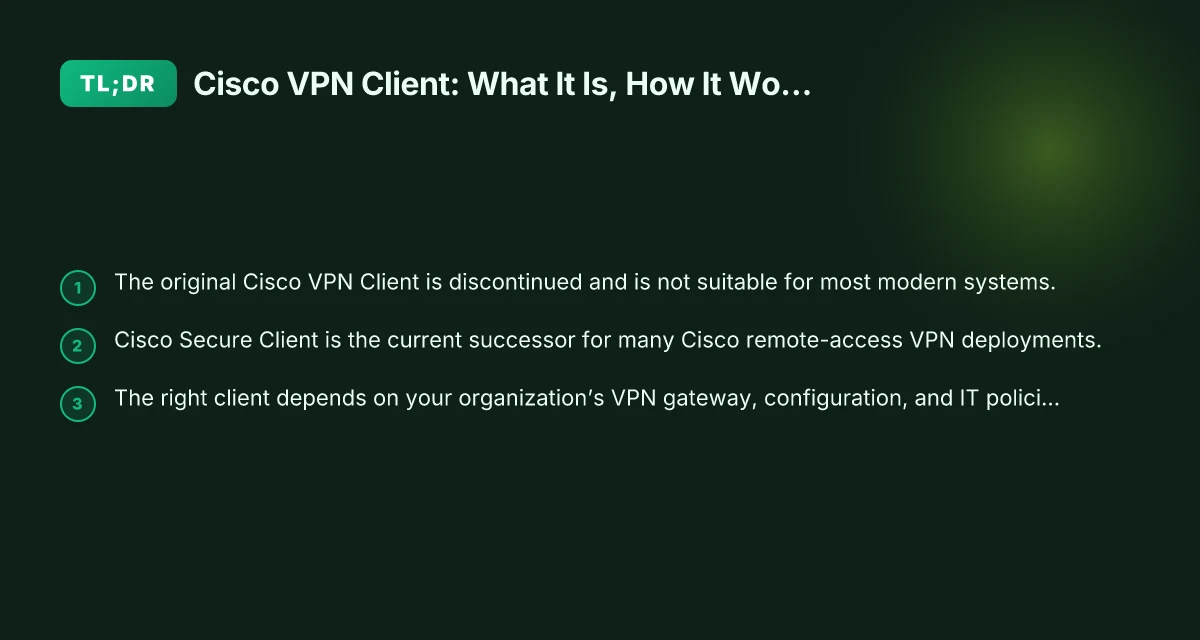
The Cisco VPN Client was software that let users securely connect to a company network over the internet. The original product is discontinued, so most people looking for a “Cisco VPN client” today should use Cisco Secure Client, formerly called Cisco AnyConnect, or another client specified by their organization. The correct choice depends on the VPN equipment and configuration your employer or network administrator uses.
Compare current Cisco VPN options by use case and access requirements
| Option | Best for | Works with legacy VPN? | How to get it | Key requirement |
|---|---|---|---|---|
| Cisco Secure Client | Current Cisco remote access | No | Organization or Cisco source | Supported gateway |
| Cisco AnyConnect | Cisco remote access where still deployed | No | Organization or Cisco source | Compatible VPN service |
| Cisco VPN Client | Older Cisco VPN setups | Yes | Legacy installation media | Compatible operating system |
| Built-in OS VPN | Networks using standard VPN protocols | No | Included with operating system | Matching VPN protocol |
| Third-party VPN client | VPNs supported by the client | Depends | Client vendor | Compatible server configuration |
| Consumer VPN app | Personal privacy VPN service | No | VPN provider | Subscription or account |
Compiled November 2026; check the provider's site for current details.
| VPN | Obfuscation | From / month | Plan | Free plan | Refund | Alipay | UnionPay | Crypto | Website opens in China | Trustpilot | |
|---|---|---|---|---|---|---|---|---|---|---|---|
 ZoogVPN | Turn on manually Shadow | $2.49/mo | 27 months: $59.99 | Yes | 7 days | ✓ | ✓ | ✓ | ✓ | Official site blocked; our special link opens (4.4 s) | 4.2/5 (195 reviews) |
 NordVPN | Turn on manually Obfuscated Servers / NordWhisper | $3.49/mo | 27 months: $94.23 | No | 30 days | ? | ✗ | ✓ | ✓ | ✗ Blocked | 4.2/5 (51,628 reviews) |
 ExpressVPN | ✓ On by default all servers | $3.00/mo | 28 months: $84 | No | 30 days | ✗ | ✗ | ✓ | ✗ | ✗ Blocked | 4.4/5 (29,706 reviews) |
 Surfshark | ✓ On by default Camouflage, with OpenVPN | See site | See site | No | 30 days | ✗ | ✗ | ✗ | ✓ | ✗ Blocked | 4.3/5 (31,823 reviews) |
 Proton VPN | Turn on manually Stealth, free plan too | $2.99/mo | 12 months: $35.88 | Yes | 30 days | ✗ | ✗ | ✗ | ✓ | ✗ Blocked | 2.1/5 (1,040 reviews) |
 Astrill VPN | Turn on manually StealthVPN / OpenWeb | $12.50/mo | 24 months: $300 | No | See site | ✗ | ✗ | ✗ | ✓ | ✗ Blocked | 1.3/5 (110 reviews) |
 Private Internet Access | Turn on manually Shadowsocks, OpenVPN only | $2.03/mo | 40 months: $81.2 | No | 30 days | ✗ | ✗ | ✗ | ✗ | ✗ Blocked | 4.2/5 (11,033 reviews) |
 CyberGhost | Turn on manually selected servers | $2.19/mo | 28 months: $61.32 | No | 45 days | ✗ | ✗ | ✗ | ✓ | ✗ Blocked | 4.0/5 (24,178 reviews) |
 PureVPN | Turn on manually switch to OpenVPN | $1.69/mo | 60 months: $101.55 | No | 31 days | ? | ? | ✗ | ✓ | ✗ Blocked | 4.4/5 (17,994 reviews) |
 AdGuard VPN | ✓ On by default TrustTunnel | $2.99/mo | 24 months: $71.76 | Yes | 30 days | ✓ | ✗ | ✓ | ✓ | Official site blocked; our special link opens (3.7 s) | 4.3/5 (290 reviews) |
 Mullvad | Turn on manually QUIC / Shadowsocks / LWO | $5.61/mo | €5/mo | No | 14 days | ✗ | ✗ | ✗ | ✓ | ✗ Blocked | 3.2/5 (192 reviews) |
 Windscribe | Turn on manually Stealth / WStunnel | $5.75/mo | 12 months: $69 | Yes | See site | ✗ | ✗ | ✗ | ✓ | ✗ Blocked | 4.7/5 (13,355 reviews) |
 StrongVPN | Turn on manually Scramble, OpenVPN TCP | See site | See site | No | 30 days | ✓ | ✗ | ✗ | ✗ | ✗ Blocked | 4.4/5 (2,695 reviews) |
 LightXtreme 闪连 | Not listed | $7.08/mo | 12 months: $84.99 | Yes | 30 days | ✓ | ✓ | ✓ | ✓ | ✓ Yes (3.5 s) | No page |
Prices checked 2026-11-10 on each vendor's pricing page (cheapest long plan, USD). Check the vendor's checkout for the final price.
Obfuscation checked 2026-11-14 on each vendor's site and help center: "on by default" = nothing to set; "turn on manually" = switch protocol or mode in settings; "not listed" = the vendor describes no obfuscation.
Payment methods checked 2026-11-10 on each vendor's payment pages: all 14 take cards and PayPal; ✗ = not listed, ? = the vendor's own pages disagree.
China access: whether the official website opens from mainland China networks (tests the website only, not the VPN connection). Last checked 2026-11-18 01:02 Beijing time.
Trustpilot score and review count checked 2026-11-10.
What the Cisco VPN Client does
A VPN client creates an encrypted connection between a device and a VPN gateway. Once connected, users may be able to access internal websites, file shares, applications, and other company resources as if they were on the organization’s network.
Cisco’s original VPN Client was designed for older Cisco VPN concentrators and related systems. It is different from Cisco Secure Client, the current product used in many Cisco remote-access VPN environments. Although the names are similar, the software and supported systems are not interchangeable in every setup.
A VPN client alone does not provide access. You also need an account, a VPN server address, and any required settings, certificates, or multifactor authentication. Your organization’s administrator determines which software and connection profile are approved.
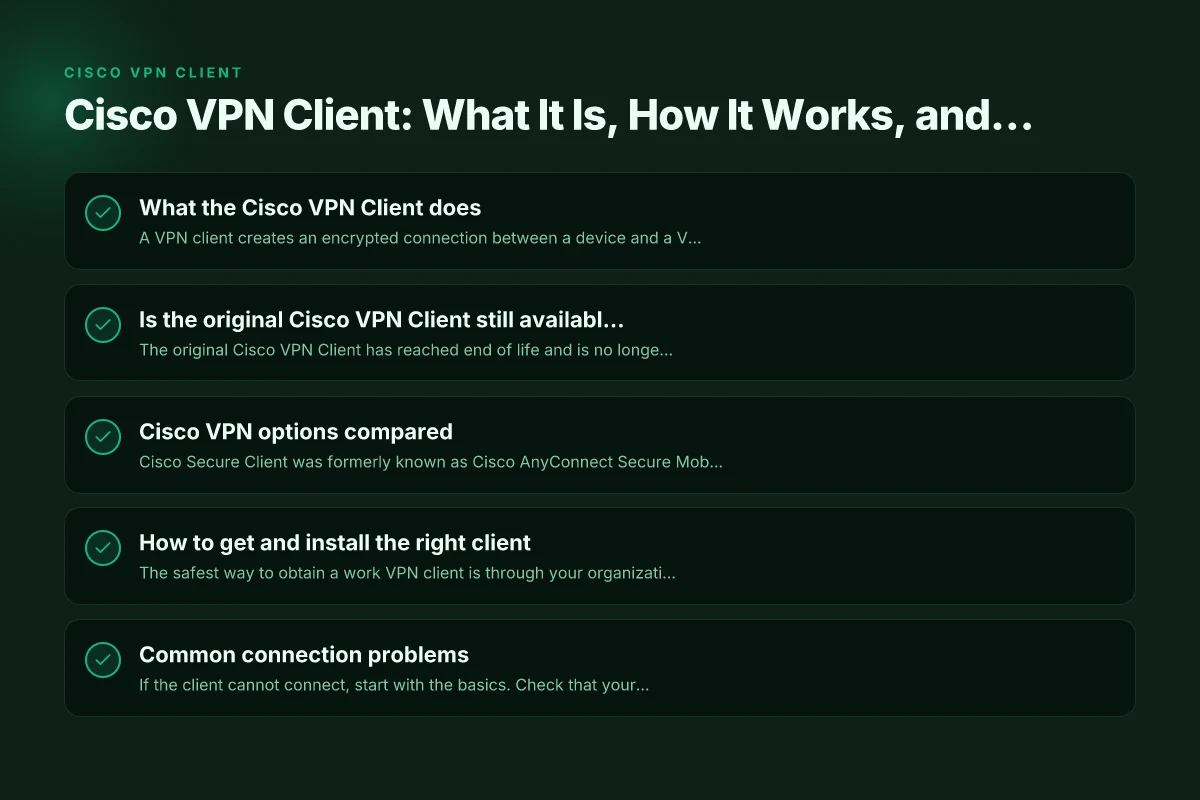
Is the original Cisco VPN Client still available?
The original Cisco VPN Client has reached end of life and is no longer the recommended choice for current computers. It was built for older operating systems and VPN infrastructure, and it may not install or work reliably on modern versions of Windows or macOS. Cisco Secure Client VPN: What It Is and How to Connect
Using an outdated installer from an unofficial download site can also expose your device to security risks. Such files may be modified, bundled with unwanted software, or incompatible with your network. Even a genuine legacy installer may lack current security support.
If a workplace still relies on the original client, ask its IT team whether the VPN service is being upgraded and what supported software you should install. Do not assume that an old client will work just because it once connected successfully.
Check what you need before choosing a client
| Question | Cisco Secure Client | Cisco AnyConnect | Cisco VPN Client | Built-in OS VPN |
|---|---|---|---|---|
| Is it a current Cisco option? | Yes | Still used in some deployments | No | Not Cisco-specific |
| Is it intended for organizational access? | Yes | Yes | Legacy deployments | Depends on VPN setup |
| Can it replace the original client directly? | Only if the gateway supports it | Only if the gateway supports it | No; it is the original | Only if protocols match |
| Is administrator guidance useful? | Yes | Yes | Yes | Yes |
| Does the VPN gateway matter? | Yes | Yes | Yes | Yes |
| Is compatibility worth checking first? | Yes | Yes | Especially important | Yes |
Compiled November 2026; check the provider's site for current details. VPN for Microsoft Edge: How to Choose and Use One
Cisco VPN options compared
| Option | Typical role | Best next step |
|---|---|---|
| Cisco VPN Client | Legacy software for older Cisco VPN systems | Avoid for new installations; contact IT if a legacy system requires it |
| Cisco Secure Client | Current Cisco client used for VPN and, depending on deployment, additional security features | Install only if your organization supports it |
| Built-in operating system VPN | Connects to certain VPN types using Windows, macOS, iOS, or Android settings | Use only when your administrator provides compatible settings |
| Third-party VPN app | Consumer privacy service or another organization’s VPN solution | Do not use as a replacement for a company-approved Cisco connection |
Cisco Secure Client was formerly known as Cisco AnyConnect Secure Mobility Client. Many people still say “AnyConnect” when referring to a Cisco remote-access VPN, but the available features and installation method can vary by organization.
How to get and install the right client
The safest way to obtain a work VPN client is through your organization. It may provide Cisco Secure Client through a company software portal, a managed-device tool, or a secure download page. Some VPN gateways also present an approved download after you visit the organization’s VPN portal.
Before installing, confirm:
- The product name and version your IT team supports.
- That the download comes from Cisco or an organization-approved source.
- Whether your device meets the operating-system and security requirements.
- Whether you need a VPN profile, server address, certificate, or separate authentication app.
- Whether your organization requires device management or administrator approval.
After installation, open the client and enter the server address or select the profile provided by IT. Sign in with your work credentials and complete any multifactor authentication prompt. Follow your organization’s instructions if the connection requires a certificate or a specific network profile. Where Is My VPN? Find It, Check It, and Fix Connection Problems
Avoid sharing VPN passwords, one-time codes, or configuration files with anyone who is not authorized to manage your account. A VPN protects the connection to the organization, but it does not make every action on the device automatically safe.
Common connection problems
If the client cannot connect, start with the basics. Check that your internet connection works, the VPN server address is correct, and your username and password are current. Confirm that your device’s date and time are set correctly, since incorrect settings can interfere with certificates and secure sign-in.
Other common causes include:
- Unsupported software: An old client may not work with a current operating system or gateway. Ask IT for the supported replacement.
- Expired or missing certificates: Your administrator may need to renew or install a device certificate.
- Multifactor authentication issues: Check that you are using the organization’s current sign-in method and that push notifications are enabled.
- Network restrictions: A hotel, public Wi-Fi network, or local firewall may block the connection. Try another trusted network if permitted.
- Outdated connection profiles: The server address or VPN profile may have changed. Request an updated one rather than guessing.
- Account or access changes: Your VPN access may need to be enabled, or your account may require a password reset.
If the problem persists, note the exact error message, your operating system, and the time of the failed attempt. Send those details to your IT help desk. Do not disable security software or change advanced VPN settings unless your administrator instructs you to. iPhone Clash: What It Means and How to Fix Common iPhone Conflicts
Troubleshoot common connection issues before switching clients
| Symptom | Check first | Possible client-side action | When to contact IT |
|---|---|---|---|
| Client cannot install | Operating system support | Use an approved current installer | Installer is unavailable |
| VPN option is missing | Organization’s approved client | Install the specified client | Unsure which client is required |
| Login is rejected | Username and authentication method | Retry with the correct credentials | Credentials appear correct |
| Connection times out | Network access and gateway address | Reconnect on a permitted network | Issue persists |
| Connection fails after update | Client and operating system compatibility | Use the organization’s supported version | Compatibility is unclear |
| Legacy client will not run | Operating system compatibility | Avoid unsupported workarounds | Legacy access is still required |
Compiled November 2026; check the provider's site for current details.
Recommendation
For most users, the original Cisco VPN Client is not the right download: it is discontinued and intended for legacy environments. Ask your employer or network administrator which client and profile are approved. In many Cisco deployments, that means Cisco Secure Client, but the gateway configuration and organizational policy determine the final answer.