What Is My VPN Location? How to Check and Understand It
Learn how to check your VPN location, why it may differ from your real location, and what to do if it appears incorrect.
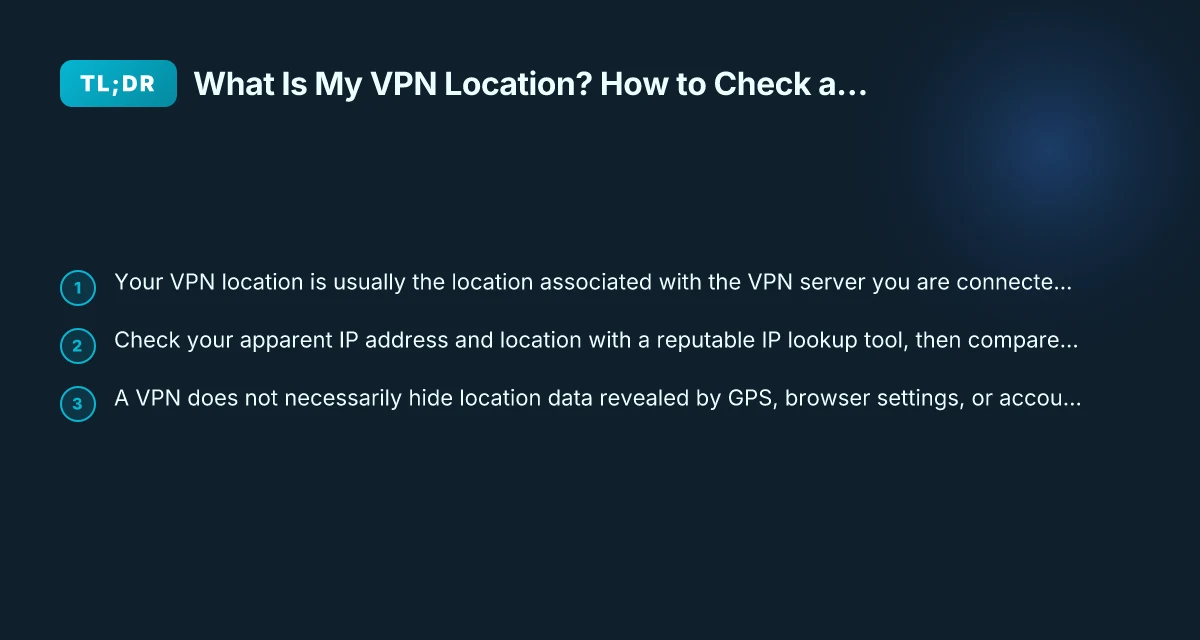
Your VPN location is generally the location of the VPN server your internet traffic exits through, not necessarily where you are physically located. To find out what it is, connect to your VPN and check your public IP address using an IP lookup website. The location shown is an estimate based on that IP address, so it may identify a nearby city, a data center, or simply the country where the server is registered.
VPN location check methods
| Method | What it shows | What it can confirm | Main limitation |
|---|---|---|---|
| IP lookup website | Public IP and estimated location | Whether your visible IP changed | Location databases can be inaccurate |
| Search engine location check | Search results’ assumed location | Whether results reflect the VPN region | May use account or browser signals |
| Map app | Approximate location | Whether an app sees a location | May rely on device location services |
| DNS leak test | DNS resolver and possible region | Whether DNS requests may reveal another region | Does not verify every location signal |
| WebRTC leak test | IP addresses exposed by WebRTC | Whether a browser may reveal an IP | Results depend on browser settings |
| VPN app status | Selected server and connection state | Whether the VPN reports a connection | Does not prove the public IP changed |
| Another device or browser | Location shown in a separate session | Whether the result is device-specific | Settings and accounts may differ |
Compiled November 2026; check the provider's site for current details.
| VPN | Obfuscation | From / month | Plan | Free plan | Refund | Alipay | UnionPay | Crypto | Website opens in China | Trustpilot | |
|---|---|---|---|---|---|---|---|---|---|---|---|
 ZoogVPN | Turn on manually Shadow | $2.49/mo | 27 months: $59.99 | Yes | 7 days | ✓ | ✓ | ✓ | ✓ | Official site blocked; our special link opens (4.4 s) | 4.2/5 (195 reviews) |
 NordVPN | Turn on manually Obfuscated Servers / NordWhisper | $3.49/mo | 27 months: $94.23 | No | 30 days | ? | ✗ | ✓ | ✓ | ✗ Blocked | 4.2/5 (51,628 reviews) |
 ExpressVPN | ✓ On by default all servers | $3.00/mo | 28 months: $84 | No | 30 days | ✗ | ✗ | ✓ | ✗ | ✗ Blocked | 4.4/5 (29,706 reviews) |
 Surfshark | ✓ On by default Camouflage, with OpenVPN | See site | See site | No | 30 days | ✗ | ✗ | ✗ | ✓ | ✗ Blocked | 4.3/5 (31,823 reviews) |
 Proton VPN | Turn on manually Stealth, free plan too | $2.99/mo | 12 months: $35.88 | Yes | 30 days | ✗ | ✗ | ✗ | ✓ | ✗ Blocked | 2.1/5 (1,040 reviews) |
 Astrill VPN | Turn on manually StealthVPN / OpenWeb | $12.50/mo | 24 months: $300 | No | See site | ✗ | ✗ | ✗ | ✓ | ✗ Blocked | 1.3/5 (110 reviews) |
 Private Internet Access | Turn on manually Shadowsocks, OpenVPN only | $2.03/mo | 40 months: $81.2 | No | 30 days | ✗ | ✗ | ✗ | ✗ | ✗ Blocked | 4.2/5 (11,033 reviews) |
 CyberGhost | Turn on manually selected servers | $2.19/mo | 28 months: $61.32 | No | 45 days | ✗ | ✗ | ✗ | ✓ | ✗ Blocked | 4.0/5 (24,178 reviews) |
 PureVPN | Turn on manually switch to OpenVPN | $1.69/mo | 60 months: $101.55 | No | 31 days | ? | ? | ✗ | ✓ | ✗ Blocked | 4.4/5 (17,994 reviews) |
 AdGuard VPN | ✓ On by default TrustTunnel | $2.99/mo | 24 months: $71.76 | Yes | 30 days | ✓ | ✗ | ✓ | ✓ | Official site blocked; our special link opens (3.7 s) | 4.3/5 (290 reviews) |
 Mullvad | Turn on manually QUIC / Shadowsocks / LWO | $5.61/mo | €5/mo | No | 14 days | ✗ | ✗ | ✗ | ✓ | ✗ Blocked | 3.2/5 (192 reviews) |
 Windscribe | Turn on manually Stealth / WStunnel | $5.75/mo | 12 months: $69 | Yes | See site | ✗ | ✗ | ✗ | ✓ | ✗ Blocked | 4.7/5 (13,355 reviews) |
 StrongVPN | Turn on manually Scramble, OpenVPN TCP | See site | See site | No | 30 days | ✓ | ✗ | ✗ | ✗ | ✗ Blocked | 4.4/5 (2,695 reviews) |
 LightXtreme 闪连 | Not listed | $7.08/mo | 12 months: $84.99 | Yes | 30 days | ✓ | ✓ | ✓ | ✓ | ✓ Yes (3.5 s) | No page |
Prices checked 2026-11-10 on each vendor's pricing page (cheapest long plan, USD). Check the vendor's checkout for the final price.
Obfuscation checked 2026-11-14 on each vendor's site and help center: "on by default" = nothing to set; "turn on manually" = switch protocol or mode in settings; "not listed" = the vendor describes no obfuscation.
Payment methods checked 2026-11-10 on each vendor's payment pages: all 14 take cards and PayPal; ✗ = not listed, ? = the vendor's own pages disagree.
China access: whether the official website opens from mainland China networks (tests the website only, not the VPN connection). Last checked 2026-11-18 01:02 Beijing time.
Trustpilot score and review count checked 2026-11-10.
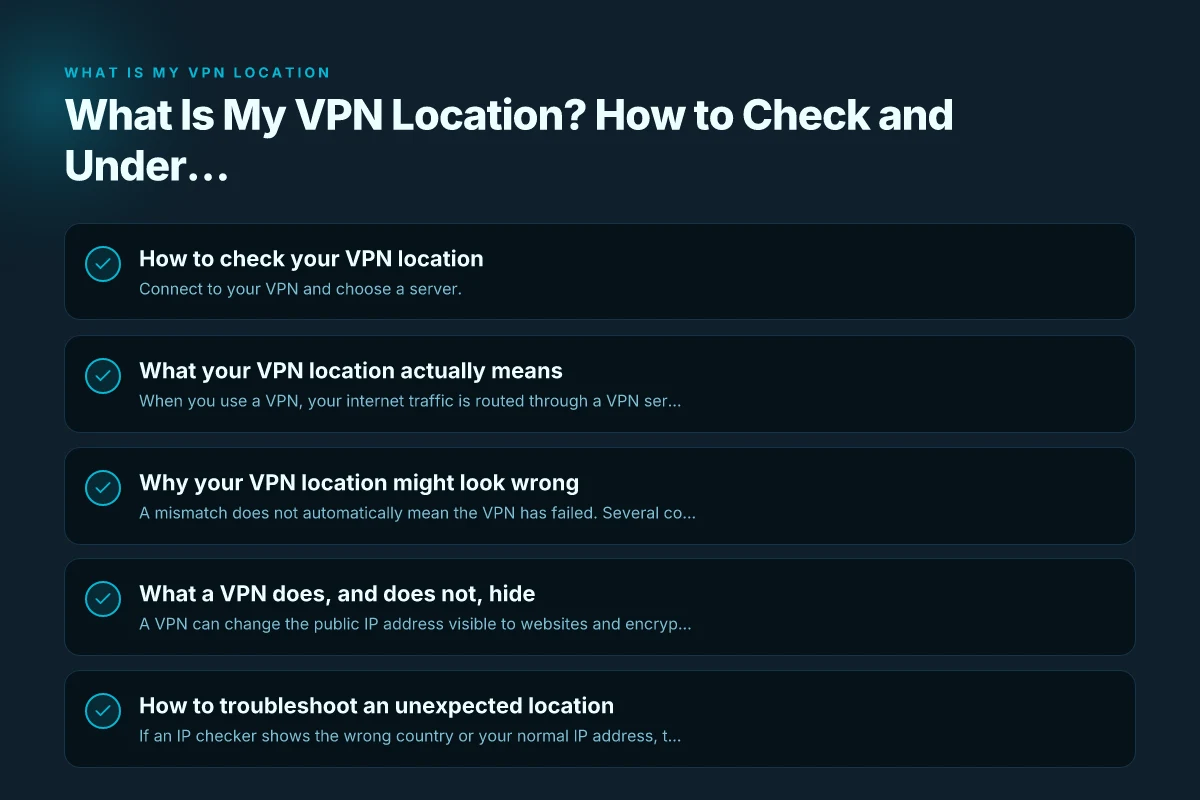
How to check your VPN location
- Connect to your VPN and choose a server.
- Open an IP-checking website in your browser.
- Look at the public IP address and the reported country, region, or city.
- If you want to confirm the result, check with a second lookup service.
The IP address displayed should normally be different from the one you see when the VPN is disconnected. The location reported by the lookup tool should also usually correspond to the server location you selected, although it may not match exactly.
For a quick check, search the web for “what is my IP” or use a service that reports both your IP address and its estimated location. Use a reputable site, and avoid entering passwords or personal details into an IP checker. A basic lookup should not require them.
What your VPN location actually means
When you use a VPN, your internet traffic is routed through a VPN server before it reaches the websites and services you visit. Those services generally see the server’s public IP address rather than your home or mobile connection’s IP address. They use that IP address to make an educated guess about your location.
This reported location is not a precise reading of your physical position. IP geolocation databases can be outdated or inconsistent. A server labeled “New York,” for example, may appear to be in a nearby city, or even a different region, in a lookup tool. Urban VPN Chrome Extension: What It Does and How to Use It
| What you check | What it can tell you | What it cannot reliably tell you |
|---|---|---|
| Public IP address | Which IP address websites can see | Your exact physical location |
| IP geolocation result | An approximate location associated with that IP | The precise location of the VPN server or user |
| VPN app’s server label | The location the provider offers you | Where the server hardware must physically be |
| Device GPS location | Your device’s location, if access is allowed | Whether your internet traffic is using a VPN |
A VPN provider may also use virtual locations. In that setup, a server is presented as being in one country or city, while the physical server infrastructure may be somewhere else. Check your provider’s documentation if you need to know how its server locations are defined.
What a VPN can hide or expose
| Signal or data | VPN effect | What may still reveal location | Useful check |
|---|---|---|---|
| Public IP address | Usually replaced with VPN server IP | VPN disconnects or IP leaks | IP lookup |
| Internet traffic route | Routed through VPN tunnel | Traffic outside the tunnel | VPN app and leak tests |
| DNS requests | May be routed through VPN | DNS leaks or custom DNS settings | DNS leak test |
| GPS location | Usually not changed | Device location permission | Device location settings |
| Browser location | Not always changed | Browser permission or device signals | Browser location prompt |
| Account-based location | Not changed | Profile, billing, or sign-in history | Account settings |
| Cookies and past activity | Not automatically cleared | Saved preferences and history | Private window or cleared data |
Compiled November 2026; check the provider's site for current details.
Why your VPN location might look wrong
A mismatch does not automatically mean the VPN has failed. Several common factors can affect the result: Urban VPN for Edge: How to Install and What to Know
- Different geolocation databases: Lookup services rely on databases that may disagree or take time to update.
- Virtual server locations: The provider’s advertised location may not be the server’s physical location.
- A nearby city is shown: IP databases often make a broad estimate rather than identifying the exact server.
- The VPN connection dropped: Your device may have briefly returned to your regular internet connection.
- The app is using a different connection: A browser extension, mobile app, or another VPN profile may route traffic differently.
- Cached website data: A site may remember your previous location or keep you signed in with location preferences.
- Your account or payment details: Some services use billing information, account settings, or past activity to infer a region.
First check the VPN app to confirm that it says you are connected to the server you intended to use. Then refresh the IP lookup page or test another one. If the IP address still appears to be your usual one, reconnect to the VPN or contact the provider’s support team.
What a VPN does, and does not, hide
A VPN can change the public IP address visible to websites and encrypt traffic between your device and the VPN server. It does not make every source of location information disappear.
A website or app may learn your location through other signals, including:
- GPS and device location: A mobile app can request permission to use your device’s location.
- Browser location permissions: A website may ask your browser for access to location data.
- Wi-Fi and cellular signals: Devices can use nearby networks or mobile signals to estimate position.
- Cookies and account history: A service may remember places you have used the account or infer a region from your activity.
- Payment and profile information: Your billing address or account settings may indicate a country.
- Browser or network leaks: In some cases, settings or connection issues can reveal information that differs from the VPN’s IP location.
If a service still seems to know where you are, check its location permissions and account settings. Also make sure the VPN is active in the app or browser you are using. A VPN changes how your internet connection appears. It does not automatically override GPS, erase stored account information, or grant access to every location-based service. FortiGate VPN: How It Works and How to Connect
Troubleshooting an unexpected VPN location
| What you notice | Possible cause | What to check | Next step |
|---|---|---|---|
| IP shows your usual region | VPN disconnected or server mismatch | VPN status and public IP | Reconnect or choose another server |
| IP shows a nearby city | IP database estimate differs | Results from another lookup site | Treat city-level estimates cautiously |
| Search results show your home area | Account or search history signals | Signed-in account and location settings | Test in a private window |
| Map app shows your actual position | GPS or device location is enabled | App and device permissions | Review location access |
| DNS test shows another region | DNS requests may bypass the VPN | VPN DNS settings and test results | Enable VPN DNS protection if available |
| Browser reveals a different location | WebRTC or browser location signals | Browser settings and leak test | Adjust permissions or browser settings |
| Location changes between checks | Different databases or network signals | Repeat tests with the same server | Compare IP, DNS, and app results |
| VPN will not connect | Network conflict or blocked connection | App status and network settings | Restart the app or try another server |
Compiled November 2026; check the provider's site for current details.
How to troubleshoot an unexpected location
If an IP checker shows the wrong country or your normal IP address, try these steps:
- Confirm the VPN is connected and the selected server is the one you intended.
- Disconnect and reconnect, or choose another server in the same region.
- Close and reopen the browser or app, then check again.
- Test with a second IP lookup service.
- Review your VPN provider’s settings for features such as split tunneling, which can send some apps outside the VPN.
- Check that no other VPN, proxy, or network-routing tool is active.
- If needed, ask your provider whether the server uses a virtual location or whether its IP geolocation data needs updating.
If you are checking for privacy, look beyond the city shown on the lookup page. Confirm that the public IP changes when you connect, review app and browser location permissions, and use the VPN provider’s troubleshooting guidance for leak checks. No single location test can verify every aspect of privacy. Cisco AnyConnect VPN: How It Works, How to Install It, and How to Connect
Recommendation
To find out what your VPN location is, connect to a server and check the public IP address with a reputable lookup tool. Treat the displayed city as an estimate, not proof of your exact location. If the result conflicts with your VPN app, compare another lookup service, check for connection or split-tunneling issues, and remember that GPS and account data can reveal location separately from your IP address.