VPN setup: how to set up a VPN for privacy, security, and access
A practical guide to setting up a VPN, covering software options, configuration steps, and best practices for home and mobile use.
VPN setup: how to set up a VPN for privacy, security, and access
If you’re asked, “How do I set up a VPN?” you’re likely balancing privacy, security, and the ability to access content from different regions. A VPN, or virtual private network, creates an encrypted tunnel between your device and a VPN server. This helps protect your data on public Wi‑Fi, hides your IP from the sites you visit, and can let you appear as if you’re browsing from another location. In this guide, you’ll find practical paths for both ready-made solutions and DIY approaches, plus tips to keep your connection secure and reliable.
Quick criteria for choosing VPN goals
| Goal / Criterion | Public VPNs (ready-made) | Self-hosted VPNs | Notes / Recommendation |
|---|---|---|---|
| Privacy focus | High | Medium to high (depends on host) | Self-hosted offers control; public depends on provider |
| Control over data | Limited | Full | Public: provider controls data; Self-hosted: you own data |
| Ease of setup | Very easy | Moderate to hard | Public: fast; Self-hosted: technical |
| Maintenance burden | Low | High | Public: updates by provider; Self-hosted: you manage |
| Cost model | Subscriptions | Hardware + OSS | Public: recurring; Self-hosted: upfront + run costs |
| Access features | Split tunneling, apps | Custom configs | Public: standard features; Self-hosted: flexible |
| Auditing / transparency | Varies | Possible | Self-hosted: you can audit |
| Scalability | High | Medium | Public scales easily; Self-hosted depends on setup |
| Use case fit | Anonymous browsing, streaming | Private network, LAN access | Choose by need |
Compiled November 2026; check the provider's site for current details.
What you want from a VPN (define your goal)
Before diving into setup details, clarify your goal. Different setups serve different needs:
- Privacy and security on public networks: prioritize reputable VPN services with strong encryption (e.g., AES-256), a no-logs policy, and a trustworthy jurisdiction.
- Bypassing geo-restrictions: you may want servers in specific countries. Be mindful that some services block streaming or have performance constraints.
- Remote work or site access: you might need a corporate VPN or a personal VPN that integrates with your work environment.
- Simple, no-configuration use: a browser extension or mobile app can be enough for casual use, though they may offer less control and fewer security guarantees.
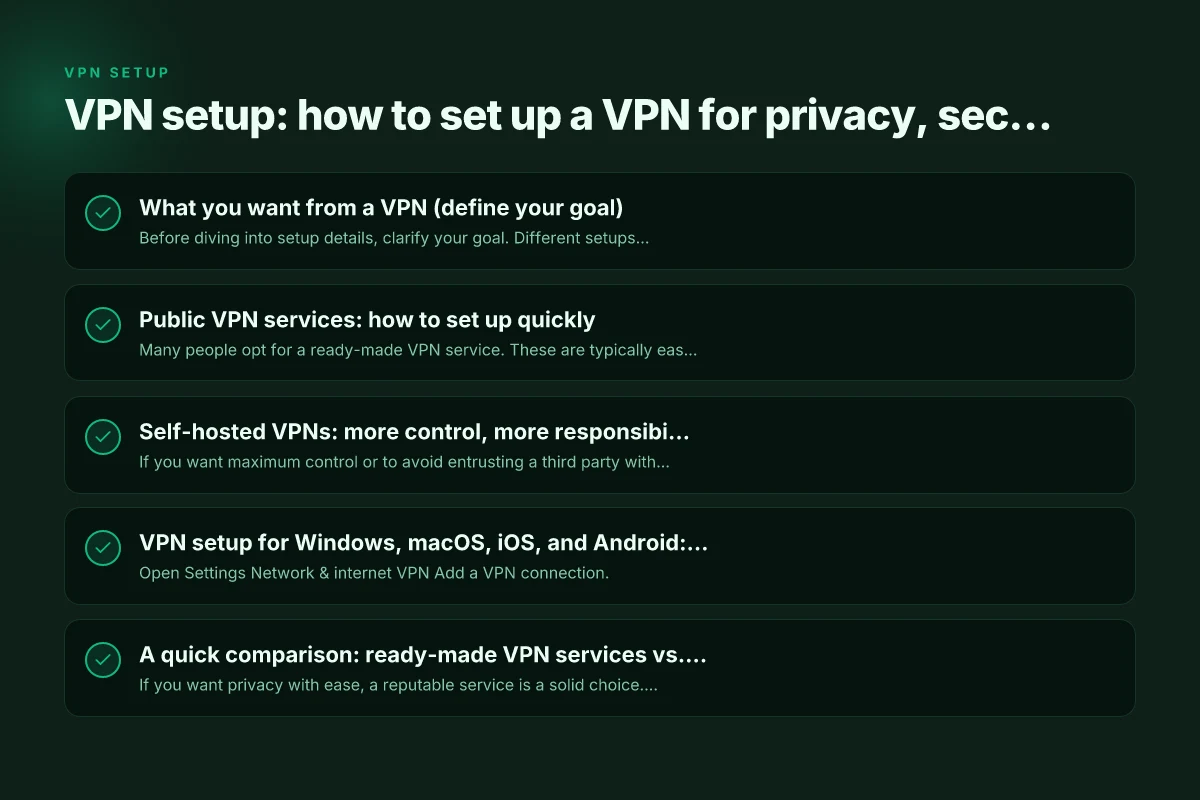
Public VPN services: how to set up quickly
Many people opt for a ready-made VPN service. These are typically easiest to set up on multiple devices and require little technical know-how.
- Choose a provider: look for a well-known provider with transparent security practices, verified audits, and acceptable privacy terms.
- Create an account: you’ll usually sign up with an email and password. Some services offer free tiers or trials. Weigh the features against your privacy expectations.
- Install on devices: providers offer apps for Windows, macOS, iOS, Android, and browser extensions. You can often install on routers or add-ons for extra devices.
- Connect and test: open the app, select a server location, and connect. Test that your IP appears to come from the chosen location and that DNS leaks aren’t occurring.
- Manage settings: enable features like kill switch (to disconnect if the VPN drops), auto-connect on startup, and DNS leak protection if available.
Pros:
- Easy to manage, cross‑platform, quick to deploy.
- Centralized billing and support.
Cons: VPN resources: a practical guide to understanding and using VPNs
- Ongoing cost, potential logging, and trust considerations.
- Some services throttle speeds or disconnect periodically.
Common questions:
- Is it free to set up a VPN? Many reputable providers offer paid plans. Free services exist but may have limits, data caps, or privacy concerns. Always read the privacy policy and terms.
- How to choose a country server? Pick a region close to you for speed, or a country that offers the content you need. Some providers also offer specialized servers for streaming.
Setup steps at a glance by type
| Step | Public VPN (ready-made) | Self-hosted VPN | Notes |
|---|---|---|---|
| 1. Sign up / install | Yes | No (install server) | Public: vendor sign-up; Self-hosted: deploy server |
| 2. App install | Yes | Optional | Public: client apps; Self-hosted: OS packages / configs |
| 3. Configure access | Quick setup | Manual config | Public: presets; Self-hosted: manual certs |
| 4. Create users | Yes | Yes | Public: per account; Self-hosted: per user / cert |
| 5. Server locations | Many | Custom | Public: broad; Self-hosted: you host only choices |
| 6. Security options | WPA2/SSL defaults | VPN protocol + certs | Public: defaults; Self-hosted: customize |
| 7. Testing | Connected test | Test connection | Both: verify tunnels |
| 8. Ongoing maintenance | Low | High | Public: provider handles; Self-hosted: you |
| 9. Backup plan | Provided | Your responsibility | Public: provider backups; Self-hosted: snapshot |
| 10. Troubleshooting | Vendor docs | Server logs | Public: vendor support; Self-hosted: logs |
Compiled November 2026; check the provider's site for current details.
Self-hosted VPNs: more control, more responsibility
If you want maximum control or to avoid entrusting a third party with your data, a self-hosted VPN can be attractive. This requires more setup but can be cheaper in the long run and gives you full control over logs and policy. UDP ssh jantit free internet HTTP custom high speed daily
- Common options:
- OpenVPN: widely supported, highly configurable, strong security.
- WireGuard: modern, lean, very fast, easier configuration in many cases.
- Hardware and hosting: you can run a VPN on a home server (PC, Raspberry Pi) or rent a server in the cloud (digital infrastructure like AWS, Linode, etc.).
- Setup outline:
- Install the VPN software on the server (OpenVPN or WireGuard are common).
- Generate server and client keys or certificates.
- Configure server settings (cipher suites, ports, DNS).
- Create client profiles and transfer them securely to your devices.
- Ensure firewall rules permit VPN traffic and enable a kill switch or similar safety net on clients.
- Pros:
- Greater privacy control. Potentially no monthly fees.
- Full visibility into data flow and logs.
- Cons:
- More hands-on work. Maintenance and security patches are your responsibility.
- Potentially more complex networking (NAT, routing, DNS).
If you’re comfortable with command line and network concepts, self-hosting can be rewarding. If not, a reputable paid service often provides a simpler path with strong privacy assurances.
VPN setup for Windows, macOS, iOS, and Android: step-by-step
Windows
- Open Settings > Network & internet > VPN > Add a VPN connection.
- For VPN provider, choose Windows (built-in) or a third-party app if you’re using a service.
- Enter the connection name, server address, VPN type (e.g., IPSec, OpenVPN if using third-party client), and sign-in info.
- Save, then select the VPN and click Connect.
- Optional: enable a kill switch in the app or use Windows’ built-in network settings to block internet if the VPN disconnects.
macOS
- Go to System Settings (or System Preferences) > Network.
- Click the + button to add VPN, select VPN type (IKEv2, IPSec, or/and L2TP over IPSec depending on your setup), and enter server address, remote ID, and local ID as required.
- Authenticate with your username/password or certificates.
- Apply and connect. Verify your IP shows the VPN server.
iOS and Android Ssh UDP custom accounts free internet
- Install the provider’s app or use built-in VPN settings.
- In iOS: Settings > VPN > Add VPN Configuration, then enter type, server, remote ID, and local ID, with your credentials.
- In Android: Settings > Network & Internet > VPN, add VPN, select type, and fill in server address and authentication.
- Connect and confirm your traffic routes through the VPN.
Testing tips across devices
- Check IP address: run a site like whatismyipaddress.com before and after connecting to confirm the IP changes.
- Check DNS leaks: use dnsleaktest.com or similar to ensure DNS queries aren’t leaking outside the VPN tunnel.
- Confirm kill switch behavior by disabling the VPN and verifying that traffic stops if the VPN drops.
A quick comparison: ready-made VPN services vs. self-hosted
| Aspect | Ready-made VPN service | Self-hosted VPN |
|---|---|---|
| Setup time | Minutes to hours, depending on device count | Hours to days, depending on experience |
| Ongoing cost | Monthly/annual subscription | Usually only hosting costs, hardware, or electricity |
| Control over data | Limited to provider’s policy | Full control over logs and policy |
| Security updates | Provider handles updates | You manage software updates and patches |
| Performance | Often optimized for speed; may be shared | Depends on your server hardware and bandwidth |
| Privacy risk | Trust in the provider | Minimal third-party trust; your own setup |
If you want privacy with ease, a reputable service is a solid choice. If you want to minimize data exposure to third parties and enjoy full control, self-hosting can be the better path.
Feature coverage comparison (ready-made vs. self-hosted)
| Feature | Ready-made VPN | Self-hosted VPN | Availability notes |
|---|---|---|---|
| Kill switch | Yes / supported | Yes / configurable | Public: client option; Self-hosted: config-based |
| DNS leak protection | Yes / standard | Yes / configurable | Public: default; Self-hosted: tailor DNS |
| Split tunneling | Yes | Yes / configurable | Public: typical; Self-hosted: granular control |
| Multi-hop / obfuscation | Limited / optional | Possible | Public: vendor add-ons; Self-hosted: DIY |
| Native OS support | Yes across major | Yes / depends on setup | Public: apps; Self-hosted: manual setups |
| Mac / Windows / iOS / Android | All supported | All supported | Public: ready-made clients; Self-hosted: depends on protocol |
| Logs retention | Limited by policy | Configurable | Public: provider policy; Self-hosted: you decide |
| Auditability | Opaque to users | Full visibility (if you audit) | Public: external audits vary; Self-hosted: internal |
| Compliance features | Varies (jurisdiction) | Customizable | Public: depends on provider; Self-hosted: you choose region |
Compiled November 2026; check the provider's site for current details. Ssh UDP account free secure fast internet HTTP custom
Common pitfalls and best practices
- Trust and privacy: Research the provider’s privacy policy, jurisdiction, and independent audits. For self-hosted setups, protect the server from exposure and follow best practices for patching and hardening.
- Kill switch: Always enable a kill switch. If your VPN drops, you don’t want traffic leaking outside the encrypted tunnel.
- DNS handling: Ensure the VPN uses trusted DNS servers to prevent DNS leaks. Some providers offer built-in DNS leak protection.
- Multi-hop and obfuscation: For added privacy, some users opt for multi-hop or obfuscated connections to reduce traffic fingerprinting. These features are provider-specific or require advanced configurations in self-hosted setups.
- Device security: Keep your devices secure with strong passwords, firmware updates, and, where appropriate, antivirus or endpoint protections.
- Performance expectations: VPNs can slow down your connection due to encryption and routing distance. Choose a nearby server when possible and test several servers for best speeds.
- Legal and policy awareness: Some services’ terms prohibit certain activities. Be aware of local laws and provider policies.
Troubleshooting common issues
- Cannot connect: verify credentials, server address, and VPN type. Check your internet connection without the VPN to rule out general connectivity issues.
- Slow speeds: try a server closer to your location, switch to a lighter encryption protocol if available, or test at different times of day.
- DNS leaks: switch to a VPN with DNS leak protection or manually configure trusted DNS servers in your device settings.
- Disconnects regularly: enable the kill switch, update the VPN client, and check for background apps that might interrupt the connection.
- Access issues with streaming: some streaming services block VPN IPs. Try different servers or a provider that explicitly supports streaming.
Final recommendations
- For most users starting out: opt for a reputable public VPN service. It’s fast to deploy, easy to manage across devices, and comes with customer support and a straightforward privacy stance.
- For long-term privacy and customization: consider a self-hosted VPN with WireGuard or OpenVPN. This approach requires more technical effort but grants you complete control over logs and data flow.
- Always test after setup: verify your IP, DNS, and kill switch behavior. Periodically re-check your privacy posture and keep all software up to date.
- Consider hybrid use: some people use a personal VPN for everyday browsing and a second, separate corporate or work-approved VPN for enterprise access, ensuring compliance with policies and security standards.
If you’d like, I can tailor the guidance to your exact devices, preferred providers, and whether you want a quick setup or a more hands-on self-hosted solution.
| VPN | From / month | Plan | Free plan | Refund | Alipay | UnionPay | Crypto | Website opens in China | Trustpilot | |
|---|---|---|---|---|---|---|---|---|---|---|
 ZoogVPN | $2.49/mo | 27 months: $59.99 | Yes | 7 days | ✓ | ✓ | ✓ | ✓ | ✓ Yes (2.5 s) | 4.2/5 (195 reviews) |
 NordVPN | $3.49/mo | 27 months: $94.23 | No | 30 days | ? | ✗ | ✓ | ✓ | ✗ Blocked | 4.2/5 (51,628 reviews) |
 ExpressVPN | $3.00/mo | 28 months: $84 | No | 30 days | ✗ | ✗ | ✓ | ✗ | ✗ Blocked | 4.4/5 (29,706 reviews) |
 Surfshark | See site | See site | No | 30 days | ✗ | ✗ | ✗ | ✓ | ✗ Blocked | 4.3/5 (31,823 reviews) |
 Proton VPN | $2.99/mo | 12 months: $35.88 | Yes | 30 days | ✗ | ✗ | ✗ | ✓ | ✓ Yes (2.5 s) | 2.1/5 (1,040 reviews) |
 Astrill VPN | $12.50/mo | 24 months: $300 | No | See site | ✗ | ✗ | ✗ | ✓ | ✗ Blocked | 1.3/5 (110 reviews) |
 Private Internet Access | $2.03/mo | 40 months: $81.2 | No | 30 days | ✗ | ✗ | ✗ | ✗ | ✗ Blocked | 4.2/5 (11,033 reviews) |
 CyberGhost | $2.19/mo | 28 months: $61.32 | No | 45 days | ✗ | ✗ | ✗ | ✓ | ✗ Blocked | 4.0/5 (24,178 reviews) |
 PureVPN | $1.69/mo | 60 months: $101.55 | No | 31 days | ? | ✗ | ✗ | ✓ | ✓ Yes (2.6 s) | 4.4/5 (17,994 reviews) |
 AdGuard VPN | $2.99/mo | 24 months: $71.76 | Yes | 30 days | ✓ | ✗ | ✓ | ✓ | Official site blocked; our special link opens (2.3 s) | 4.3/5 (290 reviews) |
 Mullvad | $5.61/mo | €5/mo | No | 14 days | ✗ | ✗ | ✗ | ✓ | ✗ Blocked | 3.2/5 (192 reviews) |
 Windscribe | $5.75/mo | 12 months: $69 | Yes | See site | ✗ | ✗ | ✗ | ✓ | ✗ Blocked | 4.7/5 (13,355 reviews) |
 StrongVPN | See site | See site | No | 30 days | ✓ | ✗ | ✗ | ✗ | ✗ Blocked | 4.4/5 (2,695 reviews) |
 LightXtreme 闪连 | $7.08/mo | 12 months: $84.99 | Yes | 30 days | ✓ | ✓ | ✓ | ✓ | ✓ Yes (2.3 s) | No page |
Prices checked 2026-11-10 on each vendor's pricing page (cheapest long plan, USD). Check the vendor's checkout for the final price.
Payment methods checked 2026-11-10 on each vendor's payment pages: all 14 take cards and PayPal; ✗ = not listed, ? = the vendor's own pages disagree.
China access: whether the official website opens from mainland China networks (tests the website only, not the VPN connection). Last checked 2026-11-11 04:07 Beijing time.
Trustpilot score and review count checked 2026-11-10.