Streaming en 8k
A practical guide to 8K streaming, what’s possible today, required bandwidth, devices, and tips for the best experience.
The promise of 8K streaming is compelling: more detail, crisper textures, and a theater-like experience from the comfort of your home. But the reality right now is a mix of content availability, network requirements, and device compatibility. In this article, we answer the common questions about streaming en 8k and lay out what you need to know to decide if it fits your home entertainment setup.
What 8K streaming is today
8K refers to a display resolution of 7680 x 4320 pixels, delivering four times the number of pixels of 4K and 16 times that of Full HD. When we talk about streaming en 8k, we’re usually referring to video delivered over the internet that is mastered or presented at 8K resolution, either natively or upscaled.
- Content availability: The catalog of truly native 8K streams is still small. Many platforms label content as 8K or provide upscaled 8K from 4K sources.
- Encoding and codecs: Efficient codecs like HEVC (H.265) and, in some cases, AV1 are used to compress 8K streams.
- Playback: A capable 8K-capable display or a high-end upscaling path is necessary to interpret the stream correctly. Some devices may show 8K as a result of advanced upscaling rather than native 8K decoding.
What you need to stream in 8K
Streaming en 8k is not just about a fast connection. It’s a combination of bandwidth, hardware, and services.
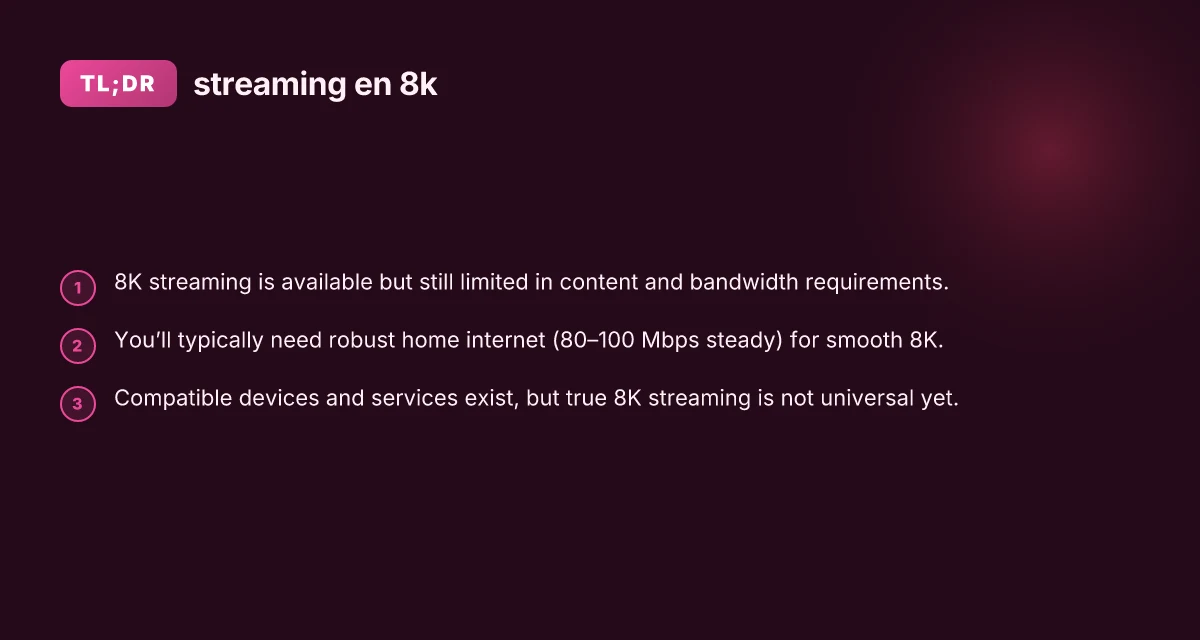
- Internet speed: Expect steady download speeds in the 80–100 Mbps range for 8K content, with headroom for other devices and peak usage. Some sources suggest this as a practical baseline, though actual needs can vary by provider and compression.
- Stability and latency: A stable connection with low jitter improves the 8K viewing experience. Wireless connections can work, but Ethernet is often the most reliable choice for high-bitrate streams.
- Display: An 8K-capable TV or monitor is essential to truly see the resolution. If your screen is 4K or 1080p, the 8K stream will be upscaled to your panel’s native resolution, and you won’t see true 8K detail.
- Source/streaming service: You’ll rely on a streaming service that offers 8K content or an app that can play 8K videos. YouTube is among the platforms where 8K content can be found, sometimes in 8K60.
How this translates to real-world setups
- Home users with a modern gigabit connection may still not hit 8K smoothly if the service is not optimized or if the device struggles with decoding.
- Some 8K videos require high processing power on the device side, so you might need a newer smart TV, streaming box, or PC with adequate CPU/GPU capabilities.
Are there dedicated 8K streaming devices?
Yes, there are devices and platforms designed to handle high-bitrate 8K streams. However, 8K support is not universal across all streaming boxes or smart TVs yet.
- Hardware requirements: A fast CPU/GPU or an 8K-capable media player helps manage the decoding and post-processing needed for 8K content.
- Software support: Some platforms integrate HEVC/AV1 decoding with 8K-friendly upscaling or native 8K playback.
- Practical note: Even when a device claims 8K support, the availability of 8K content through its apps will determine whether you can actually stream 8K.
Content landscape: what 8K is actually streaming right now
- 8K content is growing but still relatively niche compared to 4K. YouTube hosts a portion of 8K videos, and some channels curate 8K footage (nature, slow-motion, etc.).
- Live 8K streaming is demonstrated in industry showcases, but widespread consumer access remains limited.
- Some manufacturers and content creators focus on 8K as a goal for future-proofing, rather than a standard capability for every streaming app.
A note on “8K” labeling
Be aware of marketing labels. Some videos labeled 8K may be upscaled from 4K or downsampled content or may be produced at very high bitrate but not fully native 8K footage. The actual perceptible difference can depend on the source, compression, and display. Proton VPN extension Microsoft Edge: what you need to know and a better alternative
Bandwidth and network considerations
If you’re deciding whether to pursue 8K streaming, your network is the most critical variable.
- Baseline bandwidth: 80–100 Mbps steady download is a commonly cited baseline for comfortable 8K streaming.
- Consistency: Stability matters as much as peak speed. A 200 Mbps connection with frequent drops can underperform a steadier 100 Mbps line.
- Data caps: Many home internet plans impose monthly caps. Streaming at 8K can consume more data than 4K, so consider your plan’s limits.
- Wi-Fi vs Ethernet: Wired Ethernet reduces variability and is recommended for 8K streaming. If you must use Wi-Fi, ensure you have a strong signal and minimal interference.
TABLE: 8K streaming considerations by category
| Category | Recommendation | Why it matters |
|---|---|---|
| Internet speed | Steady 80–100 Mbps; higher if multiple devices | Keeps 8K bitrate stable |
| Connection type | Ethernet preferred; Wi-Fi 6/6E as good substitute | Reduces jitter and packet loss |
| Display | 8K-capable panel; good upscaling if 8K native not available | You only see true 8K on an 8K panel |
| Codec | HEVC (H.265) or AV1 | Efficient compression for high resolution |
| Content source | 8K-ready apps (YouTube and select platforms) | Availability of actual 8K streams |
| Hardware | Modern streaming device or smart TV with capable GPU/decoder | Handles decoding and upscaling smoothly |
Practical tips to optimize 8K streaming
- Test your baseline: Start by streaming 8K content on a wired connection to gauge stability. If it buffers, troubleshoot network congestion, router QoS settings, or switch to wired where possible.
- Manage expectations for content: Don’t expect a flood of 8K content today. Plan for occasional 8K viewing rather than a constant stream, focusing on the best 8K titles available.
- Use a capable device: Ensure your TV or streaming device is built with modern decoding hardware. A device marketed as 8K should align with the latest codecs and offer efficient upscaling options.
- Consider ambient factors: 8K requires more processing power for upscaling on the fly. In rooms with glare or high ambient light, perceived sharpness can vary, so optimize lighting to appreciate fine detail.
- Update software regularly: 8K streaming benefits from firmware and app updates that improve decoding efficiency, buffering, and compatibility with new codecs.
Practical comparison: 8K streaming vs. 4K streaming
- Content availability
- 8K: Limited catalog. Some platforms host 8K videos mainly on YouTube or selective apps.
- 4K: Much larger library across streaming services and HDR formats.
- Bandwidth needs
- 8K: Higher, typically 80–100 Mbps baseline for smooth playback. Occasional peaks depend on content.
- 4K: Lower than 8K but still demanding, commonly 25–50 Mbps for stable streams, depending on compression and HDR.
- Display requirements
- 8K: Requires an 8K-capable display to see the full benefit.
- 4K: Greatly improves visual clarity on many mid-range TVs. More widely supported by devices.
- Content creation
- 8K: Proliferation slower. Live 8K streams are demonstrated but not widespread.
- 4K: Abundant content across apps, films, gaming, sports.
Common questions people ask about streaming en 8k
Q: Is there anything streaming in 8K? A: Yes, there are 8K videos on platforms like YouTube and other niche channels, plus some live demonstrations and media samples. Real-world, broad availability is still evolving.
Q: Is there an 8K streaming device? A: There are devices and TVs marketed as 8K-capable, often with support for 8K codecs and upscaling. Actual access to 8K streams depends on app availability and bandwidth. Starlink mini dish and router mini linked to deco mesh
Q: Can I watch Netflix in 8K? A: Netflix currently focuses on 4K with HDR; 8K streaming on Netflix is not widely available as a standard option. Availability can vary by region and device, and not all 8K displays or plans will support it.
Q: Is 8K actually better than 4K? A: In theory, yes, 8K offers more detail and sharper textures if you sit close enough or have a large screen. In practice, the benefit depends on the source quality, viewing distance, display size, and the ability to produce native 8K content or high-quality upscaling.
Final thoughts and recommendation
Streaming en 8k represents the frontier of home entertainment. It’s a real capability on certain platforms and devices today, but it’s not yet as ubiquitous as 4K streaming. If you’re upgrading to 8K, approach it as a multi-part project: ensure your internet plan can sustain high bandwidth, invest in a capable 8K display, and choose streaming devices or apps that offer 8K content and efficient decoding. For many households, a robust 4K setup with strong HDR performance remains the most practical path, yet if you crave the pinnacle of resolution and you have bandwidth to spare, 8K streaming is a compelling option to keep an eye on as content and hardware evolve.
If you’d like, I can tailor a setup guide based on your exact devices (TV model, streaming box, router, and service subscriptions) to help you optimize for 8K streaming in your home. Purdie worldwide refund policy after cancellation policy