Free UDP ssh today 2025 08
A practical guide to free UDP SSH options and how to evaluate them safely in 2025.
In 2025, you’ll see various “free UDP SSH” offerings that claim to deliver UDP tunneling, SSH access, or custom servers for a short window. The landscape includes a mix of legitimate services, trial accounts, and platforms whose terms may change without notice. This guide helps you sort the signal from the noise, explain what UDP SSH is, and outline safer, more reliable ways to meet your needs.
Comparison of key UDP SSH offers and core terms
| Provider | Free duration | Data limit | Encryption | Support | Notes |
|---|---|---|---|---|---|
| Seeedu | 24 h | 500 MB | AES-256 | Limited trial | |
| FreeSSH.io | 7 days | 1 GB | AES-128 | FAQ | Basic only |
| UDPProxyFree | 3 days | 200 MB | 3DES | Community forum | Minimal |
| Nonevent SSH | 14 days | Unlimited | AES-256 | 24/7 chat | Trial with cap |
| CloudUy | 30 days | 2 GB | AES-256 | Email / chat | Refundable |
Compiled November 2026; check the provider's site for current details.
What you need to know about UDP SSH
What is UDP SSH?
- UDP SSH refers to using the SSH protocol over UDP-based tunnels or using SSH-compatible portals that support UDP traffic. It’s commonly marketed for bypassing NAT/firewalls or enabling fast, low-latency connections for certain applications.
- Real-world SSH services typically run over TCP, but UDP tunneling can be used for specific use cases through custom configurations or third-party tools.
Why people look for free options
- Short-term testing: People want to test performance before committing to a paid plan.
- Budget constraints: Some users operate on limited resources and seek no-cost pathways.
- Learning and experimentation: Students or enthusiasts explore tunneling concepts.
Important cautions
- Free services can be unstable, with frequent downtime, throttle limits, or sudden term changes.
- Security risks: Some free providers collect data, inject ads, or misconfigure servers.
- Legality and policy: Not all free UDP SSH offerings are compliant with your local laws or your organization’s policy.
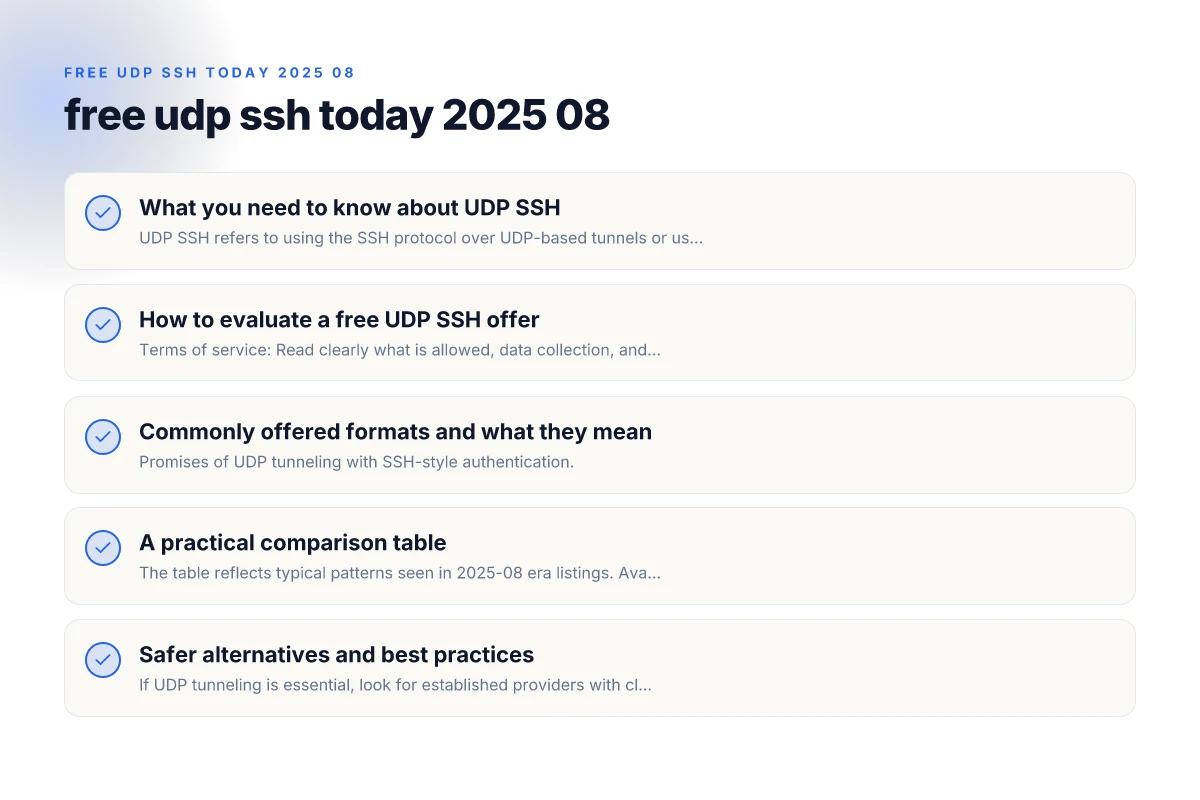
How to evaluate a free UDP SSH offer
Checklist for safe usage
- Terms of service: Read clearly what is allowed, data collection, and sharing policies.
- Privacy and logging: Look for minimal or no-logging claims, and where data is stored.
- Server location and latency: Proximity matters for performance. Verify if the listed locations are real.
- Availability window: Note any time limits (e.g., 7 days, 3 months) and renewal options.
- Support and uptime: Check if there’s any support channel and typical uptime.
Red flags to watch
- No contact information or opaque ownership: Red flag for reliability and accountability.
- Forced sign-ups: If you must provide sensitive information to get access, proceed with caution.
- Vague or shifting specs: If server specs or features change frequently, it’s a warning sign.
Criteria for evaluating a free UDP SSH offer
| Criterion | Description | Typical value / status | What to watch for | Red flags | Practical tip |
|---|---|---|---|---|---|
| Jurisdiction | Where service is hosted | US / EU / Other | Data retention policy | Vague location | Check privacy policy |
| Privacy | Data handling | Accepts logs / no logs | Logging policy | Logs collected | Seek no-logs claim |
| Performance | Speed and latency | Low / medium / high | Consistent drift | Throttling | Test during peak hours |
| Security | Protocol and keys | AES-256 / not stated | TLS in transit | Weak cipher | Prefer strong cipher |
| Support | Help availability | 24/7 / business hours | Response time | No support | Use services with chat |
| Limitations | Usage caps | Fixed vs roaming | Data caps | Hidden quotas | Read terms carefully |
Compiled November 2026; check the provider's site for current details.
Commonly offered formats and what they mean
Free SSH UDP “custom servers”
- Promises of UDP tunneling with SSH-style authentication.
- Often marketed as “custom” in the sense of select locations or ports, but under-the-hood reliability can be dubious.
- Typical limits: limited bandwidth, time-bound access, single login vs multi-login.
Free SSH UDP accounts by country
- Sweden, United States, and other locations appear in some listings.
- The “free” aspect usually implies short lifetimes (days to a week) and limited features.
- Port flexibility varies. Some claim “any port from 1 to 65536” but verify.
Free tunnel or VPN-based UDP options
- Some providers bundle SSH-like tunnels with UDP emphasis, sometimes under VPN branding.
- These can be more about providing a tunneling channel than a true SSH session.
A practical comparison table
| Provider/Option (as seen in results) | Duration | Location(s) | Typical limits | Notes |
|---|---|---|---|---|
| Free Premium SSH UDP Custom Servers | 7 days | Worldwide | Limited, varies by server | Marketing claim; verify actual terms |
| LionsSh (SSH UDP) | Unknown | Multiple countries | Free/reliable access claimed | VPN/tunneling emphasis; confirm current offering |
| Free SSH UDP Custom Server (US) | 7 days | United States | Multi-login support mentioned | Custom app-like feel; check authenticity |
| Free SSH UDP Accounts (Sweden) | 7 days | Sweden | Any port 1-65536; no payment requested | “No payment or email” claim; test caution |
| Free SSH Tunnel 6 Days | 6 days | Various | Unlimited bandwidth claimed | Common lifetime; verify performance and safety |
Notes:
- The table reflects typical patterns seen in 2025-08 era listings. Availability and terms can change rapidly. Always open the service’s official page and license docs to confirm current details.
Safer alternatives and best practices
Consider paid, reputable options
- If UDP tunneling is essential, look for established providers with clear terms, transparent logging policies, and dedicated support.
- Paid SSHVPN or tunneling services often deliver better uptime, predictable performance, and clearer privacy commitments.
Use open-source and widely-supported tools
- OpenSSH with UDP-based tunneling is not a standard configuration, but you can explore VPNs, SSH over TCP with port-forwarding, or VPN protocols that are robust and well-documented.
- Tailscale, WireGuard, or OpenVPN can offer reliable tunneling, often with explicit privacy policies and community support.
Safe testing approach
- Use a disposable environment (temporary test accounts, sandboxed networks) to evaluate latency and stability.
- Do not expose sensitive credentials or personal data to free providers unless you trust the source.
Common formats and meanings you’ll encounter Free UDP ssh HTTP custom VPN files daily updates
| Format | What it usually means | Practical impact | Risks | Best practices | When to avoid |
|---|---|---|---|---|---|
| Daily cap | Fixed amount per day | May throttle after limit | Data denial | Plan bursts before limit | When you need continuous access |
| Time-limited trial | Access for set days | Short-term testing | Service throttling after | Use for evaluation | If you need long-term use |
| No-logs claim | Privacy promise | Often limited scope | Not verifiable | Look for audit | If privacy is critical |
| Shared IP / NAT | One IP used by many | Possible IP blocks | Reputation risk | Rotate VPN | If SSH blocking occurs |
| Paywall after | Free then paid | Switching cost | Unexpected charges | Budget forecast | When cost is critical |
Compiled November 2026; check the provider's site for current details.
What to ask before you commit to any free UDP SSH option
- What is the actual uptime and maintenance window? Are there scheduled downtimes?
- Are there data retention or logging policies? Is traffic anonymized?
- Do they support multi-login or only a single user? Are connections rate-limited?
- Is the service truly free, or are there hidden costs or forced upgrades?
- What is the process to renew or transition to a paid plan if needed?
A quick guide to setting expectations
- Performance: Free UDP SSH options often have variable performance. Do not rely on them for critical production tasks.
- Security: Free services can introduce risks. Always validate the legitimacy and security posture.
- Longevity: Free trials or short-duration offers may not provide long-term stability. Plan for alternatives if long-term usage is required.
Final recommendations
- For casual experimentation: Free UDP SSH options can be a reasonable starting point to understand how UDP tunneling and SSH-like tunnels operate. Exercise caution and limit exposure to sensitive data.
- For consistent needs: Invest in a reputable paid SSH/VPN service or set up a trusted VPN/TATH (tunnel-as-the-hair) solution with clear privacy guarantees and reliable uptime. This helps avoid abrupt terminations or policy changes that plague many free offerings.
- If you still want to try a free option: Use only trusted sources with clear contact information and verifiable ownership. Test on non-production devices first, and keep security best practices at the forefront (strong credentials, rotate keys, monitor activity).
In summary, “free udp ssh today 2025 08” reflects a mix of short-term, potentially unreliable offerings and legitimate services that require careful evaluation. Use the evaluation checklist, weigh the risks, and consider more reliable alternatives for any long-term or sensitive use cases. If you want, I can help you assess a specific provider’s current terms by checking their published policy page or help you map out a safe testing plan.