Divinity ii classes 2026

A thorough, up-to-date guide to Divinity II classes in 2026, with playstyle summaries, top picks, and practical build tips.
the article body in Markdown
Divinity Original Sin II offers a rich ecosystem of classes that map to three broad foci: warriors, mages, and survivors. The game rewards experimentation, but many players want a clear “best” path for a fresh run or a revised 2026 lineup. Below is a practical, up-to-date guide to the classes and how they tend to perform in 2026, including recommended archetypes, how to build them, and quick notes on gear and skills.
Core class groups at a glance
| Group | Roles / Focus | Primary 2026 niche | Typical traits | Example archetypes |
|---|---|---|---|---|
| Warrior | Frontline, tank, melee DPS | High survivability | sturdy, attack-oriented | Knight, Berserker |
| Mage | Ranged spellcasters | Burst damage, control | fragile but powerful | Elementalist, Evoker |
| Ranger | Hybrid ranged/melee | Mobility, precision | versatile, snare/stealth | Sharpshooter, Pathfinder |
| Support | Buffs/heals, utility | Team buffs, sustain | crowd-control aid | Cleric, Oracle |
| Hybrid | Blends of any two roles | Flexible builds | adaptable, switchable | Rune Warrior, Arcane Scout |
Compiled November 2026; check the provider's site for current details.
Understanding the three core class groups
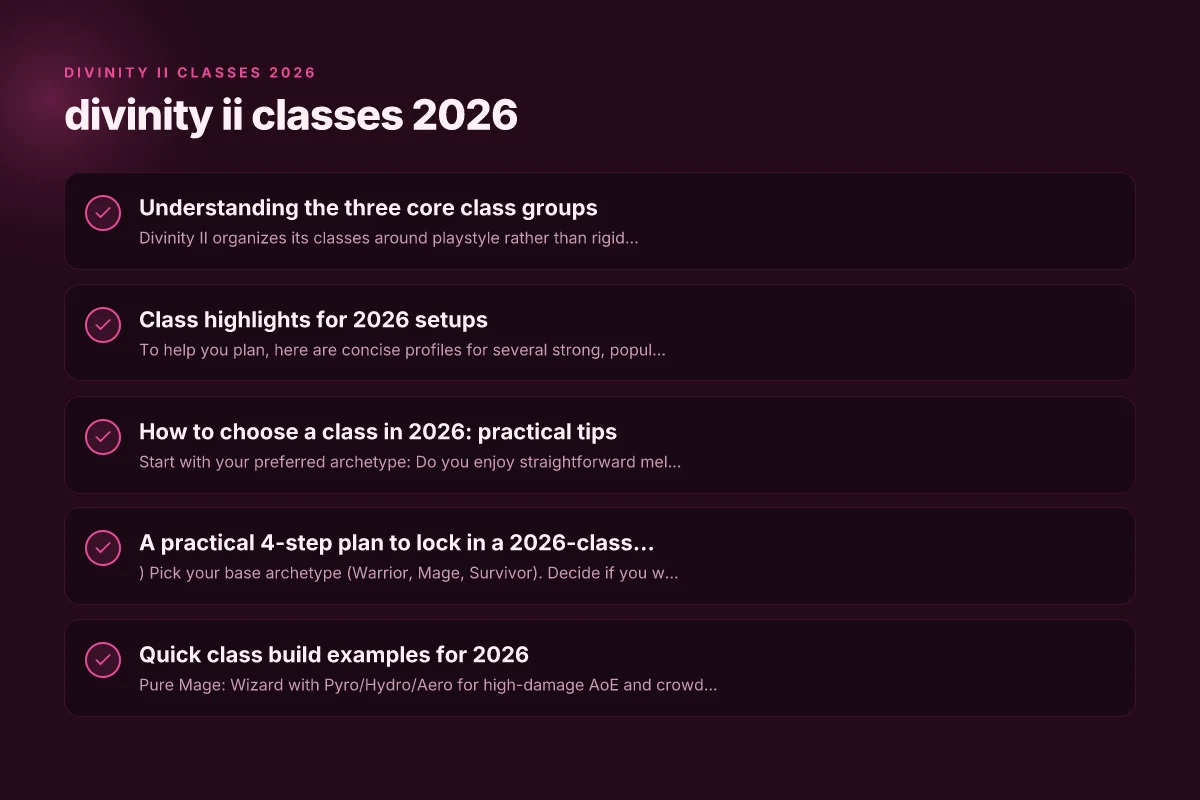
Divinity II organizes its classes around playstyle rather than rigid class trees, though each labeled class has signature skills and preferred gear. In practice:
- Warrior-focused classes emphasize melee power, survivability, and frontline presence.
- Mage-focused classes lean into elemental or magical damage, crowd control, and utility.
- Survivor-focused (hybrid) classes offer flexibility, often mixing weapons, magic, and survivability to adapt to different encounters.
A quick mapping to common playstyles helps when you’re planning a party or re-speccing a character.
Popular class groupings in 2026
- Warriors: Fighter, Knight, Battle Mage (part-time warrior)
- Mages: Wizard, Conjurer, Enchanter, Inquisitor
- Hybrids/Survivors: Ranger (ranged but can use magic), Rogue/Shadowblade (stealth mastery), Cleric (support with healing), Metamorph (shape-shifting variety)
The widely cited classes in 2026 discussions include: Fighter, Knight, Ranger, Rogue/Shadowblade, Wizard, Enchanter, Conjurer, Inquisitor, Cleric, Metamorph, and Battlemage. Each class blends weapon proficiencies with schools of magic or special abilities.
Class highlights for 2026 setups
To help you plan, here are concise profiles for several strong, popular builds in 2026, with playstyle notes, ideal early game choices, and mid-to-late game considerations. Dashlane login to my account
Fighter
- Role: Frontline attacker with solid armor and straightforward melee damage.
- Strengths: Consistent damage output, high durability, easy to learn.
- Weaknesses: Fewer ranged options unless you mix with a ranged skill set.
- Suggested skills: Warfare-based abilities, some Defensive skills.
- Gear focus: Heavy armor, two-handed or sword and shield combos.
Knight
- Role: Tankish melee combatant with survivability and some team support capability.
- Strengths: Excellent sustain, frontline control.
- Weaknesses: Slower to escalate damage compared to pure DPS classes.
- Suggested skills: Warfare and Support (Auras, Shields), some Paladin-like buffs.
- Gear focus: Heavy armor, defensive auras, shield synergy.
Ranger
- Role: Ranged DPS and off-tank with traps and pet-like utility via skills.
- Strengths: Strong crowd control if used with the right shots and terrain.
- Weaknesses: Battery drain if used in melee-heavy fights.
- Suggested skills: Ranged base, with some Wits/Survivor elements for traps.
- Gear focus: Bows or crossbows, crafted poisons or traps.
Rogue / Shadowblade
- Role: Stealth-based damage dealer with backstabs and utility.
- Strengths: High burst potential, bypasses defenses with stealth.
- Weaknesses: Fragile when caught in open combat. Needs positioning.
- Suggested skills: Dual-wielding, Sneaking, and some Deception/Manipulation tools.
- Gear focus: Light armor, daggers or swords, utility items for stealth.
Wizard
- Role: Primary ranged mage with big elemental damage andAoE control.
- Strengths: Big, scalable damage. Strong crowd control.
- Weaknesses: Typically lower survivability. Mana/resource management matters.
- Suggested skills: Pyrokinetic (fire), Hydrosophist (water), Aerotheurge (air. Control), optional Earth for survivability.
- Gear focus: Robes, staves, elemental resistances, mana efficiency.
Conjurer
- Role: Summoner/buffer mage with battlefield control.
- Strengths: Partner summons help in crowd control and DPS.
- Weaknesses: Depends on minions. Can be niche outside big battles.
- Suggested skills: Conjuration primary, with related supportive schools.
- Gear focus: Light to mid-weight gear. Items that boost summoning or mana.
Enchanter
- Role: Support mage focused on buffs and debuffs.
- Strengths: Party utility, multi-target control.
- Weaknesses: Damage-dealing capabilities are often lower than pure DPS mages.
- Suggested skills: Hydrosophist, Aerotheurge for CC. Focus on buffs and debuffs.
- Gear focus: Accessories that boost resistances and spell duration.
Inquisitor
- Role: Hybrid mage-knight-like class with access to strong disruptive and damage options.
- Strengths: Versatile. Reliable damage with strong utility.
- Weaknesses: Not as specialized for pure DPS or pure CC as some other paths.
- Suggested skills: A mix of Warfare and Magic, a touch of Control.
- Gear focus: Balanced gear that supports both offense and defense.
Cleric
- Role: Healer with solid supportive magic and octane in battles.
- Strengths: Team survivability and sustain.
- Weaknesses: Often secondary in raw DPS unless built specifically.
- Suggested skills: Hydrosophist, Necromancer (if using lifesteal and revival mechanics), with healing-focused trees.
- Gear focus: Heavy to mid-armored items with mana and healing bonuses.
Metamorph
- Role: Shape-shifting hybrid capable of rapid adaptation.
- Strengths: High versatility, flexible build options.
- Weaknesses: Can be skill-hungry and equipment-dependent.
- Suggested skills: A mix of all schools based on role you want in a given fight.
- Gear focus: Items increasing flexibility and survivability. Adaptable weapons.
Battlemage (hybrid)
- Role: Offense & defense with hybrid magic and melee.
- Strengths: Flexible, scales well with gear and ability choices.
- Weaknesses: Slight cognitive load to balance wand/spell use.
- Suggested skills: A blend of Warfare and Pyro/Hydro/Aero as needed.
- Gear focus: Balanced gear with spellpower and physical damage.
Table: Quick class comparison for 2026 playthroughs
| Class | Core Strengths | Ideal Role in Party | Notable Weakness | Suggested Schools |
|---|---|---|---|---|
| Fighter | Durability, steady DPS | Frontline DPS/taunt | Deals less ranged damage | Warfare, some Defense |
| Knight | Tankiness, team protection | Tank/Support | Slower DPS progression | Warfare, Auras |
| Ranger | Ranged DPS, traps, utility | Ranged DPS, CC | Vulnerable in melee | Finesse/Warfare, Ranger traps |
| Rogue/Shadowblade | High burst, stealth, mobility | Assassin, skirmish | Fragile in straight fights | Dual-wield, Sneaking |
| Wizard | Massive AoE, control | Primary ranged caster | Mana management, squishy | Pyro/Hydro, Aero; optional Earth |
| Conjurer | Summons, battlefield control | Tanky support/damage | Minion dependence | Conjuration, some Pyro/Aero |
| Enchanter | Buffs/debuffs, CC | Support/Control | Lower raw DPS | Hydrosophist, Aerotheurge |
| Inquisitor | Versatile damage/control | Flexible damage/support | Not the top in any single niche | Mixed Warfare + Magic |
| Cleric | Healing, sustain | Primary healer/backline support | Lower DPS when solo | Hydrosophist, Necromancer (optional) |
| Metamorph | Versatility, adaptation | Flex tactical role | Skill hunger, gear dependency | All schools selectively |
| Battlemage | Both magic and melee power | Hybrid frontline damage | Requires careful resource management | Warfare + Pyro/Hydro/Aero |
Note: In practice, you can mix two schools within a single class to create a hybrid that fits your party and the current encounter. The original game rewards experimentation, so use these as a starting point rather than strict templates.
2026 class highlights by setup
| Setup | Key class strengths | Best matchups | Weaknesses | Suggested pairings | Example builds |
|---|---|---|---|---|---|
| Solo dungeon | Sustain, control, damage | Pull-heavy fights | Resource management | Tank + Healer backup | Guardian + Rune Weaver |
| PvP skirmish | Mobility, burst, CC | Quick engages | Positioning risk | Frontline disruptor + DPS | Knight + Elementalist |
| Raid party | Heals, buffs, mitigation | Multi-target threats | Cooldown timing | Aura healer + buffer | Cleric + Arcane Scout |
| Gear-centric | Max stat synergy | Optimization, min-max | XP/gear grind | Support + DPS | Oracle + Sharpshooter |
| Casual exploration | Easy survivability | Needle-fast clears | Minimal risk | Flexible hybrid | Ranger + Rune Warden |
Compiled November 2026; check the provider's site for current details. Cost to incorporate in california embassy california
How to choose a class in 2026: practical tips
- Start with your preferred archetype: Do you enjoy straightforward melee, classic magic damage, or flexible hybrids that adapt on the fly?
- Consider your party: If you’re playing solo, a Battlemage or Metamorph can cover many roles. In a party, pick complementary classes (for example, Ranger with Shadowblade, Wizard with Cleric support, and Battlemage to bridge).
- Check your equipment pool: Some classes rely heavily on specific weapon types (two-handed sword vs staff) or armor that supports spell casting. Your loot and crafting options can steer your choice.
- Plan for resource management: Mages care about mana or magic points. Hybrids balance health, action points (AP), and mana. Ensure your build has enough sustain for long fights.
- Early game vs late game: Early game is forgiving. Late game rewards optimized skill picks and gear synergies. If you’re near the mid-late game, prioritize synergy with companions and high-impact spells.
- Skill books and sources: In DOS II, finding or purchasing the right skill books matters for unlocking and leveling up your class' signature abilities.
A practical 4-step plan to lock in a 2026-class build
- Pick your base archetype (Warrior, Mage, Survivor). Decide if you want a simple, robust frontline or a high-skill ceiling caster.
- Choose secondary schools that give you a reliable combo. For example, Wizard (Pyro/Hydro/Aero) or Conjurer (Conjuration + a support school). For hybrids, consider Battlemage or Metamorph if you love adaptability.
- Gather gear that fits your core. If your class relies on elemental damage, stock up on items that boost spellpower and resistances to your elements. If you’re a melee class, focus on weapons that increase crit chance and armor you can sustain.
- Practice with a few encounters. In DOS II, fights can hinge on position, AP management, and environmental effects. Test your class against different enemy types to learn optimal rotation.
Quick class build examples for 2026
- Pure Mage: Wizard with Pyro/Hydro/Aero for high-damage AoE and crowd control. Use staves and robes, aim for mana sustainability and cooldown reductions.
- Tanky Hybrid: Battlemage with Warfare and Pyro, wearing heavy armor, using shields in tricky fights, keeping pressure on enemies while supporting your squad with buffs.
- Stealthy Assassin: Shadowblade+Rogue with dual-wield, Sneaking, and a few utility spells from Enchanter for CC and control. Light armor, mobility boots, and daggers.
2026 class selection criteria
| Criterion | Description | Weight (1-5) | Ideal picks | Not recommended |
|---|---|---|---|---|
| Playstyle fit | Does it match your preferred vibe? | 5 | Warrior, Mage | Support if you hate management |
| Team needs | Do you fill a gap? | 4 | Healer, Tank, Buffer | Pure DPS solo-focused |
| Gear accessibility | Availability of upgrades | 3 | Mage, Ranger | Rare drop-heavy classes |
| Learning curve | Time to master | 2 | Hybrid, Ranger | Complex caster meta |
| Longevity | Stay relevant in patches | 4 | Support, Hybrid | Short-lived gimmicks |
Compiled November 2026; check the provider's site for current details.
How to maximize class effectiveness in 2026
- Invest in companion synergy: Some companions offer skills that pair well with certain classes. For example, a Cleric companion works well with a high-damage melee class, enabling healing and buffs in tight fights.
- Use terrain to your advantage: In DOS II, high ground, water sources, or fire sources can amplify certain schools of magic. Plan your path to exploit these environmental advantages.
- Manage resources carefully: Nothing kills a perfect rotation like wasted AP or mana. Learn your class’ natural cadence and reserve a few AP for high-impact moments.
- Prepare for scaling: As you progress to late-game, boss encounters demand more precise builds and better gear. Upgrade your weapons, refine your spell choices, and reallocate points if needed.
Final recommendation
If you’re new in 2026 or want a forgiving yet still powerful path, start with a Battlemage or Metamorph. These hybrids offer flexibility, strong combat presence, and the ability to adapt to a variety of encounters. For players who prefer a pure mage experience, Wizard remains the most satisfying choice for big damage and crowd control. If you want pure frontline resilience with steady numbers, Knight or Fighter are solid picks. For players who lean into stealth and high burst, Rogue/Shadowblade is a compelling option.
In short: There isn’t a single “best” class in Divinity II for 2026. The strongest choice depends on your preferred playstyle, your party composition, and how you like to approach combat. Use the profiles above to test and customize a build that fits your goals, and you’ll enjoy a strong, versatile run in 2026. Cost of incorporation in alberta