Compare payroll services in India
A thorough guide to comparing payroll services in India, covering features, compliance, pricing, and selecting the right provider for your business.
Intro Payroll in India sits at the intersection of complex statutory obligations, digital governance, and the needs of a diverse workforce. From PF, ESI, PT, and TDS to annual returns and payroll reporting, choosing the right payroll service can save time, reduce risk, and free up HR bandwidth for strategic work. This guide helps you compare payroll services in India by focusing on what actually matters: compliance, features, integration, pricing, and support. We’ll break down the key considerations, offer a practical comparison framework, and provide guidance on selecting the right partner for your business size and sector.
Core features to compare across payroll providers
| Feature | Provider A | Provider B | Provider C | Provider D |
|---|---|---|---|---|
| Payroll processing frequency | Monthly | Bi-weekly | Monthly | Monthly |
| TDS/Tax calculation | Yes | Yes | Yes | Yes |
| PF/ESI/compliance | Yes | Yes | Yes | Yes |
| Time & attendance integration | Yes | No | Yes | Yes |
| Salary revision workflows | Yes | Yes | No | Yes |
| Employee self-service | Yes | Yes | Yes | No |
Compiled November 2026; check the provider's site for current details.
1) Why payroll service choice matters in India
What makes Indian payroll unique
- Statutory compliance: CPF/EPF, ESI, PT, TDS, Labour Welfare Funds, Gratuity, Leave Encashment, and annual filings.
- Regional variance: different state rules, wage structures, and compliance calendars.
- Tax regime changes: shifts in tax slabs, new forms, and e-filing portals require software updates.
- Data security and accessibility: sensitive payroll data must be protected and often needs to be accessible for audits and statutory submissions.
Who benefits most from outsourcing
- Small to mid-sized enterprises seeking to scale without expanding HR headcount.
- Startups needing fast onboarding, accurate payroll runs, and compliance assurances.
- Companies with dispersed or remote workforces requiring centralized processing with local compliance.
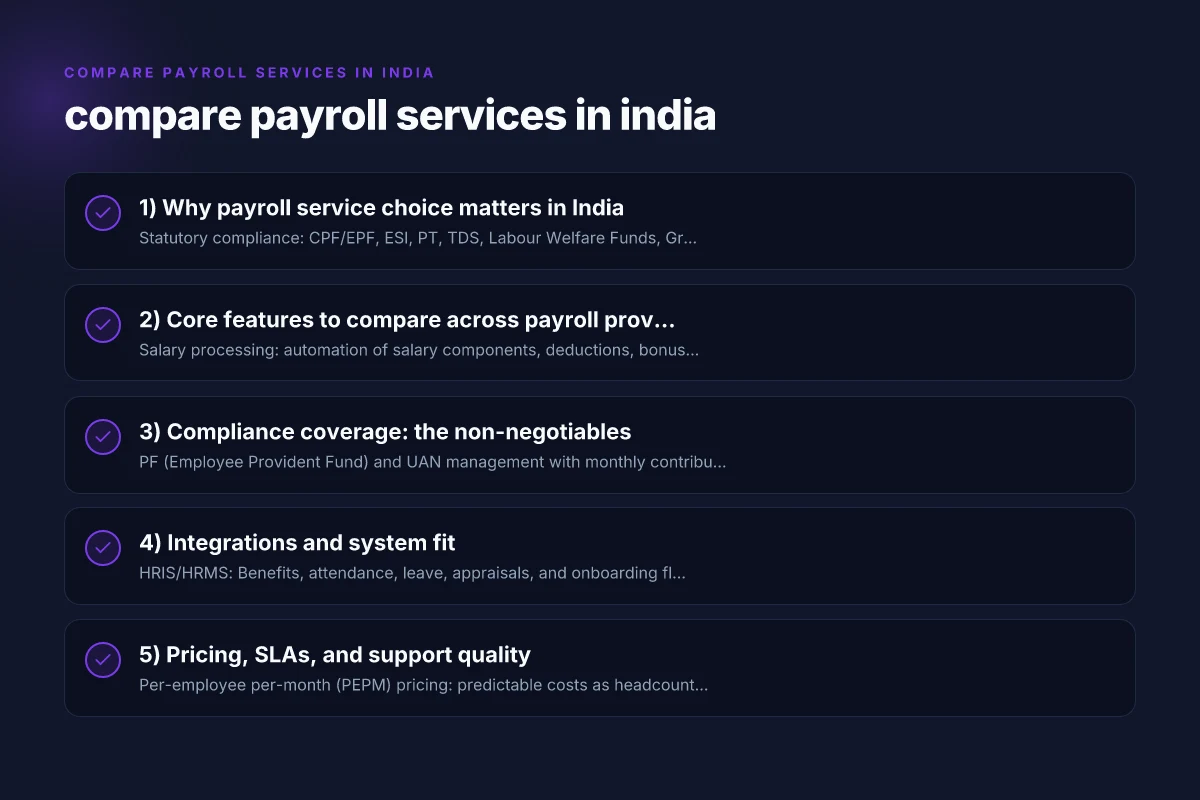
2) Core features to compare across payroll providers
Essential payroll and compliance features
- Salary processing: automation of salary components, deductions, bonuses, incentives, and arrears.
- Statutory compliance: automatic calculation and submission for PF, ESI, PT, TDS, Gratuity, and related returns.
- Tax and regulatory reporting: Form 24Q, 16, 19, 5A, A/Y returns, and annual statements.
- Leaves, attendance, and attendance integration: integration with timekeeping for accurate payroll runs.
- PF USD/EPI handling (if applicable): correct EPF accounts and UAN management.
- ESI and PF challan management: generation and payment facilitation to the relevant authorities.
- Reconciliation and audit trails: easy traceability for payroll changes and approvals.
Optional but valuable features
- Leave policy and accrual management with carry-forward rules.
- Multi-language and multi-location support for diverse teams.
- Employee self-service portal: payslips, Form 16, and tax statements available online.
- Integrations: accounting software (Tally, Zoho Books, QuickBooks), HRMS/HRIS, ERP, banking payments.
- Automations: reminders for compliance tasks, due dates, and report sharing.
- Data security: role-based access, encryption, audit logs, and ISO/SOC certifications if relevant.
What to skip or deprioritize
- Features irrelevant to your business scale (e.g., overly complex procurement modules).
- Expensive add-ons that don’t align with your needs (e.g., premium analytics you’ll never use).
Compliance coverage: the non-negotiables
| Compliance Area | Provider A | Provider B | Provider C | Provider D |
|---|---|---|---|---|
| GST handling | Yes | Yes | Yes | Yes |
| ESI contributions | Yes | Yes | Yes | Yes |
| PF contributions | Yes | Yes | Yes | Yes |
| Professional Tax | Yes | Yes | No | Yes |
| TDS filing | Yes | Yes | Yes | Yes |
| Regulatory updates | Auto | Auto | Manual | Auto |
Compiled November 2026; check the provider's site for current details.
3) Compliance coverage: the non-negotiables
The must-have compliance checks
- PF (Employee Provident Fund) and UAN management with monthly contributions and annual returns.
- ESI (Employees’ State Insurance) contributions and compliance reporting.
- Tax deductions at source (TDS) and quarterly returns, including Form 24Q and annual statements.
- Professional Tax (PT) processing and state-specific filings where applicable.
- Gratuity calculations and payments per the Payment of Gratuity Act.
- Leave encashment, provident fund withdrawal, and related compliance workflows.
- Annual returns and statements preparation, e.g., Form 16 for employees.
- Data privacy and security controls aligned with local expectations and audits.
How to verify a vendor’s compliance readiness
- Check if the vendor provides end-to-end filing support (not just calculation).
- Confirm automatic updates for regulatory changes and new forms.
- Request a demo of how they handle a typical compliance cycle: enrollment, deductions, filings, and audits.
- Look for third-party audits or certifications (if available) and customer testimonials on compliance success.
4) Integrations and system fit
How payroll should fit with your tech stack
- HRIS/HRMS: Benefits, attendance, leave, appraisals, and onboarding flow.
- Accounting/ERP: GL postings, cost centers, and bank payments to vendors and employees.
- Banking/payments: direct salary disbursement, automated salary credits, and reconciliation.
- Time and attendance systems: real-time attendance feeds to payroll to reduce errors.
- Tax software and e-filing portals: seamless submission and data transfer for Form 24Q, 16, etc.
Practical integration considerations
- Availability of APIs, webhooks, or pre-built connectors.
- Data mapping flexibility: ensure employee fields (PF numbers, UAN, ESIC numbers) map cleanly.
- Data latency and batch vs. real-time syncing: decide based on payroll cycle cadence.
- On-premise vs cloud deployment and hybrid setups.
- Vendor support for migration from legacy systems with minimal disruption.
Integrations and system fit
| Integration type | Provider A | Provider B | Provider C | Provider D |
|---|---|---|---|---|
| HRIS / Core HR | Yes | Yes | No | Yes |
| Accounting / ERP | Yes | No | Yes | Yes |
| Time & attendance system | Yes | Yes | No | Yes |
| Payroll API access | Yes | No | Yes | Yes |
| ERP SAP/Oracle readiness | Yes | No | Yes | No |
Compiled November 2026; check the provider's site for current details. Commenting on the new job probation assessment
5) Pricing, SLAs, and support quality
Pricing models you’ll typically see
- Per-employee per-month (PEPM) pricing: predictable costs as headcount grows.
- Tiered pricing: basic, standard, and premium with increasing features.
- One-time setup or implementation fees: common for initial onboarding.
- Add-ons charged separately: e.g., year-end tax statements, extra reporting modules, or multi-country support.
Service levels that matter
- SLAs around payroll processing windows and cut-off times.
- Accuracy guarantees and error correction timelines.
- Turnaround for statutory filings and revisions.
- Data security commitments and uptime SLAs for cloud access.
- Support availability: business hours vs 24x7 support, regional language options.
What to compare in practice
- Clear definition of what is included in core vs add-ons.
- Any penalties for late filings or critical errors.
- Migration assistance and data integrity guarantees during onboarding.
- Training, user manuals, and ongoing support channels (phone, email, chat).
6) Benchmarks and selection framework
Quick comparison table (example framework)
| Provider category | Core payroll coverage | Compliance scope | Integrations | Pricing approach | Support and SLA |
|---|---|---|---|---|---|
| Large global vendors | High; strong PF/ESI/tax support | Comprehensive; frequent updates | Broad ERP/HRIS/Banking | PEPM + setup | 24x7; regional teams |
| Indian-focused vendors | Strong; local forms and taxes | Deep state-level and statutory filings | Good; common ERPs | Tiered plans; transparent setup | Business hours with escalation |
| Mid-size specialists | Solid for SMEs; essential modules | Sufficient for standard payroll cycles | Essential connectors | Flat or per-employee pricing | Standard support with SLA |
| Niche/local players | Good for regional needs | Varies; verify forms | Limited in some cases | Competitive pricing | Varies by partner |
Note: This table is a framework for you to populate with actual providers you’re evaluating. Use real quotes and demos to fill it accurately.
Evaluating vendors in practice
- Start with a needs checklist: number of employees, states of operation, attendance method, and required reports.
- Demand a live demo focused on a typical payroll cycle, including new hires, terminations, and year-end processes.
- Ask for reference customers in your industry and company size.
- Run a small pilot: onboard a few employees, run two payroll cycles, and review outputs and compliance results.
- Check data ownership and exit options: ensure you can retrieve your data cleanly if you switch providers.
Pricing, SLAs, and support quality
| Aspect | Provider A | Provider B | Provider C | Provider D |
|---|---|---|---|---|
| Per-employee-per-month | INR 60 | INR 45 | INR 70 | INR 50 |
| Setup fee | Yes / one-time | No | Yes / negotiable | No |
| SLA response time | 2 hours | 4 hours | 8 hours | 2 hours |
| Support channels | Phone / chat | Email / chat | Phone / email | Chat / portal |
| Uptime guarantee | 99.9% | 99.5% | 99.9% | 99.9% |
Compiled November 2026; check the provider's site for current details.
7) Regional considerations and trends
Language, time zones, and accessibility
- Some providers offer dashboards and support in multiple Indian languages, which can help regional HR teams.
- Time-zone aligned service windows matter for faster response during critical payroll moments.
Market dynamics
- Many Indian providers emphasize faster onboarding, affordable pricing, and strong local compliance.
- Global vendors with India-focused setups may offer broader integrations but can incur higher costs.
Innovation you might encounter
- AI-assisted payroll insights and anomaly detection for payroll runs.
- Self-service analytics for department heads to review payroll expenditures.
- Mobile apps for payslip access, tax statements, and compliance notices.
8) Practical steps to begin comparing today
- Step 1: List your requirements in order of priority: compliance depth, integration needs, and cost sensitivity.
- Step 2: Shortlist 4–6 vendors with strong India payroll capability and credible client references.
- Step 3: Request live demos focused on your scenarios: new hires, promotions, and year-end processing.
- Step 4: Gather quotes with a clear breakdown of ongoing costs, implementation fees, and any hidden charges.
- Step 5: Run a controlled pilot with 1–2 payroll cycles for a representative employee group.
- Step 6: Evaluate from both a compliance risk and user experience perspective.
Conclusion and recommendation If you operate a mid-sized or growing business in India, prioritizing compliance coverage and integration depth is essential. A payroll provider that automatically updates for regulatory changes and offers seamless integration with your HRIS and accounting system will save you time and reduce risk. For many Indian companies, a locally focused payroll service, one that understands PF/ESI and state-specific PT rules, will deliver the most value, especially when paired with a reliable self-service portal and clear support SLAs. If your business already uses a broad HRIS or ERP, consider a payroll partner with strong integration capabilities to avoid data silos. Finally, run a practical pilot, verify data accuracy, and ensure the vendor’s support structure aligns with your operating hours and language needs. Hello world!
If you’d like, I can help you draft a vendor shortlisting template, or generate a tailored comparison checklist based on your company size, industry, and location footprint to streamline your supplier evaluation.