Candidate experience record border patrol: what to know for CBP entrance exam
A practical guide to the Candidate Experience Record for Border Patrol and CBP entrance exams, with tips and steps.
The Border Patrol and U.S. Customs and Border Protection (CBP) recruit through a multi-step process that begins with a digital entrance exam. A central component of that exam is the Candidate Experience Record (CER). Here’s what you need to know to navigate this part of the process with clarity and confidence.
What is the Candidate Experience Record?
The Candidate Experience Record is an online assessment that asks you to reflect on your past work experiences. It’s not a “pass/fail” test of knowledge or math. Rather, it’s a behavior-based questionnaire designed to gauge how you have performed in real-world job situations. The CER helps CBP assess relevant competencies such as teamwork, decision-making, leadership, problem-solving, integrity, and adaptability.
- It typically appears as a lengthy questionnaire rather than a short quiz.
- Expect questions about how you handled conflicts, followed procedures, or demonstrated accountability in previous roles.
- Your responses help the hiring team understand your fit for the demanding environment of CBP.
How to access and complete the CER
Access to the CER comes via an email from the test vendor. Once you receive that message, you’ll have a limited window to complete the assessment.
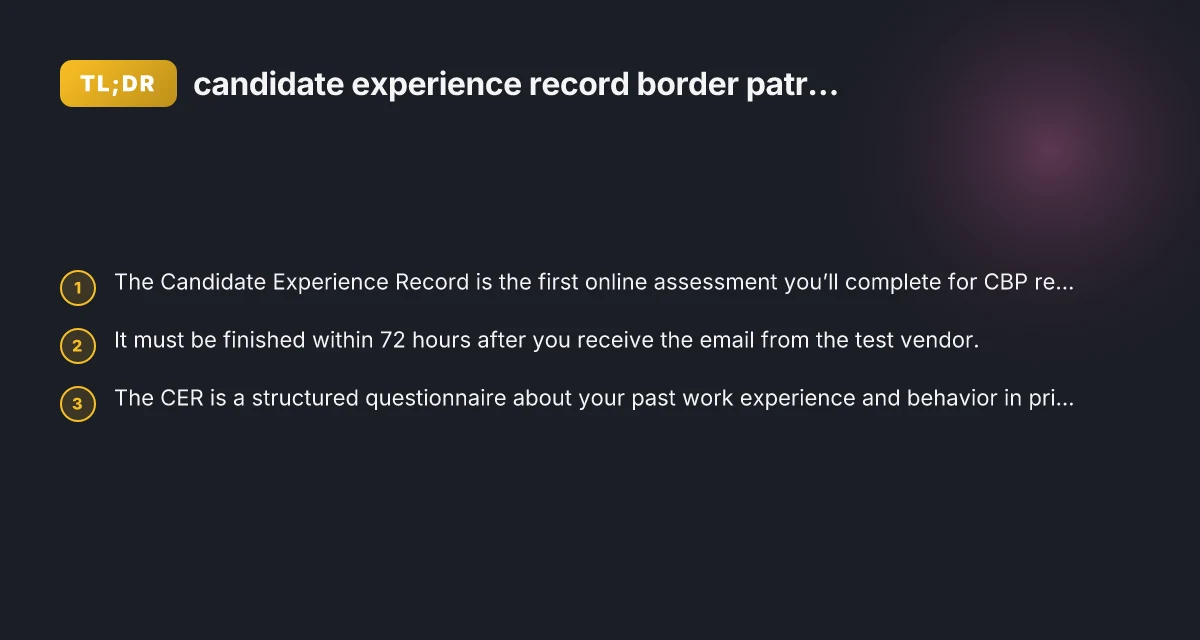
- Time window: The CER must be completed within 72 hours of receiving the email.
- Platform: The CER is online, hosted by the designated test vendor used by CBP.
- Preparation: There is no “study guide” for the CER, but you can prepare by reviewing your recent job experiences and identifying concrete examples that illustrate core competencies (e.g., teamwork, safety compliance, customer service under pressure, ethical decision-making).
If you miss the 72-hour deadline, you may risk your candidacy or have to request an extension. Always set reminders to ensure you finish within the window.
What the CER looks like in practice
The CER is described as a long questionnaire about your past experiences. The questions are designed to surface patterns in how you approach work scenarios, not to test specialized Border Patrol knowledge. Are bliss cameras companion able to a fire tablet
- Expect prompts like “Describe a time you faced an ethical dilemma at work and how you resolved it.”
- You’ll be asked for details such as the situation, actions you took, and the outcome.
- Some items may require you to rate the importance of certain competencies or to provide examples across different contexts (leadership, teamwork, stress management, safety).
Tip: Use the STAR method (Situation, Task, Action, Result) to structure your responses. Be specific about your role and the impact of your actions.
How long does the CER take, and how does it fit with other tests?
The CER is part of a broader Entrance Exam for CBP roles, which also includes other components such as a writing portion and possibly a logical reasoning test. The CER itself is online and can take a reasonable portion of time.
- Estimated duration: The CER portion is typically described as part of the overall Entrance Exam package. Individual estimates vary, but plan for a substantial time block to complete thoughtfully.
- Other components: After or alongside the CER, you may encounter a separate online writing section and a logic-based assessment. The combined process aims to measure both your experience-based judgment and your ability to communicate clearly.
If you see a duration estimate: the “Candidate Experience Record” date is fixed by the vendor’s scheduling system. You should plan for the full examination session.
Common questions about CER
- What is a candidate experience record for Border Patrol? It’s the online questionnaire about your past work experiences used to gauge fit for CBP roles.
- What is a candidate experience record? It is a validated assessment instrument that collects insights into how you have demonstrated key competencies in real-world settings.
- How hard is it to get hired for Border Patrol? The process is competitive and rigorous, with multiple steps, including the CER, writing test, physical requirements, medical clearance, and security checks.
- How do you know if you passed the Border Patrol interview? Pass/fail outcomes are typically communicated through the official channels. You’ll receive updates if you advance to subsequent stages or require additional steps.
CER and related CBP resources
Many applicants find it helpful to cross-reference official CBP materials for the Entrance Exam components. The CER is frequently described in CBP career pages and related Q&A articles. Advanced muscle plus scam alert
- CBP Officer Entrance Exam resource pages: These pages outline the structure of the exam and where the CER fits in.
- Public forums and applicant discussions: Reddit threads and applicant forums can offer anecdotal insights, but rely on official CBP communications for requirements and deadlines.
- The CER is often mentioned alongside the “Entrance Exam” as a combined evaluation step.
Note: While user-generated content can provide a sense of what to expect, always confirm details with the official CBP resources to avoid outdated or inaccurate information.
A practical approach to preparing for the CER
Since the CER is about your personal experience and behavior, preparation is about reflection and articulation rather than memorization.
- Gather your recent roles: List your most relevant jobs from the last 5–10 years, focusing on roles that required compliance, teamwork, decision-making, and safety-conscious behavior.
- Identify concrete examples: For each competency (e.g., teamwork, integrity, adaptability), select 3–5 stories that demonstrate your performance and outcomes.
- Practice with the STAR framework: Write out brief narratives using Situation, Task, Action, Result. Emphasize measurable outcomes where possible (e.g., improved safety metrics, reduced incidents, efficient resource use).
- Keep it professional and concise: The CER responses should be thorough but focused. Avoid vague statements. Include specifics about your role and the impact.
- Be honest and reflective: CBP values integrity and accountability. Don’t overstate experiences or claim responsibilities you didn’t actually have.
A comparison perspective: CER versus other exam components
| Component | Purpose | What it evaluates | How to prepare |
|---|---|---|---|
| Candidate Experience Record (CER) | Behavioral assessment of past work experiences | Leadership, teamwork, ethics, problem-solving, adaptability | Prepare stories using STAR; be specific about actions and outcomes |
| Online Writing Section | Demonstrates communication skills | Clarity, structure, grammar, ability to present a point | Practice concise, well-structured writing on CBP-relevant topics |
| Logical Reasoning Test | Abstract reasoning and problem-solving | Analytical thinking, pattern recognition | Practice logic puzzles, watch for time management |
| Interviews / Further steps | In-person or virtual assessment of fit | General suitability, motivation, demeanor | Prepare to discuss experiences, CBP mission, and ethics |
| Medical and background checks | Clearance to proceed | Health, security, reliability | Follow medical instructions; disclose required information honestly |
This table helps you see how CER fits with other elements of the CBP hiring process. The CER lays the foundation by understanding your past behavior, while the subsequent elements assess broader capabilities and readiness.
Real-world tips from applicants and official sources
- Timeliness matters: The 72-hour completion window is strict in most CBP processes. Set calendar reminders as soon as you receive the email.
- Accuracy over speed: The CER is not a speed test. Take the time to provide thoughtful, precise responses rather than rushing through prompts.
- Consistency across stories: If you’re asked about similar scenarios in multiple questions, ensure your examples are consistent with your documented experiences.
- Privacy and security: Treat the CER as any official employment assessment. Do not share login information or screenshots. Keep credentials secure.
- Use official channels for updates: Always monitor your email and the CBP careers portal for status updates, deadlines, and next steps.
The recommended path after completing the CER
- Complete the Entrance Exam in one sitting if possible, to avoid losing momentum or missing subsequent steps.
- Prepare for the writing and logic components in parallel, so you’re not rushed after the CER.
- Review your CBP eligibility criteria: Ensure you meet minimum requirements such as age, fitness, and legal prerequisites before moving forward.
- Stay organized: Maintain a checklist of each stage, CER, writing test, oral interviews, medical clearance, drug testing, and background checks.
If you’re navigating the CBP hiring process, the Candidate Experience Record is a crucial first step that signals how you’ll approach challenges and collaborate with others in a complex, security-focused environment. By preparing thoroughly, you can present a compelling narrative of your past performance and lay a strong foundation for the rest of your CBP journey. Proton VPN extension for Edge: what you need to know
Recommendation: Start early, reflect deeply on your past roles, write concise STAR-based stories, and stay organized with deadlines. The CER is your opportunity to demonstrate readiness for a demanding, mission-driven career with CBP.