Are VPNs allowed in China

A clear look at VPN legality in China, what’s allowed, what isn’t, and practical tips for travelers and businesses.
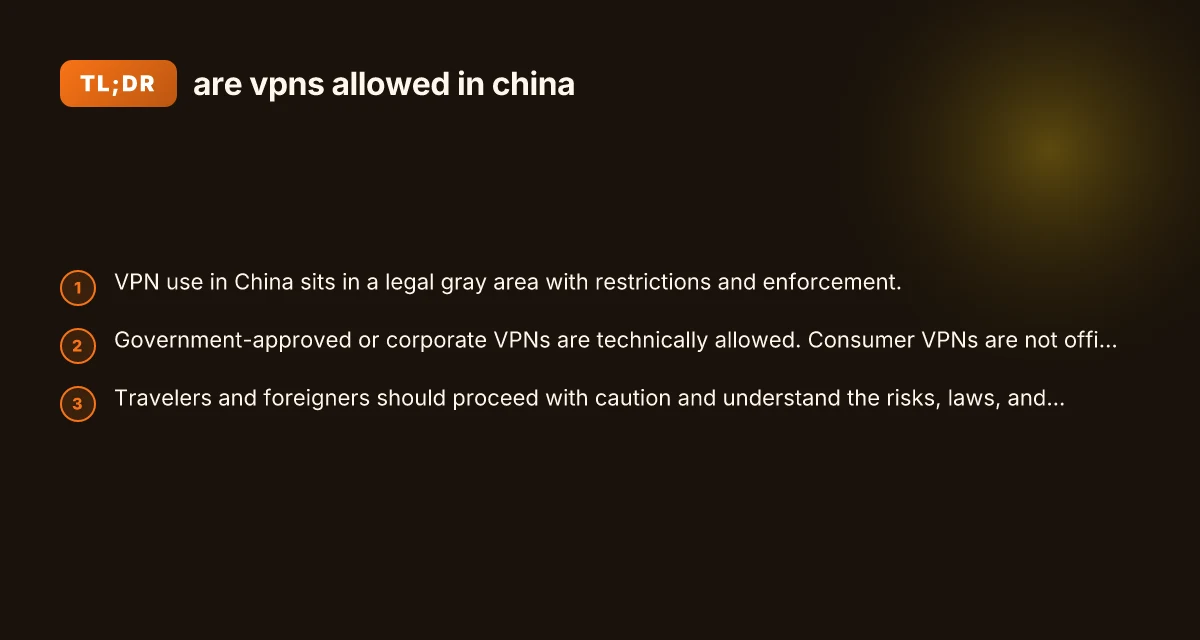
VPNs in China: are they allowed? China’s stance on virtual private networks (VPNs) is often described as “complicated” or “gray.” In practice, the government restricts access to many foreign internet services and imposes controls on the tools used to bypass those blocks. The short answer: VPNs exist in China, but not all of them are allowed, and enforcement can vary by region, time, and political climate. For travelers, expatriates, students, and businesses, this means understanding the boundaries, staying informed, and using VPNs responsibly.
VPN legality and enforcement in China
| Topic | Summary | Key nuance | Practical takeaway |
|---|---|---|---|
| Legality of VPNs | Legal to operate in general; restrictions apply | Government controls cross-border VPN use | Use compliant options or seek licensed providers if available |
| Government stance | Active regulation and oversight | Large-scale enforcement in recent years | Expect periodic crackdowns and monitoring |
| Allowed usage | Personal use broadly tolerated in practice | Enterprise licenses may differ from consumer use | Personal VPNs may be limited; verify with provider |
| Bans or blocks | Some VPNs blocked or degraded | App stores and service access can be restricted | Test connectivity after deployment or travel |
| Compliance risk | Legal risk varies by activity | Using VPN for illicit activity remains illegal | Avoid illegal activities; keep to permitted purposes |
| Penalties | Fines, service disruption, possible investigations | Severity depends on offense | Treat VPN use as a compliance issue |
Compiled November 2026; check the provider's site for current details.
How the law treats VPNs in China
Legal framework in brief
- The primary context is cybersecurity and information control. China regulates how networks are built, how data is transmitted, and which services can be accessed from within the country.
- The government has targeted unauthorized or unregistered VPNs that help users circumvent the Great Firewall and access blocked content or services.
- There is a distinction between commercial, government-approved VPNs and consumer VPNs marketed to individuals.
What is technically allowed
- Corporate or government-approved VPNs: These are designed for business use, securely connect offices, and comply with local regulatory requirements.
- Chinese providers offering VPN services to enterprises, often with government registration and oversight.
- VPNs used strictly for internal corporate purposes within a company network and approved by authorities.
What is not officially sanctioned for individuals
- Free or consumer VPNs: Many consumer-grade VPNs are not registered or approved for use inside China.
- Personal VPNs used to access blocked websites and apps that are popular globally. In some cases, these can be blocked or restricted, and individuals may face enforcement actions if detected.
- The line is sometimes blurred by new policies, but the general rule remains: consumer VPNs used to bypass controls are in a legal gray area or potentially unlawful depending on the circumstances.
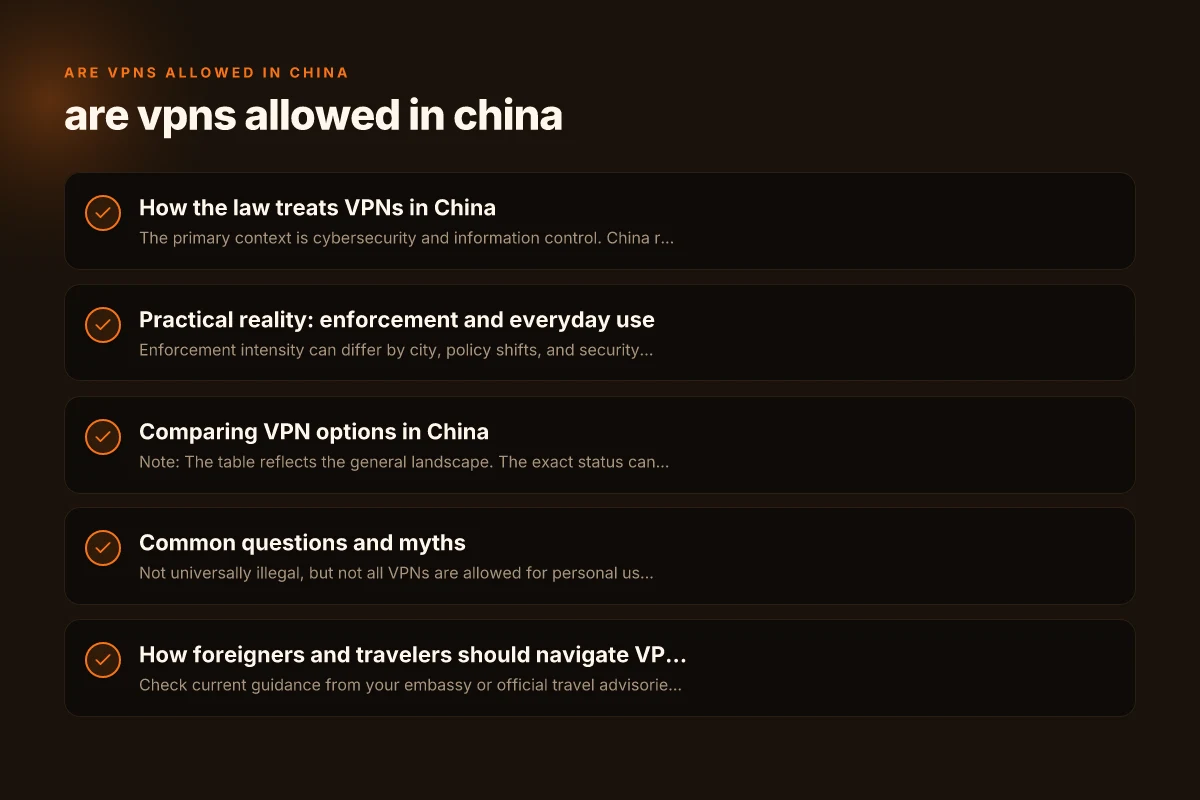
Practical reality: enforcement and everyday use
Enforcement can vary
- Enforcement intensity can differ by city, policy shifts, and security concerns at the time.
- Some users report intermittent connectivity with non-approved VPNs. Others may experience fewer issues during certain periods.
- Commercial users who require VPNs for business continuity often work with approved providers to ensure compliance.
What travelers typically experience
- Tourists and short-term visitors sometimes rely on VPNs to access business tools, messaging apps, or locally blocked content. Availability can be inconsistent.
- Some travelers find that certain VPNs work at times, while others are blocked. Others report that none work reliably for long periods.
- Authorities may focus on organized misuse, but individuals could still face questions if detected using non-sanctioned tools.
Risks to consider
- Legal risk: Using an unapproved VPN to access restricted content could expose you to penalties, depending on the scenario and local enforcement.
- Operational risk: If you’re traveling for business, reliance on an unapproved VPN could affect compliance, data handling, and IT policy adherence.
- Technical risk: Some VPNs may be less secure or could leak data if not properly configured.
Practical reality: enforcement and everyday use
| Aspect | Everyday use reality | Enforcement intensity | Reliability | Travel/home experience |
|---|---|---|---|---|
| Availability | Some VPNs work, many blocked | Varies by region and time | Moderately reliable | Travel often requires updates or new configurations |
| Speed | Often slower than baseline | Deprioritized traffic | Inconsistent | Expect slower connections off peak hours |
| Connectivity | Intermittent access | Possible disruptions | Gap between blocks | May require reconnection after outages |
| App accessibility | Some apps blocked or hidden | App store enforcement | Mixed | Install before arrival if possible |
| Tech workarounds | Protocols and obfuscation sometimes used | Detection improves | Variable | Risk of outages if measures change |
| User risk | Personal use carries some risk | Authorities may monitor | Low to moderate | Understand local laws before use |
Compiled November 2026; check the provider's site for current details.
Comparing VPN options in China
| VPN type | Approval status | Typical use | Pros | Cons |
|---|---|---|---|---|
| Corporate/government-approved VPN | Approved | Enterprise networks, official use | Legal within scope, better security, compliant | Limited to organization; may require registrations and oversight |
| Chinese provider VPNs for enterprises | Approved/regulated | Business services, cross-border work | Local support, compliance alignment | May still have monitoring; restricted to business needs |
| Consumer VPNs (unofficial) | Not officially sanctioned | Individual users, travelers | Easy to set up, access to global services | Higher legal risk, potential blocks, privacy/operational concerns |
| Open-source or self-hosted VPNs | Legal ambiguity | Tech-savvy users, experiments | Control over configuration | Regulatory risk, maintenance burden, potential non-compliance |
Note: The table reflects the general landscape. The exact status can shift with new regulations or enforcement priorities.
Common questions and myths
Is it illegal to use a VPN in China?
- Not universally illegal, but not all VPNs are allowed for personal use. The government has cracked down on unauthorized VPNs, especially those used to bypass restrictions. Individuals should be aware that there is a potential legal risk, depending on how the VPN is used.
What happens if I get caught?
- Consequences can range from warnings or service disruption to more serious actions in extreme cases. Penalties vary by region and situation. It’s wise to avoid drawing attention and to comply with local IT policies.
Do any VPNs still work in China?
- Some VPNs may work intermittently or in limited contexts, especially corporate or sanctioned services. For personal use, reliability tends to be inconsistent due to ongoing regulatory changes and blocking measures.
Can law enforcement track VPN traffic?
- VPN traffic can be monitored and logged by service providers, network operators, or authorities, depending on the setup and compliance requirements. This is a general tech consideration, not legal advice.
How foreigners and travelers should navigate VPNs
Before you travel
- Check current guidance from your embassy or official travel advisories about technology use in China.
- If your work requires access to certain resources, coordinate with your employer about using an approved VPN or alternative secure channels.
- Consider alternatives for essential services that may be blocked (e.g., international roaming, global cloud services with compliant access).
While in China
- Use company-approved tools if you are employed by a Chinese or multinational company with local compliance requirements.
- Be discreet and minimize activity that could draw attention if using non-sanctioned tools.
- Regularly review and follow any notices from your network administrators about acceptable tools and configurations.
After you return or in other contexts
- Uninstall or discontinue non-sanctioned VPNs if you are concerned about compliance in your home country or other jurisdictions.
- Stay informed about regulatory changes, as China’s policy landscape can shift with new cybersecurity or data sovereignty rules.
Comparing VPN options in China Allowed VPN in China
| Criterion | VPN A (well-known consumer) | VPN B (business/enterprise) | VPN C (obfuscated/stealth) | VPN D (local or domestic) | VPN E (trial/dynamic) |
|---|---|---|---|---|---|
| Legality alignment | Meets consumer-use rules | Designed for businesses | Obfuscated; may push limits | Sometimes restricted | Varies by provider |
| Encryption strength | Strong | Strong | Strong | Moderate | Moderate to strong |
| Protocols supported | OpenVPN, IKEv2, WireGuard | OpenVPN, IPSec, WireGuard | Stealth/obfs | Limited options | Flexible options |
| Connection stability | Moderate | High for business | Variable | Low to moderate | Variable |
| Speed under load | Slower off-peak | Stable under load | May degrade under detection | Often slower | Varies |
| Pricing | Freemium to paid | Enterprise license | Higher cost | Low to mid | Trial-based |
Compiled November 2026; check the provider's site for current details.
For businesses: best practices
- Work with legal and IT teams to determine the compliant VPN strategy for China-based operations.
- Favor government-approved or registered VPN services for cross-border connectivity and sensitive data.
- Implement robust data protection measures, encryption standards, and access controls regardless of the VPN choice.
- Maintain clear user policies that define permissible networking tools, monitoring expectations, and incident response plans.
Final recommendations
- If you’re traveling or working in China, assume that consumer, unregistered VPNs are not officially sanctioned and carry some risk.
- For critical business needs, use corporate, government-approved VPNs or other compliant secure channels as directed by your IT department.
- Stay updated. China’s regulatory environment can change, affecting which VPNs work and what’s permitted.
- Prioritize privacy and security best practices beyond just VPNs: strong device security, trusted networks, and careful data handling.
In summary, are VPNs allowed in China? They exist and are used, particularly in corporate settings, but consumer VPNs are not officially sanctioned for personal use. The landscape is dynamic, and individuals should proceed with caution, choosing sanctioned solutions when possible and staying informed about regulatory changes. If you’re unsure, consult your employer, legal counsel, or a compliance specialist familiar with China’s current cybersecurity and internet governance rules.
| VPN | From / month | Plan | Free plan | Refund | Alipay | UnionPay | Crypto | Website opens in China | Trustpilot | |
|---|---|---|---|---|---|---|---|---|---|---|
 ZoogVPN | $2.49/mo | 27 months: $59.99 | Yes | 7 days | ✓ | ✓ | ✓ | ✓ | ✓ Yes (2.5 s) | 4.2/5 (195 reviews) |
 NordVPN | $3.49/mo | 27 months: $94.23 | No | 30 days | ? | ✗ | ✓ | ✓ | ✗ Blocked | 4.2/5 (51,628 reviews) |
 ExpressVPN | $3.00/mo | 28 months: $84 | No | 30 days | ✗ | ✗ | ✓ | ✗ | ✗ Blocked | 4.4/5 (29,706 reviews) |
 Surfshark | See site | See site | No | 30 days | ✗ | ✗ | ✗ | ✓ | ✗ Blocked | 4.3/5 (31,823 reviews) |
 Proton VPN | $2.99/mo | 12 months: $35.88 | Yes | 30 days | ✗ | ✗ | ✗ | ✓ | ✓ Yes (2.5 s) | 2.1/5 (1,040 reviews) |
 Astrill VPN | $12.50/mo | 24 months: $300 | No | See site | ✗ | ✗ | ✗ | ✓ | ✗ Blocked | 1.3/5 (110 reviews) |
 Private Internet Access | $2.03/mo | 40 months: $81.2 | No | 30 days | ✗ | ✗ | ✗ | ✗ | ✗ Blocked | 4.2/5 (11,033 reviews) |
 CyberGhost | $2.19/mo | 28 months: $61.32 | No | 45 days | ✗ | ✗ | ✗ | ✓ | ✗ Blocked | 4.0/5 (24,178 reviews) |
 PureVPN | $1.69/mo | 60 months: $101.55 | No | 31 days | ? | ✗ | ✗ | ✓ | ✓ Yes (2.6 s) | 4.4/5 (17,994 reviews) |
 AdGuard VPN | $2.99/mo | 24 months: $71.76 | Yes | 30 days | ✓ | ✗ | ✓ | ✓ | Official site blocked; our special link opens (2.3 s) | 4.3/5 (290 reviews) |
 Mullvad | $5.61/mo | €5/mo | No | 14 days | ✗ | ✗ | ✗ | ✓ | ✗ Blocked | 3.2/5 (192 reviews) |
 Windscribe | $5.75/mo | 12 months: $69 | Yes | See site | ✗ | ✗ | ✗ | ✓ | ✗ Blocked | 4.7/5 (13,355 reviews) |
 StrongVPN | See site | See site | No | 30 days | ✓ | ✗ | ✗ | ✗ | ✗ Blocked | 4.4/5 (2,695 reviews) |
 LightXtreme 闪连 | $7.08/mo | 12 months: $84.99 | Yes | 30 days | ✓ | ✓ | ✓ | ✓ | ✓ Yes (2.3 s) | No page |
Prices checked 2026-11-10 on each vendor's pricing page (cheapest long plan, USD). Check the vendor's checkout for the final price.
Payment methods checked 2026-11-10 on each vendor's payment pages: all 14 take cards and PayPal; ✗ = not listed, ? = the vendor's own pages disagree.
China access: whether the official website opens from mainland China networks (tests the website only, not the VPN connection). Last checked 2026-11-11 04:07 Beijing time.
Trustpilot score and review count checked 2026-11-10.